Disclosure: Meeple Mountain received a free copy of this product in exchange for an honest, unbiased review. This review is not intended to be an endorsement.

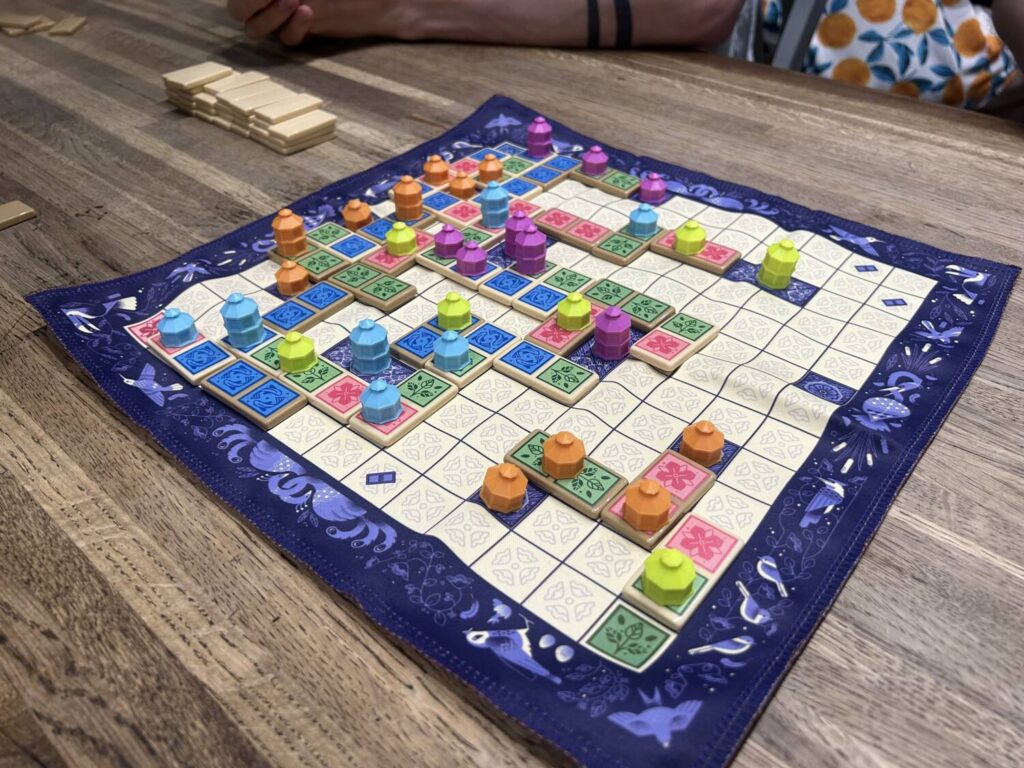 I’ve spent much of my time with Gazebo, publisher Bitewing Games’s update of Reiner Knizia’s cult release Qin, appreciating the humble domino. Why is it so good? Is it the heft? Unexpectedly heavy tiny objects are disarming, after all. There’s the abnormally smooth texture and the rounded corners, the clack—not a click, but a clack—every time you put one down on a hard surface. Maybe it’s a shared cultural memory of the nearly 1,000 years we’ve been playing with them.
Whatever the reason(s), dominoes are enchanting. They’re one of the few objects that suggest and immediately invite play of all sorts for people of all ages. The youngest children know to construct with them. A love of dominoes seems to be hardwired into us from the jump.
While Gazebo is one of the thinkier applications of dominoes I’ve ever come across, the magic is still very much there. Rather than two sets of pips, these dominoes—or regular-degular cardboard tiles if you don’t opt for the upgraded components—show two squares of color. Players take turns placing one tile down on the cloth board with the goal of creating groups of the same color. Well, that’s not entirely true.
The goal isn’t to create groups, which are called Nooks for reasons that escape me. The Nooks are a means to an end. When you create a Nook, you get to place a Lisa Frank–coded Gazebo on top of it. This is your goal. You want to place as many Gazebos as you can, as quickly as you can. Gazebos also find purchase, somewhat confusingly, on Patios. Does a gazebo go on a patio? Aren’t gazebos usually larger than patios? I’m not a landscaper, I don’t know these things for certain. These pre-printed spots on the board house one or two Gazebos belonging to whichever player has the most Gazebos connected to that Patio. The first player to empty their Gazebo supply is the winner.
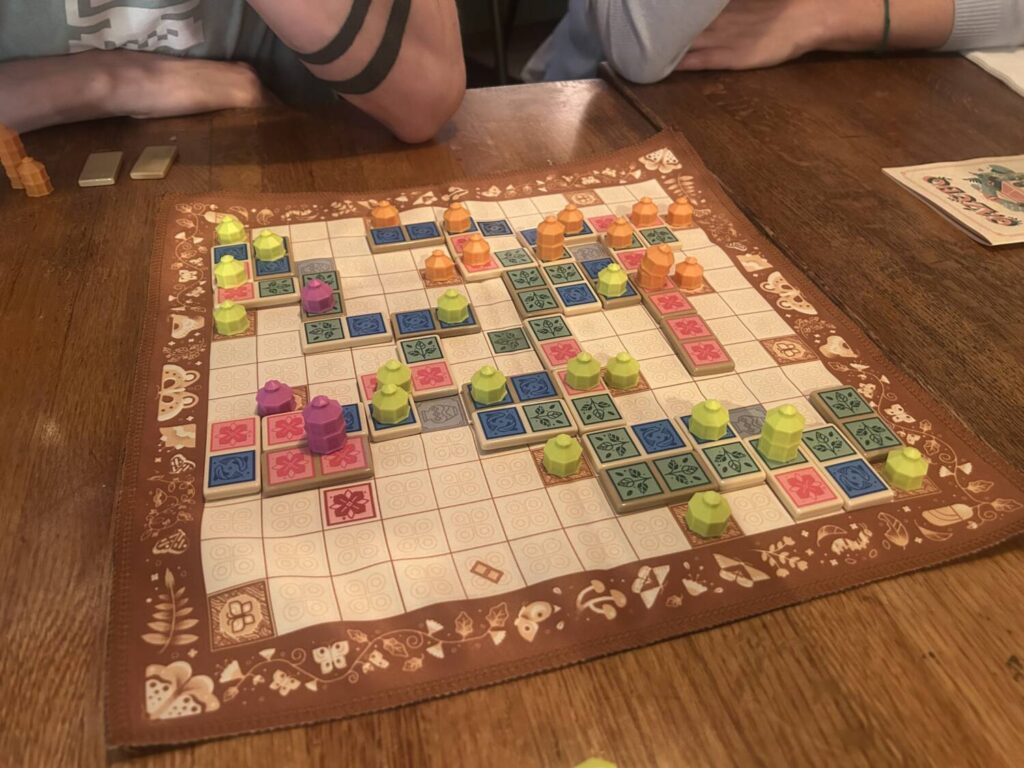
I have encountered a tendency with the impatient among my friends to accuse Gazebo of boiling down to Who Got There First. Because of the tempo of adding one domino at a time, it can be difficult for one player to catch up to another. Due to the nature of Patios, the first player to arrive at one does have an advantage in maintaining their control. But this whole idea is only true in the micro. Yes, in any one instance, that player does have an immediate advantage. But to that I ask, why are you letting that player tell you what to do?
On the macro level, every player has ample opportunity to get somewhere first. That’s the easy part. The art and the thrill of Gazebo come from leveraging small advantages in tempo, spotting tiny weaknesses that can cascade into immense vulnerabilities. Bigger Nooks can absorb smaller ones. If I position my dominoes just right and catch you with your guard down, I can remove your Gazebo and add a second of my own. That may then cause you to lose control of a patio, which costs you another Gazebo or two and gains me the same. A one-point gain is worth a lot more when your opponent loses a point at the same time.
Some of the most interesting decisions in the game surround the double dominoes, a darker set of tiles with two squares of the same color. Each player gets five at random at the start of the game, set off to the side in a private draw pile. At the end of every turn, you can choose to either draw a normal domino from the supply or a double domino from your private cache. Drawing the latter is analogous to picking up a knife and a whetstone. In a game where two matching squares make a structure worth a point, a double domino is a menace. You can add a Nook anywhere, immediately, with little assistance.You can invert the tempo of an exchange, putting yourself in the advantaged position. Doubles are just as valuable in your hand as they are on the board; to see one in your opponent’s hand is to know the meaning of fear.
For all its apparent coziness, Gazebo would be an almost unbearably tense experience were it not for the dominoes themselves. It’s hard to feel worked up while playing a domino game. It has built-in fidget spinners. You start running your fingers along the edges, or clacking two together, or absent-mindedly running a domino along the outside of your lips, and all the while, you don’t notice how nasty Gazebo really is. A great game of Gazebo is brutal. Thanks to the magic of dominoes, though, you might be able to fool friends and family just long enough to get them to try it.
Gazebo details
- Designer: Reiner Knizia
- Artists: A. Giroux
- Publishers: Bitewing Games
- Release Date: 2025
- Player count : 2 - 4
- Age range : 8+
- Time range : 30 minutes
- Mechanism(s): Area Majority / Influence, Enclosure, Hand Management, Race, Square Grid, Team-Based Game, Tile Placement
- BGG Geek Rating: 7.44447 - converted to Meeple Mountain scale: 3.5.
- More articles about Gazebo.