
Disclosure: Meeple Mountain received a free copy of this product in exchange for an honest, unbiased review. This review is not intended to be an endorsement.
Last year, I reviewed Fromage, a game about making cheese where time is used as a resource. The game is played around a circular gameboard, divided into four quadrants (a.k.a venues). Each venue is a different mini-game where players will be placing their workers and aging cheeses in an effort to score points. At the end of each round, the game board rotates a quarter of the way, lazy Susan style, so that each player will be presented a new venue with which to interact on their turn. This continues until someone has placed out their final piece of cheese, and then end scoring is performed to determine the winner.
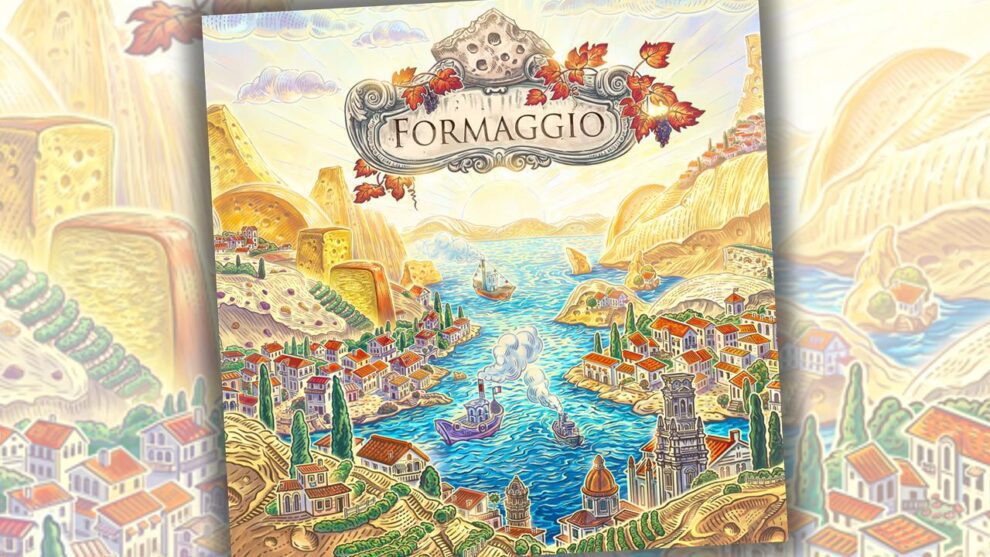
Formaggio, the standalone expansion to Fromage, follows this same format (place workers and cheese, rotate to the next venue, rinse and repeat) with a few small tweaks and four brand new venues. Due to its standalone nature, it is possible to own—and play—Formaggio without having played, or without owning, Fromage. However, if you own both, then the opportunity to mix the two together is possible, if you so wish.
This mixing of things isn’t as smooth as you might hope. It isn’t as simple as just grabbing four of the venues and slapping them together. Some of the venues have their own specialized bits that go along with them. Some of the advanced mode’s Structure tiles refer to aspects of specific venues. If those venues aren’t in play, then you’re going to have to discard those Structure tiles and keep drawing and discarding until you’ve come up with tiles that work with whatever you have. Then, once you’ve got that taken care of, there’s the matter of locating the correct venues inserts for your player count and then inserting them.
So, yeah. If you’re mixing and matching, the setup can be a bit of a bear. The upside, though, is that since Formaggio comes with everything you need to start playing, once you’ve mixed and matched four venues, you can use the remaining components to create a second game if you happen to have more than four people. The four new player colors that have been introduced with Formaggio makes this green player’s heart take flight.
So, What About Those New Venues?
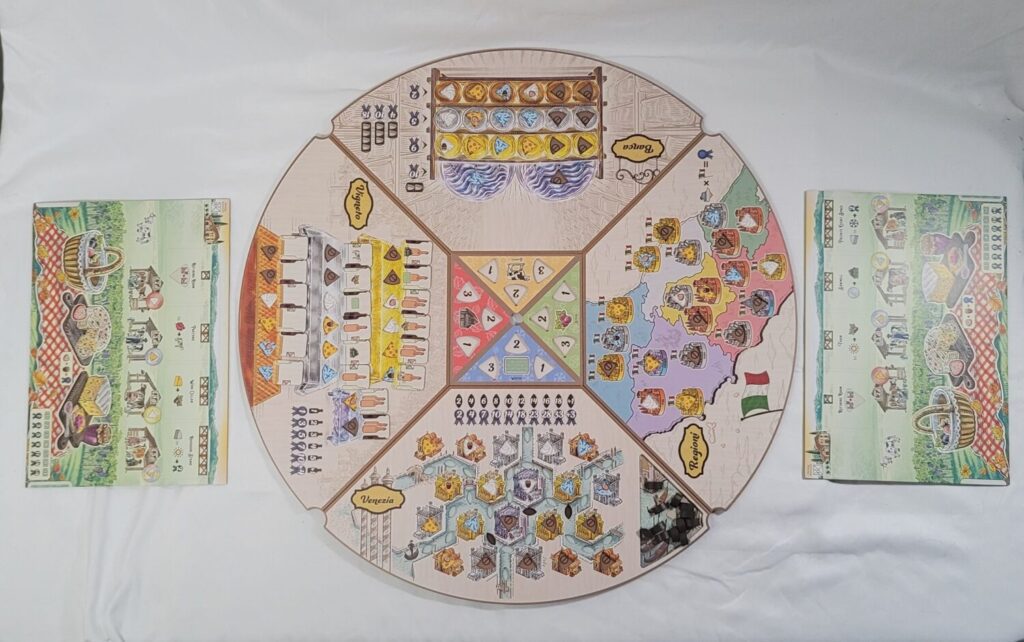
As previously stated, Formaggio comes with four brand new venues: Banca, Regioni, Venezia, and Vigneto. Here’s a quick rundown on how each of these functions:
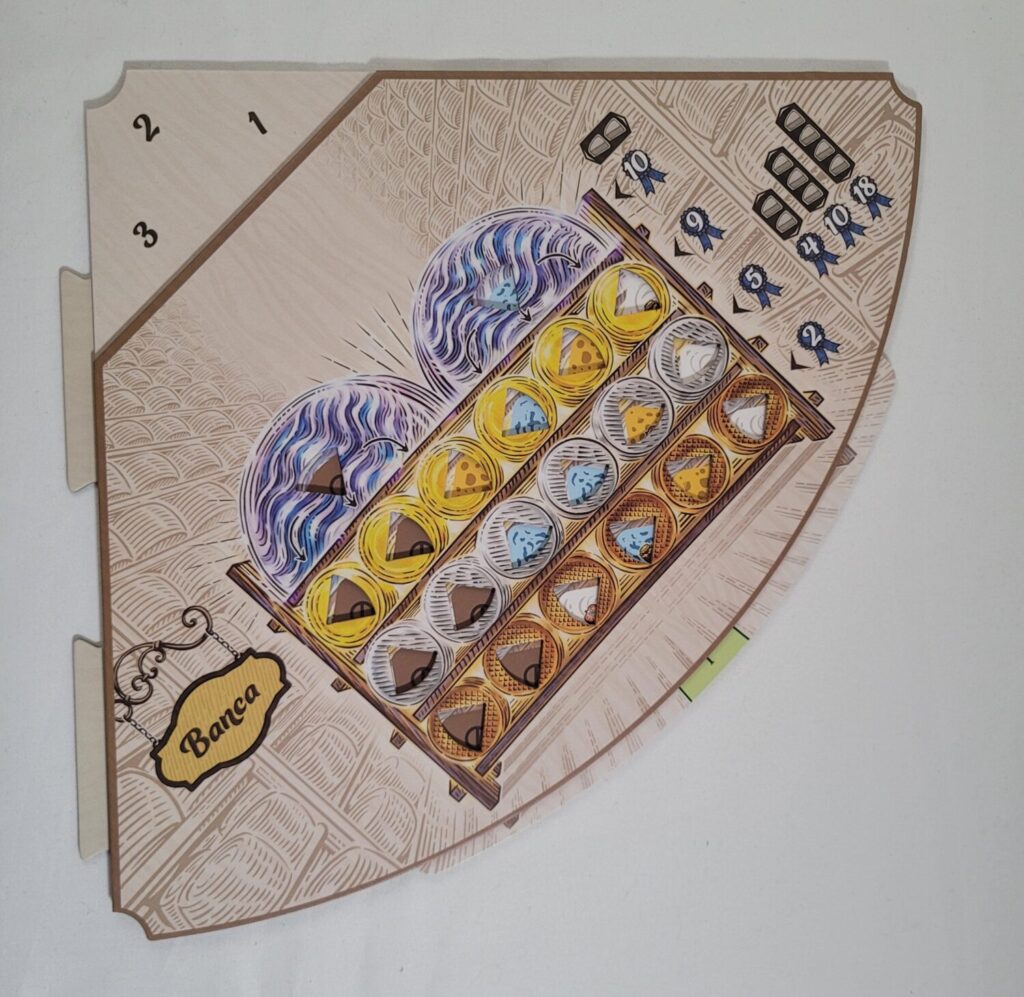
Banca – players store cheese in the vault at the cheese bank. This venue is divided into several rows and grids. Players score a varying number of points based on how many rows and columns they’ve managed to add cheese to by the game’s end.
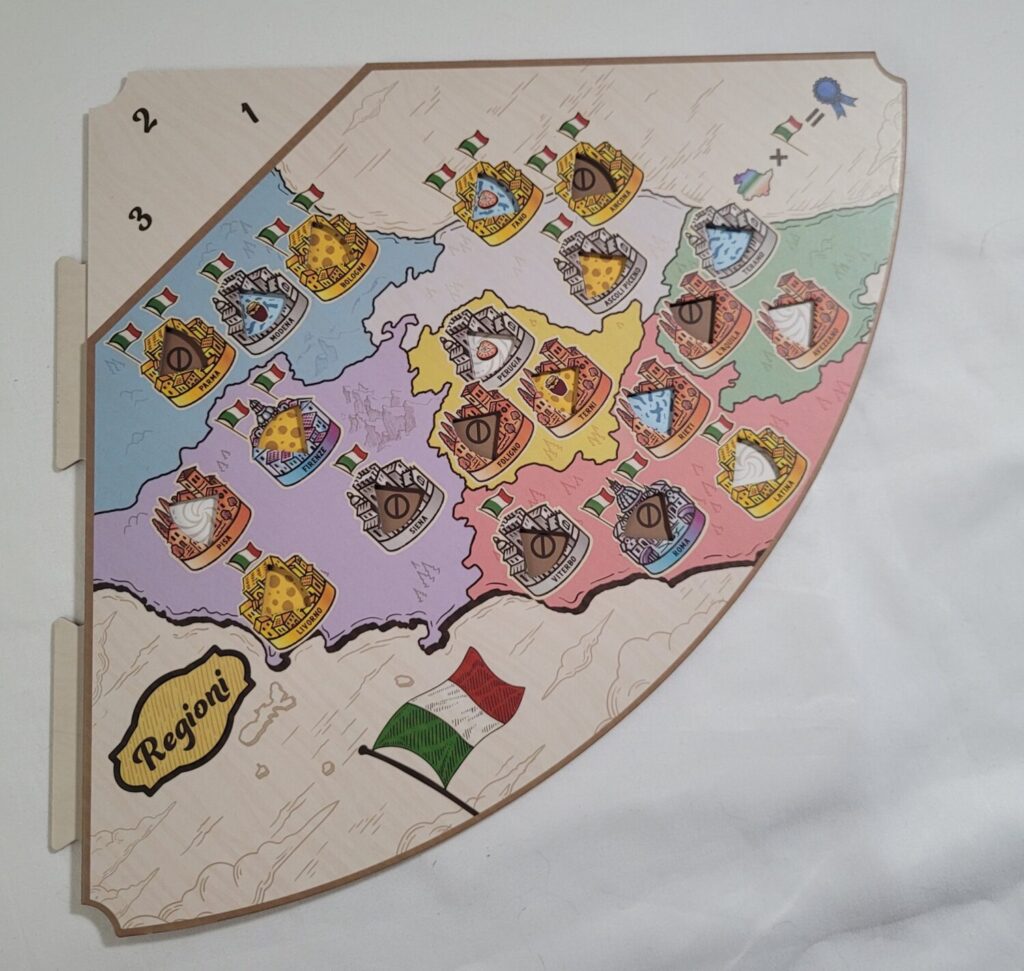
Regioni – players deliver cheese to different regions across the country. Each region features several locations where cheese can be placed. Most of these have a number of flags attached to the space. At game’s end, players score points equal to the total number of regions in which they have presence times the number of flags they’ve claimed.
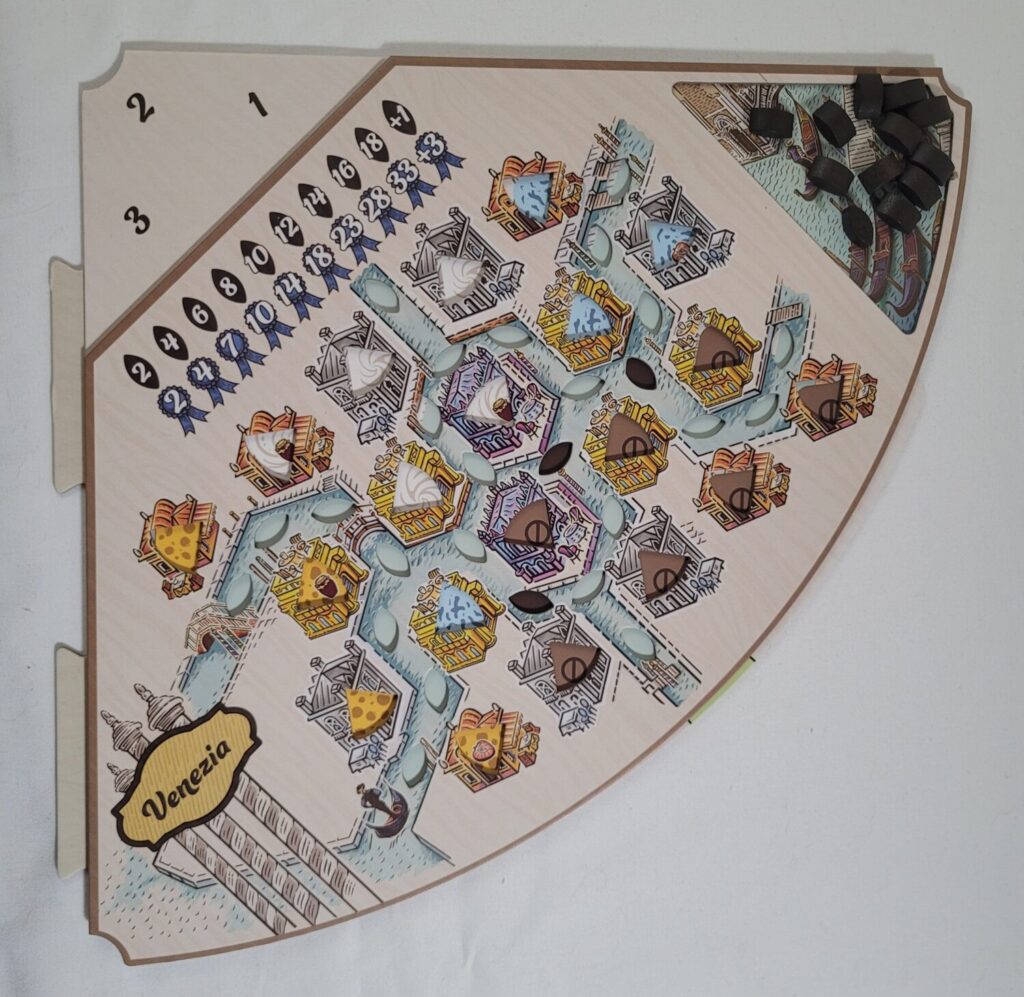
Venezia – players sell cheese to restaurants and provide transportation to tourists using gondolas. This venue features an overhead view of an area within Venice. This area features several rows of shops, separated by a series of canals. Each canal contains several indents that can be filled with gondolas (extra game bits unique to this venue). Each time a player places cheese into this venue, they also place two of the gondola pieces into empty spots along the canal. At game’s end, each player’s pieces of cheese earn points equal to the total number of gondolas surrounding them.
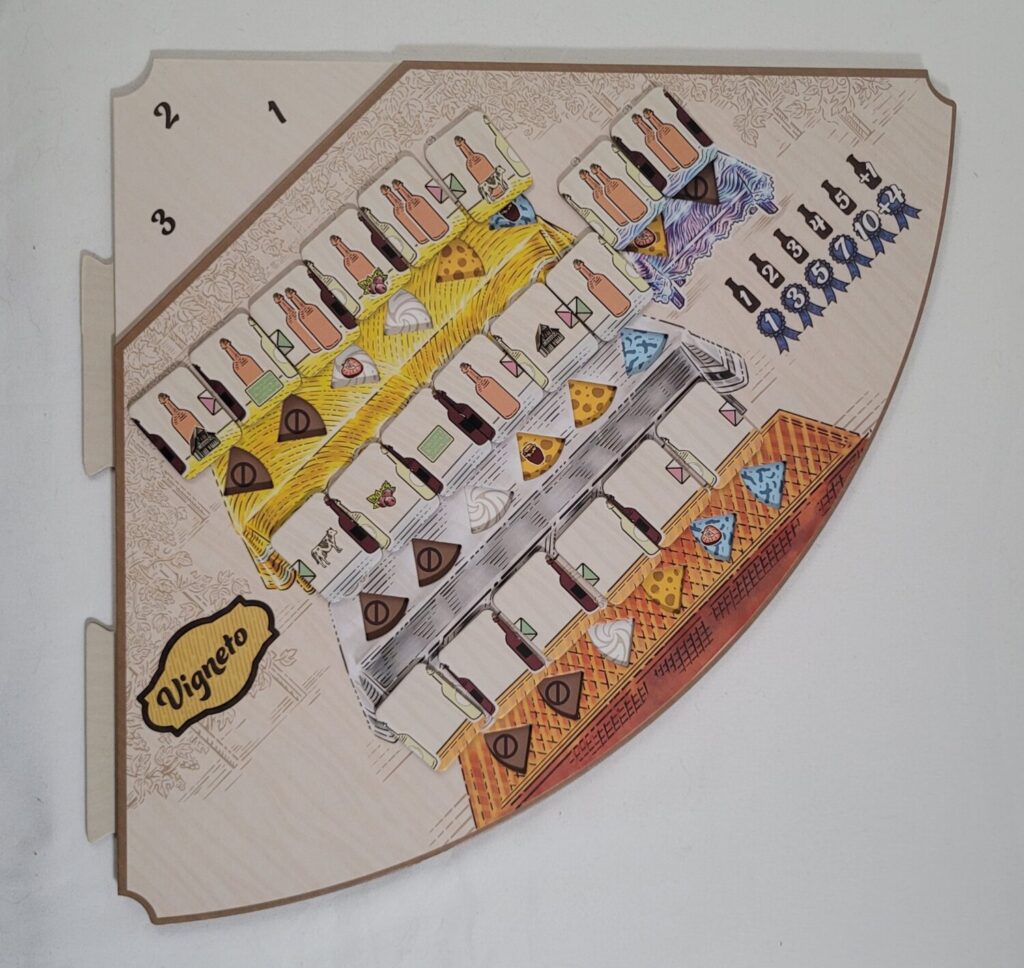
Vigneto – players pair their cheese with the local vineyard’s finest wines. This venue also comes with its own set of unique bits: wine tiles. At either edge of each wine tile, you’ll find half of an image. In the middle will be a completed image. When a player places a cheese into this venue, they collect the wine tile that is associated with that space and place it into their own personal tableau. Newly acquired wine tiles are placed to the left or the right of previously acquired wine tiles. If two halves of an image meet up to form a completed image, the players gain whatever benefit that image provides (free resources, for instance). At the end of the game, players score points based on how many wine bottle images they’ve managed to accumulate across their wine tiles over the course of the game.
I’ve played games with only these four venues as well as games where they’ve been mixed in with venues from Fromage. In either case, these venues hold up well and present interesting logistical challenges. Out of the four, the ones I get most excited to see in play are Venezia and Vigneto. The other two venues are fine, but there’s just something about the V’s that makes them feel more exciting to interact with.
It’s probably the game bits. I’m a sucker for more bits.
Some Other New Stuff
Formaggio introduces the concepts of seasons. The square cutout that sits in the middle of the frame has been replaced. While it’s pretty much a clone of its predecessor, the new cutout features a specific season for each of the four quadrants.
Formaggio also introduces four brand new player boards that are not only aesthetically different from their predecessors (featuring an image of a picnic at dusk as opposed to Fromage’s more rustic lunchtime image), but they also feature brand new structures as well. Notably, each of the new player boards provide benefits for specific seasons. So, if the fall quadrant is in front of you, then you are in the fall and would gain any benefits you might receive in the fall. Likewise, if you have a structure that rewards you with end game points for having cheese in the fall venue, then you wouldn’t want to let the opportunity to add cheese to the board pass you up while the fall quadrant is in front of you.
Also included in the box are an additional 32 Structure tiles for the advanced game. I didn’t touch on these in my review of Fromage because I hadn’t used them at the time. But, these are present in every game we play these days. Each person receives four random tiles during setup, and the players then go through several rounds of drafting a tile to keep and passing the rest along. While you’re never forced to use any of the four tiles you wind up with, these tiles essentially give you the opportunity to re-program your Structures row on your player board, adding a rich layer of strategic depth to the game.
Thoughts…
…on Formaggio as a standalone game
While working on this review, I was gently reminded that the phrase “standalone expansion” consists of two words and that maybe I was focusing on the second part of that phrase and glossing right over the first part. So, how does Formaggio stand up on its own? Is it a viable game in its own right?
In my review of Fromage, I celebrated the way that the game uses time as a resource and how the passage of time is represented by the highly thematic aging of your cheese. It’s absolutely brilliant. The same is true for Formaggio. In fact, everything that I liked about Fromage, I like about Formaggio. Aside from the specific mechanics of the venues, there isn’t much difference between the two. The tight decision spaces and the need for careful planning, lest the next venue rotates into view and you haven’t got any workers, still exist. But Formaggio kicks things up a notch with two minor changes:
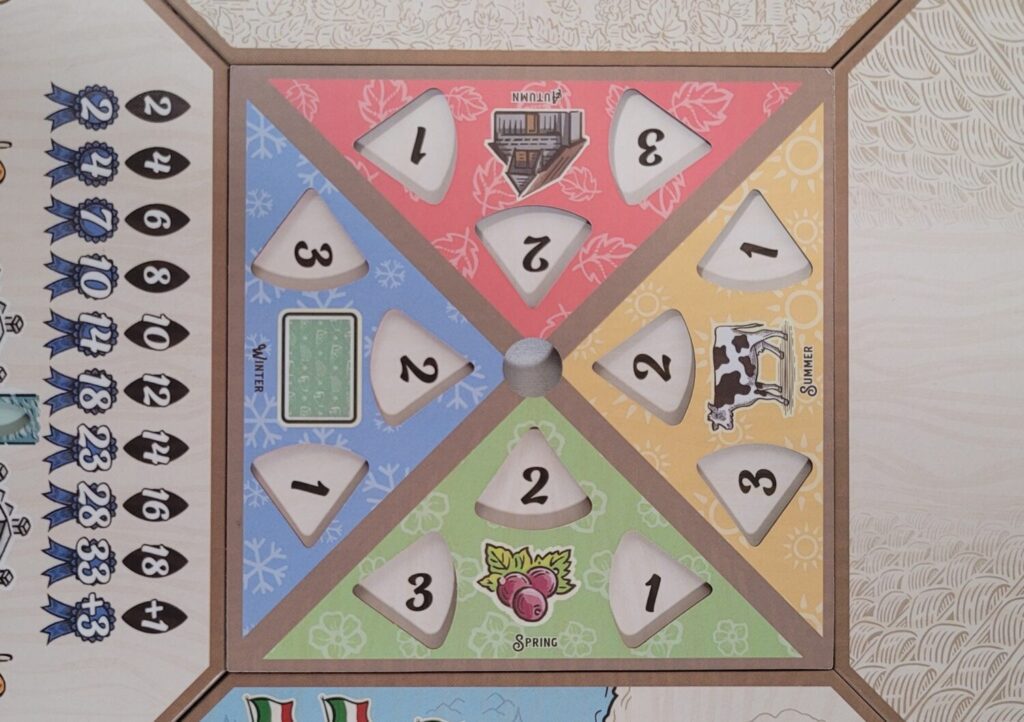
Firstly, as mentioned previously, it introduces the concept of seasons. While the existence of seasons isn’t fundamentally game changing, it does introduce a few extra decision points if the right things are in play. For instance, each of the default player boards has a structure that awards its owner with a specific resource whenever they are interacting with a specific season’s venue (receive livestock in the autumn, for example). Not only is the passage of time even more tied to the theme, but you’ll find yourself passing up opportunities in anticipation of the specific season(s) you’re waiting for. When playing with the advanced mode, you might even come across multiple Structure tiles that reward for the same season, making a specific season even more valuable.
Seasons are a small change. But, under the right circumstances, their existence can have larger implications.
Another minor change is the introduction of ‘Platinum’ level cheeses. In Fromage, there are only three levels of cheeses: bronze, silver, and gold. Each of these will tie up your workers for one, two, or three rotations of the board respectively. Platinum level cheeses will tie up your workers for a full four cycles on the board, meaning you won’t see that worker again until the venue it is placed into is facing you again. With only a total of three workers at your disposal, giving up a worker for that long is a massive investment of time, and it’s very risky. Not only are you giving up a worker, but you’re also giving up the ability to produce the specific type of cheeses that worker is able to produce. But, these big risks come with big rewards. Should you go for the big payoff immediately, or do you wait until you’re better established to risk it? Wait too long and someone else may grab up the opportunity before you have a chance.
Out of all the new ideas that Formaggio brings to the table, this new level of cheese is the one that has the greatest impact.
Formaggio is a fine game on its own, but it’s even better as an expansion.
…on Formaggio as an expansion
As an expansion, Formaggio gives you just about everything you’d want. It introduces a few new concepts, tweaking the gameplay just enough to keep things interesting, while not increasing the complexity significantly. It’s easy to integrate and easy to teach.
I’ve thoroughly enjoyed Formaggio both as a standalone game, and as an addition to Fromage. I’d be happy with it either way. That being said, I prefer them mixed together. It’s more fun that way. And that brings me to my only really negative point: Fromage and Formaggio cannot co-exist in the same box. If you choose to own both and, if you choose to mix them together, then you’re going to be forced to lug both boxes around with you wherever you take them. As these were review copies, I will gladly accept them and deal with that. But, I could see how not being able to pack them together in a single box might be a deal breaker for some.
In a scenario like that, being faced with having to choose one over the other, I’d go with Fromage. For me, personally, I think Fromage’s venues edge out Formaggio’s in terms of interesting engagement.
But then again, Formaggio DOES have green player pieces…
Formaggio details

- Designer: Ben Rosset
- Artists: Pavel Zhovba
- Publishers: Road To Infamy Games (R2i Games)
- Release Date: 2025
- Player count : 1 - 4
- Age range : 14+
- Time range : 30 - 45 minutes
- Mechanism(s): Bias, Chaining, Closed Drafting, Contracts, End Game Bonuses, Rondel, Set Collection, Simultaneous Action Selection, Variable Set-up, Worker Placement
- BGG Geek Rating: 8.12965 - converted to Meeple Mountain scale: 4.0.
- More articles about Formaggio.