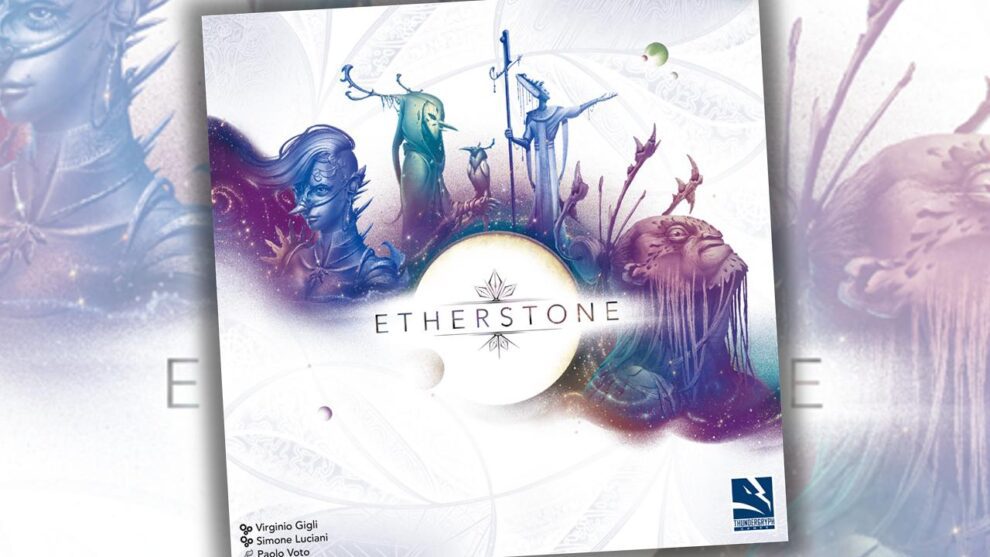

I’m a big fan of weird dueling games—Ortus Regni is one of my all timers—and if they allow for multiplayer silliness, all the better. Etherstone manages to be a complete product, thoughtful, novel, and at times, surprisingly clever. If nothing else, it gets props for not just being a blatant money-grab, instead offering a self-contained and compelling game that has a lot of depth.
The conceit
The lore of Etherstone is not that compelling, mainly because the art is so expressive that I don’t really end up caring much about whatever the story is. It’s evoking druids and biopunk—wild and crazy characters collecting various blobs of mana and using them to bring in more characters so you can battle shared threats, etc., etc.
Mechanically, at the beginning of the game you’ll select a leader card from two that you’re dealt randomly. This will give you a starting distribution of resources. From there, you’ll draft seven cards from a large deck. Once you’ve done both of these things, it’s time to duel.
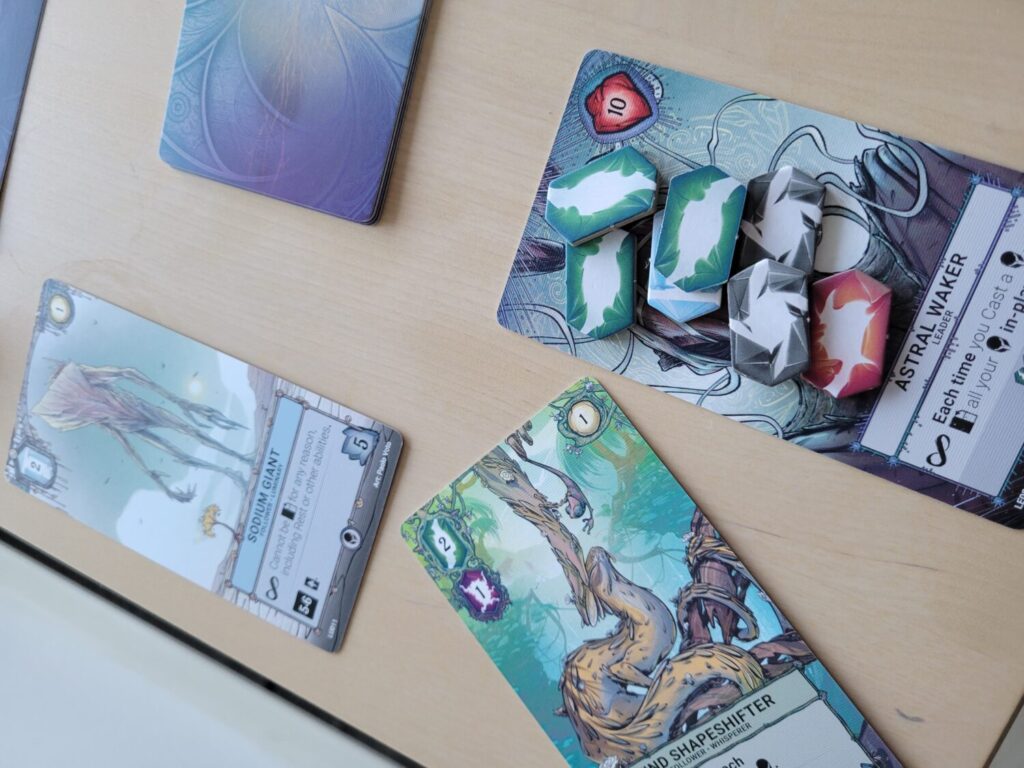
Etherstone captures one of my favorite underutilized mechanisms in gaming—the point buy. Though it’s a standard card draft that you see in many games, the fact that you’re only getting seven cards to play the entire session with feels like a miniatures game. You have this massive selection of troops, equipment, and spells, but only 7 choices. Sure, this card looks powerful, but will your opponent play along and let you marshal it?
It feels more like building a force of troops that are cohesive, rather than hate-drafting or taking cards your opponent wants. You want to synergize your leader choice with the choices that the draft offers, and it feels very much like “I think this troop deployment will win me the game.”
It’s reminiscent of Res Arcana, a Tom Lehmann game that I’ve bounced off many times over the years, and I think part of what makes Etherstone work is its commitment to the indirect interactivity ethos.
I will crush you beneath the weight of my economy
You start with your leader, and your hand of seven cards. On your turn, you can: draft a die from a set of five, gaining two mana tokens of the die’s color; play a card; untap all of your exhausted cards; attack a “threat”; or, recharge your health in exchange for losing 7 points at the end of the game (this is mandatory if you’ve been reduced to 0 health).
Most often, you’ll be either casting a card, fighting a threat, or drafting a die. Each offersr juicy decision-making, but I’ll start with the first option. Basically, you play one of your 7 drafted cards into a tableau in front of you, paying its cost in mana (just like 7 billion other games of this ilk). Cards sometimes have an effect when you cast them, and they typically come in one of three varieties: cards that can attack the shared threats, cards that combo with other cards, or cards that have some kind of status effect that you try to massage into existence.
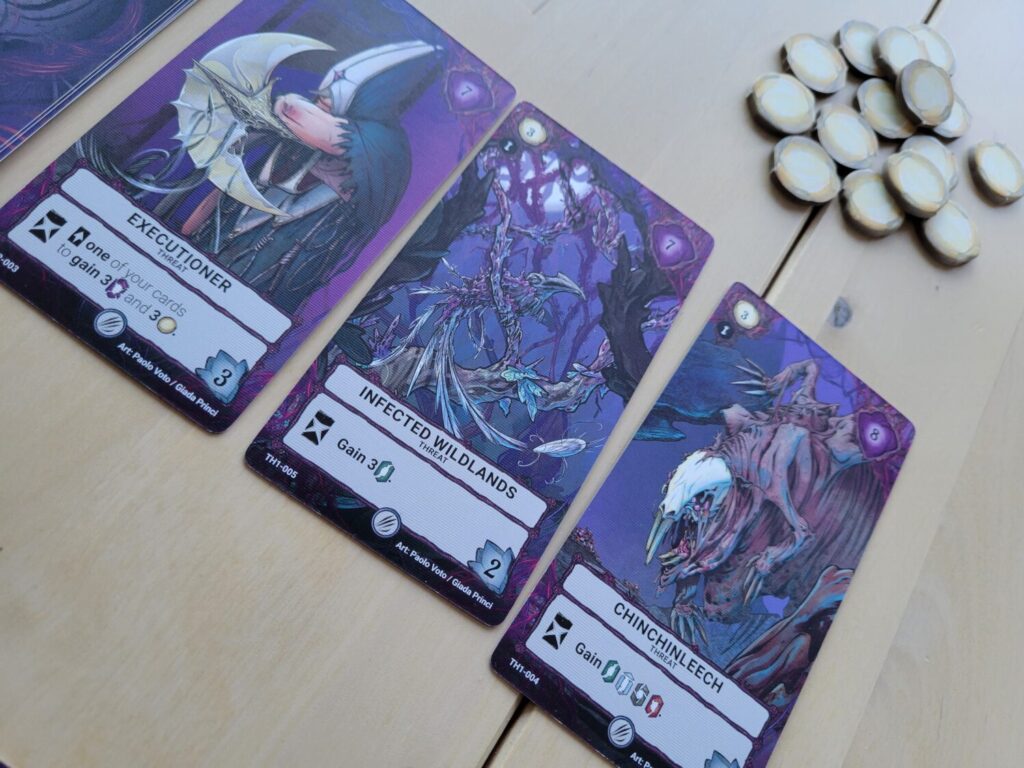
The powers are evocative—for example, in my last game, I had some kind of cool sword that when I activated it, it let me spend mana to defeat one of the threats. Typically, this is an action by itself, where you tap a bunch of cards to build up enough strength to attack one of the threats in a shared marketplace of sorts. My Etherblade, however, let me spend mana instead—with one more caveat. I have to draft the right dice.
The other action you’ll be frequently taking is drafting a die. The die come in 5 colors, four correspond to the four mana colors in the game (when you draft the die, you get two mana matching its color along with it) and a fifth wild color that lets you draft it as if it were any of the four other colors, at an additional cost of 1HP. On top of all of this, if you draft a die that corresponds to a number or color on one of your active powers on a card, you get to activate that card’s power as well.
Hopefully, through this description you’re starting to get a sense of how the game feels to play. It feels very much like you’re casting a series of rituals that are escalating in power. First, you’ll bring out a soldier, which you might use to help you defeat one of the threat cards for points (in another interesting twist, cards are tapped to fight threats, but retain all of their powers whether they’re tapped or not).
Then, you might draft a die, which is empowered by that soldier you cast earlier, which is then further enhanced by some sort of weirdo relic you cast earlier. It feels like a very short version of the high I imagine people get from playing games like Magic: The Gathering.
Winning
The final interesting bit of Etherstone is how you win. This is a creation from the minds that brought games like Lorenzo il Magnifico, and the indirect eurogamey-ness shines through. The game ends when a point pool is depleted, someone plays all of their cards, or a certain number of threat cards are defeated. You gain points for point tokens you earned in the game, remaining life, threat cards, and cards you played.
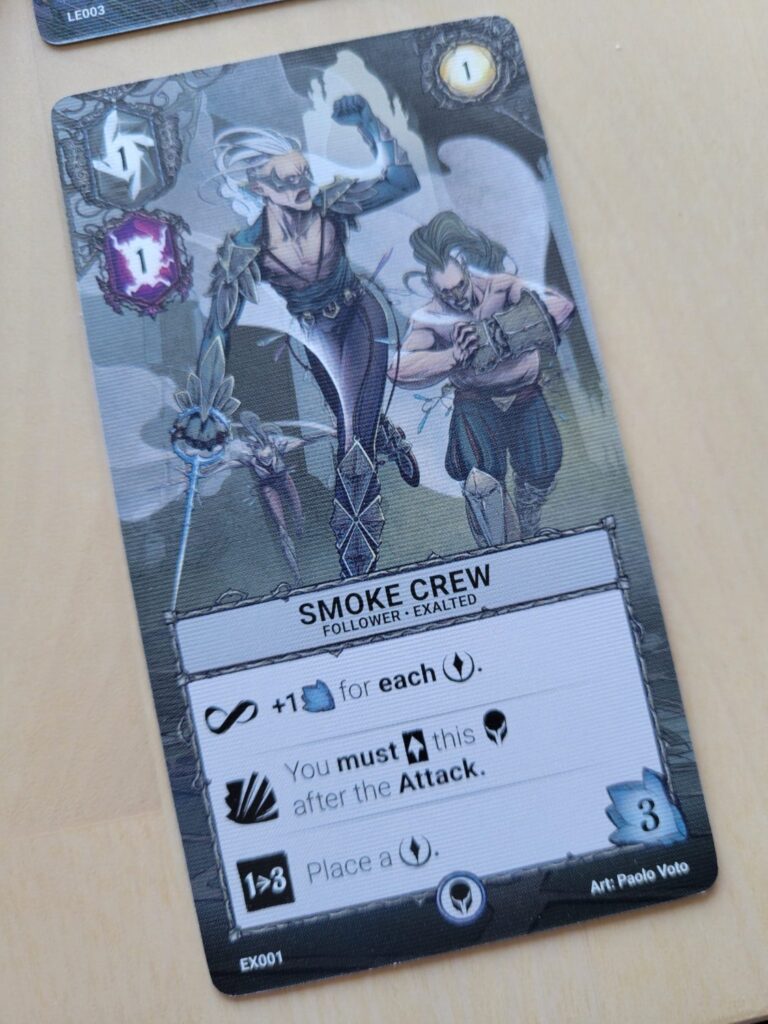
It results in unconventional duels where the objective is not simply to beat the tar out of the other player. In my last game, I ended the game by playing all of my cards and somehow lost to my opponent, who had only played three. Other than me blowing up one of his cards at one point, the only point of interaction was in the dice drafting. There have also been games that were slugfests, where we were indirectly (and sometimes directly) attacking one another’s health.
I was never much interested in deck construction games, living card games, or collectable card games, but Etherstone scratches the itch that I imagine these games offer—you get the thrill of drafting and constructing a battle force and then see, often very quickly, how that battle shakes out, and whether your synergies were good ideas or not. It’s got a low price point, is self-contained, and is surprisingly easy to teach to new players. I’ll be casting spells with it for the immediate future.