
Disclosure: Meeple Mountain received a free copy of this product in exchange for an honest, unbiased review. This review is not intended to be an endorsement.
Disclosure: Meeple Mountain was provided a pre-production copy of the game. It is this copy of the game that this review is based upon. As such, this review is not necessarily representative of the final product. All photographs, components, and rules described herein are subject to change.
One of my favorite things about the games released under Carla and Nick Kopp’s Weird Giraffe banner: the games are often legitimately weird.
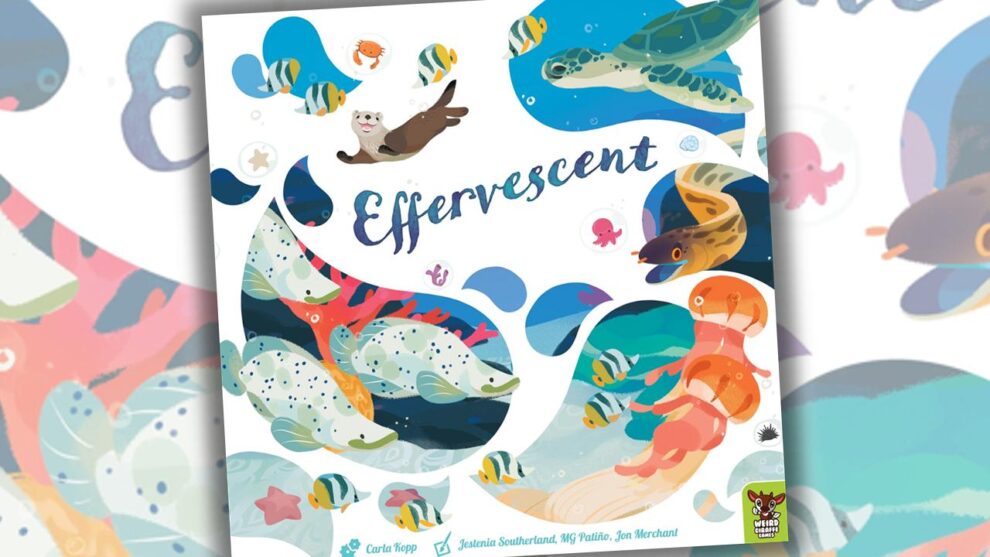
Here’s what I mean. I was explaining the rules to my wife and nine-year-old for our first play of Effervescent (a Carla design currently on crowdfunding, set for release in 2027), and when I tried to explain the main concept of placing sea-based creature tiles in such a way that the tail of a newly-placed tile must touch the head of a previously-placed animal tile, my wife openly balked.
“So, like, this way?” She used a large whale tile as an example.
“Well, sort of,” I began. “Each tile has a head area, a distinct tail point…then, every other part of the tile is a ‘side.’”
“Seems kind of weird,” she said. And our first play went that way, as players took tiles in one of three sizes to create scoring patterns that would trigger with a mix of scoring sequences, tied to “Drift” cards and Harmony cards, the latter of which were established before the game as public milestones that are always available to score.

Turns are simple. Place a tile, and if a placed tile meets a Drift card scoring condition, a player puts 1-3 “Effervescent Bubbles” next to their tile, which will later score points if a section of closed tiles creates a pattern aligned with one of the 2-3 Harmony cards at the top of the play area. After each player takes their turn in a round, one Drift card falls into a discard pile, revealing a fresh way to add Bubbles on later turns.
The creature tiles come in four different colors, four different species, and three different sizes, so there are usually a variety of ways to get Bubbles onto the grid. This also makes it fairly simple to teach the game’s concepts to kids, and I think Effervescent probably fits best as a game for parents with kids in the 5-7 range. My nine-year-old nearly won that first game then immediately dismissed the notion of ever playing Effervescent again.
This feels right in my house, because that same child has leveled up and now wants to play games in Daddy’s strategy game closet.
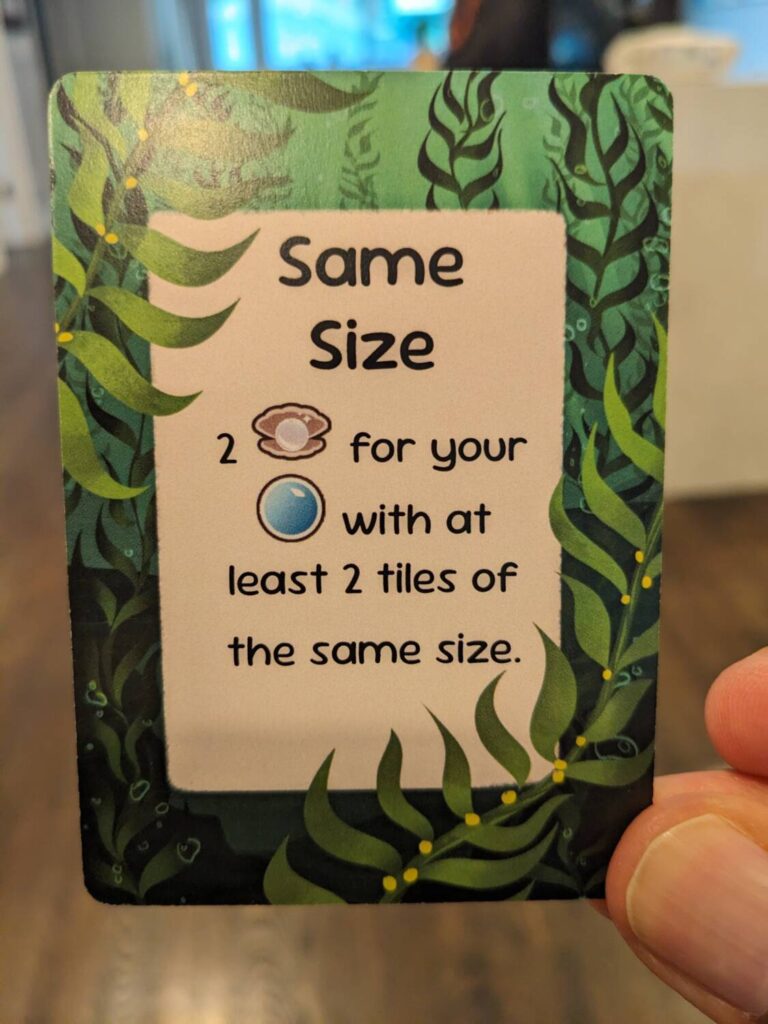
When any player runs out of their 15-Bubble allotment (before tapping into a small reserve of extra tokens to continue placements in a final round), or there are less than two of each tile size left in the draw pile, play wraps up. In-game scores are then added to conditional scoring criteria that was distributed during setup, and all players with the highest score win.
Effervescent didn’t get me all hot and bothered; it’s a tile-laying game in a sea of many comparable titles. In addition to my sense that this will land best with younger families, Effervescent also feels like the kind of game best suited for gamers who are new to the hobby. I think long-time hobbyists who already own the high-ranking classics of the genre—from Cascadia to Harmonies to Kingdomino—should consider Effervescent only if they are intrigued by the sea life theme of this game.
The game’s best physical asset are those cute Bubble tokens. The creatures do the trick, and the variety of Harmony cards is nice. But Effervescent feels like a middle-of-the-pack entry, and Weird Giraffe has done better work elsewhere.