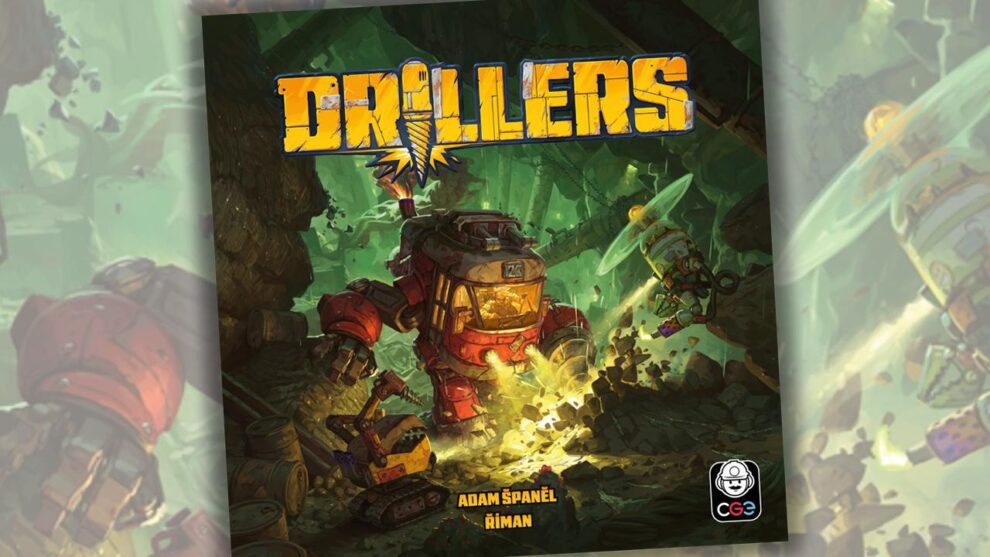

Disclosure: Meeple Mountain received a free copy of this product in exchange for an honest, unbiased review. This review is not intended to be an endorsement.
Sometimes you can tell where a company’s focus is in a given year.
Czech Games Edition (CGE) has a very, very large piece of chicken releasing later this year called Kingdom Come Deliverance, a $150 game so large it has 10 individual artists working on only the artwork for the 700+ cards in the box. Forget the fact that CGE’s lead designer, Vlaada Chvátil, and one of the world’s hottest designers, Tomáš Holek (SETI: Search for Extraterrestrial Intelligence, amongst many other now-published titles), are the co-designers on Kingdom Come Deliverance and there are are dozens of hours of content in that box. (I’m more shocked that a single game has TEN ARTISTS working on it!)
That means Drillers, CGE’s Gen Con release, is its other “big” release for 2026. It’s not nearly as ambitious as Kingdom Come Deliverance, but Drillers is as solid as its title is plain. Drillers is a deckbuilding game that plays in about 90 minutes even at its full player count, and it does excellent, limited work within its tidy playtime.

Dive In
Drillers accommodates 1-4 players, and is a very standard deckbuilding game. Players begin the game with a deck of nine cards—eight action cards and a “Damage” card, which essentially serves to muck up your starting deck because of its large negative point value—and spend the entire game doing one of two things: diving into a six-level mine to gather resources and tiles that build up a massive point tableau, or returning to the surface to sell those resources and buy new cards and upgrades to their driller mech, handsome miniatures with limited fuel that represent the player’s deck in physical form.
I’m not kidding when I say that is the entire game. Even the upgraded cards, which come in four different flavors tied to improving a player’s movement ability, special powers, drill power and utility bits, are in very small decks that are, in some cases, only 12 cards deep. Although I played Drillers three times for this review (once each at solo, three-, and four-player counts), I saw almost all 52 upgraded action cards by the end of that first play, with two of the four decks running completely out of cards by the end of the four-player game.
Have you ever heard of a deck-building game where the draw deck ran out? I haven’t either. That should tell you what Drillers is going for: a very speedy efficiency play. Solo is limited to a maximum of 18 turns, and that play ended on the 13th turn for both players (me and the bot). I could see experienced players digging all the way into the mine’s sixth floor by the midway point of a game, and the focus here is very tight: run down, grab the most valuable of the game’s five different resource types, run back to the surface and sell. Lather, rinse, repeat.

An Incredibly Safe Bet
It was still interesting to figure out the best way to race opponents to Drillers’ best goodies. Special barrier mine tiles can be mined for big points for the first player to explore a new level. The advanced action cards—one of the four card categories in the market—have very cool abilities that players can buy to either provide once-per-turn abilities that don’t go into their deck, or cards that have outsized actions that use very little fuel, if any, to activate. One card, the ATM Drone, was immediately identified as a go-to for future games, because it provides cash and an extra ability that all players wanted to have in their deck.
CGE has mastered the elements of tabletop production, and Drillers is no exception. In fact, this is the first time I can remember grabbing “bling” components for a CGE game at release, so metal coins (not automatically included with the base game, mind you) are a nice upgrade and the mechs do their part to bring a great look to the table presence here. The player aid is exceptional—again, not a surprise, since the SETI player aid is the best aid I have ever seen—and answers every question that a player has during the game, right down to the starting resource setup for each player by player count, on a very reasonably-sized, double-sided sheet.

The real downside with Drillers is that I’ve already seen everything the game has to offer. During our second play, scoring for winners was very closely tied to racing for a small pool of public milestones—aligned with each player’s progress adding barrier and corridor mine tiles to the top of their player board—giving these tiles a slight edge over racing for mineral tokens. Both are important (cash is the only way to buy new cards to improve a player’s deck) but tiles, particularly the four barrier mine tiles, were always the difference in my three plays.
That’s not a bad thing, but it does limit the game’s scope and replayability. As a solid addition to a player’s collection, particularly players new to deckbuilding mechanics or those who are intimidated by heavier fare or games that focus on the value of newly-added cards or card complexity (Terraforming Mars is the standard bearer here), Drillers is a great place to start.