
Disclosure: Meeple Mountain received a free copy of this product in exchange for an honest, unbiased review. This review is not intended to be an endorsement.
Czech Games Edition rolled the dice back in 2022 with the release of Deal with the Devil. It was the most shocking thing I played from a major publisher that year by a country mile. A strictly four-player-only, hidden role, app-driven board game from the people who gave us Codenames? It wasn’t just a departure…it was the biggest creative swing CGE has ever taken with a major release.
Deal with the Devil (and its fantastically twisted box cover art) was a big swing…but also, a big miss. You can find copies of the game online for less than $20 all the time now. The critical reception was a decidedly mixed bag. But I still stand behind CGE for that release, because I am so happy that CGE took the risk.
CGE could make a safe bet every year with their releases, but Deal with the Devil (and releases like their upcoming video game-to-board-game adaptation, Kingdom Come: Deliverance—The Board Game) prove that CGE are willing to take real chances with their biggest productions.
Courtroom: The Noir Trilogy is the newest release under the Mindclash Games’ “Play” line, the publisher’s lighter line of games that pushes a release directly to retail every fall. The previous Mindclash Play games include last fall’s Emberheart and their first release in the line, Astra. Both are lighter games for Mindclash, but I still wouldn’t call them “light” in terms of rules weight or depth. I think of the Play games as titles that Mindclash junkies can table with their families and/or “muggle” friends who don’t want to whip out Cerebria: The Inside World on a Tuesday night.
Just the existence of Courtroom reminds me quite a bit of my experience hearing about Deal with the Devil. That’s because Courtroom is easily the biggest departure Mindclash has ever undertaken. Mindclash makes very deep, very strategic, somewhat expensive and absolutely deluxified strategy games set in fantasy settings, with mechanics and a rules grit that represent some of the most challenging gaming in the market.
I adore the Mindclash catalog because of those heavier titles. While I highly recommend Courtroom for the reasons you will see below, I think Courtroom is for a very select audience. Your mileage will vary; I can already imagine a very wide critical reception for Courtroom based on my own experiences.

There is No Right Answer
At its root, Courtroom: The Noir Trilogy is a deduction game for 2-6 players that plays in about 90 minutes.
There are a lot of asterisks that should be attached to that basic description. The game includes three distinct court cases, in real-world locations around the U.S. in the 1930s. Although it is not required for play, an app built for the game can be used to read various text passages from the game’s introductions and other game elements, such as reading witness statements. The app features timers to help corral the playtime to ensure games really do run for about 90 minutes.
The box comes with three “one shot” cases. Although the game can be fully reset, you’ll only be able to play Courtroom with the same group three times. Each play breaks groups into two teams: one representing the defense, and one representing the prosecution, with very clear instructions on what each side needs to do in order to win.
It’s important to note here that the cases of Courtroom do NOT have a predetermined solution or “right” answer. 15 evidence cards and a half-dozen witnesses provide information on the case, with lots of ways for the defense and prosecution teams to spin the case’s facts into an argument that will help a jury decide the winner (a jury represented by cards and an evaluation form, not the other team or a third set of players).
That, alone, threw players off just a tad during my plays. (For this review, I completed two of the three included cases, “Death in the Garage” and “A Fallen Western Star.”) If you are the kind of player who likes a puzzle game with a specific, predetermined answer, Courtroom is not the right game for you. My wife and I play a ton of those cold case, escape room, one-shot-mystery style games with a final answer that can be deduced by sifting through photo evidence or crime scene analysis and the like.
This is not that.

Courtroom is a more traditional board game, albeit one that turned into an experience during my plays. During the review of the evidence cards, each team gets to select 7 of the 15 evidence cards for their side, leaving one card completely out of the game for both sides. Then, each side gets to keep two of their seven evidence cards hidden from the other team, with the rest placed in the middle of the play area to be reviewed by the players on both sides.
These 10 cards are used to form written and verbal arguments that will later be read by one player from each side during final arguments, as you get to make your Law & Order-style arguments in front of the other team…and, for the “theater kids” in your playgroup, the app is ready to record your final arguments as you make those deliberations.
“I HATE making speeches,” my wife said during my second play of Courtroom. And that’s OK, because players can also just read the bullet points of their argument, with statements used to support that team’s interpretation of the evidence during an evaluation round.
All of this makes Courtroom very difficult to describe to someone used to sifting through the Mindclash catalog, from worker placement games like Trickerion: Legends of Illusion or hand management games like Voidfall. Even Mindclash Play titles such as Emberheart have more traditional, “gamey” concepts. Courtroom is like nothing else I’ve seen from Mindclash and it’s like nothing else I’ve played this year.

“I Don’t Think I’ve Played Anything Like It”
Courtroom: The Noir Trilogy is a unique package. It’s got three cases slipped into a very handsome set of packaging, requires almost no teach, has no predetermined final answers, and asks players to solve crimes by taking a side and using their deduction skills to build written arguments that can be delivered as a 5-to-10-minute speech at the end of the game.
That quote leading off the section break above? Two different people who played Courtroom said it after finishing our plays. I, too, can’t think of anything else I’ve played quite like it, especially when considering that Courtroom is a board game that asks players to temporarily role-play as lawyers. Sifting through evidence cards? I’ve played a dozen games like that this year. But a game that asks one team to defend the innocence of a fictional character by writing a timed argument that can be recorded and scored? Not a single one that I can think of, ever.
Of course, all of this is in pursuit of a concept every gamer understands: victory points. Those points stem from building an understanding of each case’s concepts and a small pool of points that can be earned by convincing uncertain jury members about a suspect’s guilt or innocence.

The cases themselves have a very familiar touch, for anyone who has watched, read, or otherwise consumed a police procedural at some point in their lives. In one case, a movie star is kidnapped and later killed during a botched rescue attempt. There’s a specific person named as the guilty party. But there are a few different ways each side can build up a case to support that person’s guilt or innocence.
Working with a team member or two feels like the more interesting way to play Courtroom, so while one person can play against another person, I recommend Courtroom at higher player counts, even if teams are not equally balanced in terms of players. One knock against the game comes with multiple players, though: you really have to play this game in a space where each team can go off to their own area to discuss the case, privately. Talking about your thoughts on the case while the other team is sitting across from you at a small table is not ideal.
I’m still not sure where I land on the fact that each case does not have a “right” answer, even as I draft this review. This gives credence to the idea that it’s not always about having the right facts even in real-world court cases; the lawyers are trying their best to sell the jury to land on their side of the argument.

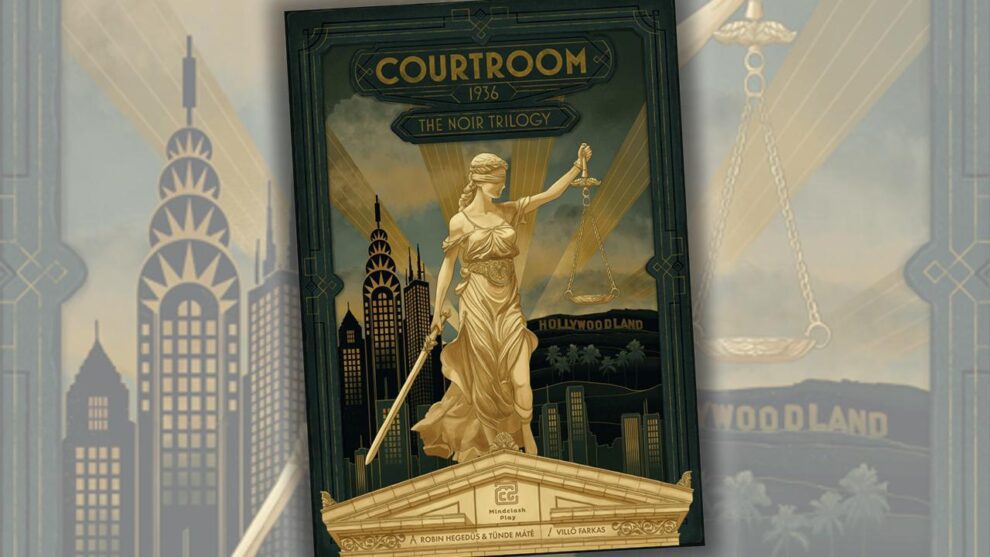
As a production, Courtroom mostly sings. The artwork, the packaging, the rules, and the app are all very good, with my only minor issue tied to the low voice tone of the main narrator voice used with the app. In a room with any other noise, it can be hard to hear the narrator unless the volume is turned up to a high volume. The voice itself is the right call, and other voice work used for the witness snippets is great.
I really love the price of this game. Courtroom comes in at just €30 (about $35). For a game that can only be played three times, this feels like the right price and absolutely means you should try it. Worst case? Gift it to a friend, because the game can be reset for new audiences.
I think the sweet spot for Courtroom will be players who like the stage elements of acting out their favorite courtroom dramas in game form. Courtroom is a team game that is played as a 1v1 fight, so it’s a lightly competitive team game for a certain type of player. It’s date night material, especially on a couples date night, with a playtime that is very reasonable.
If any of this sounds like you, Courtroom: The Noir Trilogy is a must. And, if playing a lawyer or giving a speech gives you the willies, look elsewhere!