Disclosure: Meeple Mountain received a free copy of this product in exchange for an honest, unbiased review. This review is not intended to be an endorsement.
I have never before given much thought to the ways in which music composition and game design are similar. Like all creative arts, both share the goal of trying to communicate and share an experience with their audience. As disciplines, music has notes and rhythms while game design has rules and mechanisms, but both are about taking those disparate ingredients and making them cohere into something whole, something that vibrates with inevitability.
Ted Mann Schaller’s Counterpoint is a must-follow cooperative trick-taker with bidding and a trump-suit. A blessing, to live to see such times as those in which I can write that sentence and assume much of the audience will understand. Each player is a member of an animal chamber trio–to-quintet, be they an iguana violinist or an armadillo pianist. Such is the quality of Brandon Campbell’s illustration work here that fights will break out over who gets to be what. The cooperative nature of the game follows the template laid out by blockbuster predecessors The Crew and The Lord of the Rings: The Fellowship of the Ring – Trick-Taking Game: over a series of performances, scenarios named after pieces in the chamber music canon, players attempt to complete certain challenges while also ensuring that everyone makes or exceeds their bid.
There are a few twists on the formula, as you’d expect. What is a trick-taking game without a couple of blue notes. Each player gets a unique single-use power card and a Rest card, which allows them to opt out of the current trick. When I saw that, my eyes lit up. Giving every player the equivalent of l’excuse from French tarot has the potential to lead to some incredible interactions and decisions.
Bidding in Counterpoint is done auction-style. An amount of charming wooden musical notes dictated by the performance is set in the middle of the table, and players take turns claiming anywhere between 0 and 3 of them. If you take 0, you’re out for the rest of the bid, and all remaining notes will have to go to other players. I love that idea.
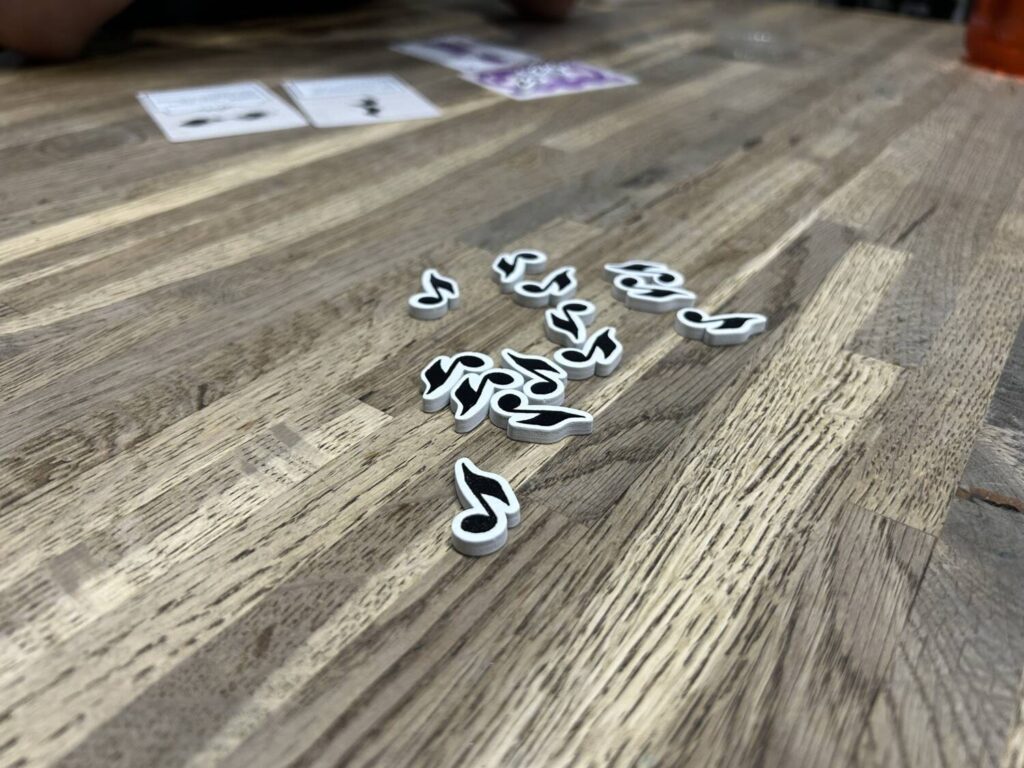
Rather than bidding the number of tricks you expect to win, Counterpoint asks you to bid the number of cards you expect to win. And not just cards, but cards in a specific suit. The deck always consists of one suit per player, and each player is assigned one of those suits. You are trying to calculate the number of your own cards you’ll be able to snag. Predicting how many cards of a particular suit you’ll win is much, much more difficult to do with any sense of intentionality than bidding for tricks, and the task is further complicated by the fact that one player’s suit is the trump suit.
Then I started idly flipping through the Music Book containing all the performances, and my eye snagged on the rules for the third one, String Quartet No. 2, “Intimate Letters”: After each trick, pass a card to your left. Immediately, instinctually, alarms were triggered. A big ol’ red warning light began flashing in the back of my mind. I heard a high-pitched pealing, which may have just been tinnitus. Trick-taking games are inherently chaotic. At their best, the joy comes from navigating that chaos, from splitting the atom and living to tell the tale. Adding more entropy to this already entropic space is risky. It has to be done right, with great care. A carousel of cards constantly wending its way around the table is not careful. On spec, it will likely either destroy the ability to make decisions, or it will make the game much too easy.
But we have to find out, right? And, besides, that’s just one scenario. There are a few dozen in here. The repertoire is vast.
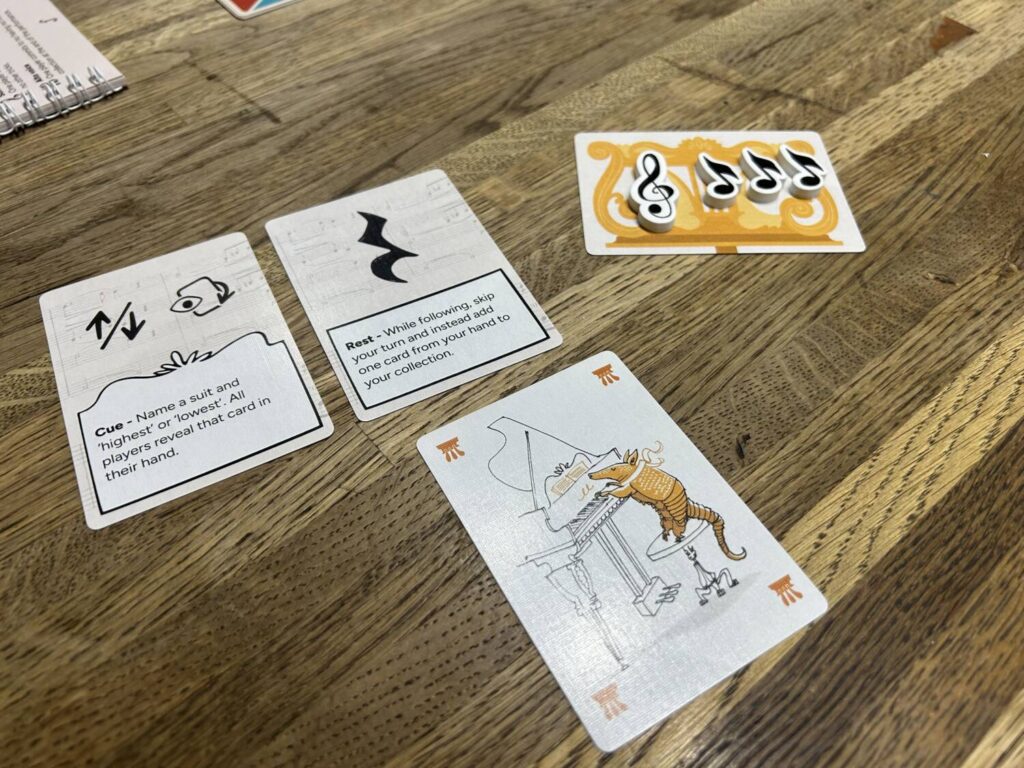
At the table, Counterpoint proved ungainly. The easier performances are toothless and the more difficult ones push players past caring. Intimate Letters was, indeed, a shell of an experience. Not only was it incredibly easy, players in the different groups I played with became visibly annoyed that they had to keep passing a card.
And let’s talk about bidding for cards instead of tricks. It’s a fun idea, and entirely novel to me, but it has enormous downsides in practice. You simply cannot plan for it.
Consider the final performance, Webern’s Five Movements for String Quartet, Op. 5. It could be described as “fiendishly difficult,” but it goes well beyond that. With four players, there are 26 musical notes in the middle of the table, and players have to bid perfectly. One player also has to commit to winning only the first and last tricks.
This is not “difficult.” “Difficult” implies you can manage it with enough skill and gumption. 26 out of 36 cards have to go to specific locations. Two players have to have strong hands, and not only do those hands have to be strong, they have to be strong in particular ways relative to the other players’ hands. And if the player assigned to the trump suit doesn’t have any high trumps, which is likely, then forget it. The other players have to be in a position to win between eight and nine of their own cards each.
Out of curiosity, we tried the same scenario with bidding for tricks instead of for cards. Instead of bidding for 26 notes, we were bidding for nine tricks, each bid had to be exact, and one player had to win the first and the last tricks without winning anything in between. With that adjustment, Five Movements for String Quartet was a challenging blast.
At this point, I started to wonder if the game was simply too novel, challenging me to think about this in ways I hadn’t before, but that didn’t hold up to scrutiny. I played with expert trick-takers, and they loathed it. I brought it to people who barely play trick-taking games at all, and it didn’t work for them either.
There are a lot of great bits to this design. The implications of Counterpoint’s core design choice, bidding for cards, are fascinating. I’d never considered what would happen if a trick-taking game worked this way. The system for bidding is excellent in the context of a co-op game. I would love to see another stab at the same system married to a different game. I’ve also wondered more than once if the game would work better if the trump suit were separate from the player suits. I don’t know what the answer is. There are a lot of notes in this piece, but they don’t make for a harmonious whole.