
Disclosure: Meeple Mountain received a free copy of this product in exchange for an honest, unbiased review. This review is not intended to be an endorsement.
From time to time, I use my meetings with publishers at conventions to intentionally pick up older games from their catalog. I usually need them for the new tabletop release doldrums of spring. That’s because publishers hit all of us hard with new titles in “Convention Season”, which for my money starts at Gen Con, peaks at SPIEL Essen, and stays warm through PAX Unplugged. (Shows like UK Games Expo and the Tokyo Game Market have new releases, but the noise level is a bit more muted.)
At last year’s Gen Con, I picked up a couple games from the team at CrowD, including City of the Great Machine, released in 2023. I had heard good things about it, and I liked the idea of its “one versus many” gameplay. Spring has arrived, and I pushed City of the Great Machine to the table for a couple plays.
My Spidey Sense was on point. City of the Great Machine—at least, its multiplayer version—rocks. (Solo is another story, which we’ll get to.)

Steampunk, Anyone?
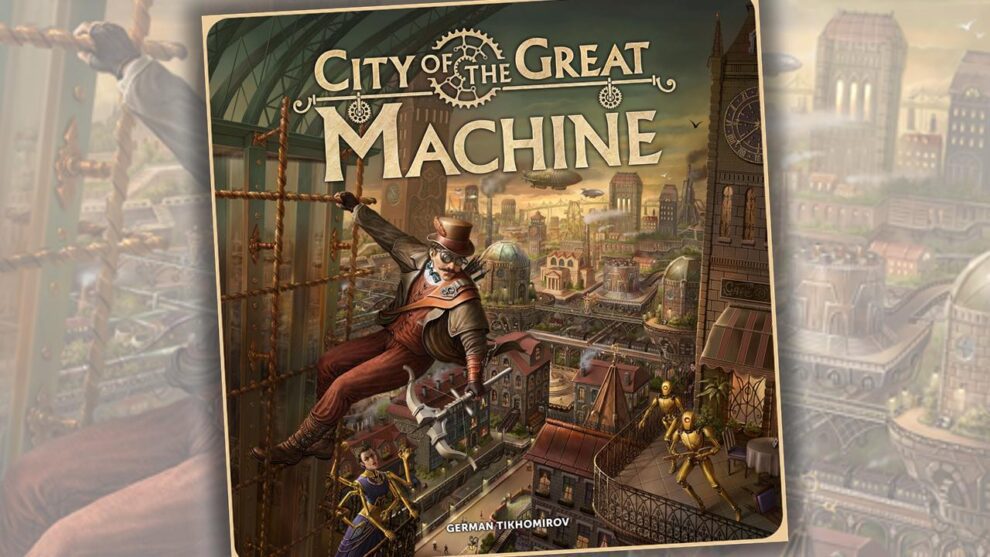
City of the Great Machine, depending on player choices and headcount, is a hand management, hidden movement game for 1-4 players. It can be played solo, cooperatively with up to three players, or competitively with 2-4 players. If played competitively, one player takes on the role of the Great Machine, an AI network in a Victorian, steampunk-ish future bent on destroying the will of the people. Everyone else becomes one of the game’s six revolutionary Hero characters, with the goal of starting enough riots to take down the system.
In solo/co-op play, players take on only the parts of the Heroes, with the Great Machine and its loyal servants and guards run by a deck of cards. No matter the format, there are always three Heroes trying to take on the Machine.
This means City of the Great Machine is going to be different things to different people. For this review, I did a play with a full player count of four, where I took on the role of the Great Machine and three guys from the review crew played as three Heroes. In another play, I took on the Great Machine solo, playing as the three Heroes that I hadn’t seen from our multiplayer game. A third play, which was going to feature me as the Heroes and a friend as the Machine, was cancelled at almost the last minute, and while I am working to reschedule that play, I didn’t want to hold the review…because I know where I land on the total experience.
Multiplayer is something else. City of the Great Machine surprised me in one major area: it’s very approachable. The teach is pretty quick, and getting players up to speed on their roles is easy thanks to a mix of the dedicated player aids and the one featured on the back cover of the main rulebook.
Setup is a breeze, too; the city of the game is really nine small boards that can be arranged in a variety of patterns to meet a simple set of repositioning rules. Various game effects can force city tiles to be shuffled, changing the game’s layout constantly during play.

Each game round starts with an event card that changes some of the rules before players program their destination tile for the current round. Players are encouraged to talk this out, in part because the game’s lore pushes everyone to assume that The Great Machine can hear every conversation. We played this up in spades during our multiplayer game, and players can try to throw the Machine off the scent of where each Hero intends to go.
Locations matter because the Machine has access to robot guards in every location as well as three enforcers, known as Servants, who can conduct Raids in locations where the Machine thinks a player will try to place a character. If those Heroes get detained, the game’s clock counts ever closer to Armageddon…and yes, City of the Great Machine uses an actual clock dial to track time. When the clock hits 12 (whoops, “XII”), the Machine wins if the players haven’t already created enough riots around town.
The Heroes work to spend their form of currency, Trust, to do their single action at the end of their movement phase. Taking out guards costs Trust. Revealing the identity of Famous Citizens in each district also costs Trust. Boosting Discontent in the city is another action choice, but doing that helps both sides of the equation…the Machine gets access to more Bonds (cash), which helps them move more guards and Servants around the map. Discontent also helps the Heroes, as they need to create more political noise in order to get more people to buy into their revolutionary agenda.
One of my favorite things about City of the Great Machine is the idea that artists, merchants and scientists are pretty easy to coerce into rioting on behalf of the rebellion, but rich folks aren’t down until everyone else has jumped into the fray. Each district has tokens that begin the game face-down, waiting to be discovered by the Heroes. But their identities aren’t revealed to the Machine until a riot occurs, when Famous Citizens decide to rise up. Naturally, the game also features Traitors, and in our four-player game, Traitors turned the tide of one riot in the Machine’s favor, and it was the turning point for my victory in that game.
The Machine has a few tricks up its sleeve in the form of Directive cards. Heroes can use their turns to take those Directives out of the game, too. It’s relatively easy for players to temporarily disable guards, and these openings could be the difference if the Heroes plan well. The Machine’s income gets huge by the end of the game, but by that point, the game might come down to a riot in the final round or two.
City of the Great Machine feels like it has the tension bit down perfectly. The Hero powers combo nicely with other Heroes, so planning turns is pretty interesting for the Hero players. And even though I didn’t try the game as a 1v1 affair, I could see that being a nice battle of wits for experienced players.
For all the talking (I prefer the word “scheming”), arrested citizens, rioting, and detainment of Hero players, I was shocked to find that our four-player game took just 90 minutes. And that was our first play! As a cat-and-mouse affair with a decent amount of drama, I can imagine future plays with other friends taking an hour, maybe a hair more. For the experience, that’s hard to beat, and finding strong one-versus-many games is a tough one.

Solo? It’s Fine
The main drag with the solo variant of City of the Great Machine isn’t the increased rules load while managing both the Machine and a pool of three Heroes. It’s not the three-stage Mission setup that adds another layer of rules on top of the game’s normal rules, where riots ultimately determine the winner.
The main issue with the solo mode here is that player movement, the chance to outwit a human rival, and table talk are just not possible when no one else is sitting next to you.
That’s a shame, and I’m glad I did the solo play AFTER I did my four-player game. I found myself somewhat bored with the housekeeping that comes from navigating the Machine’s three Servant characters. In solo, their movements and their actions are tied to a small deck of cards. On some turns, the Servants did nothing. Sometimes, they picked the exact tiles I was heading to with a Hero, and that meant I was hosed during a couple of rounds. On one turn, a Servant moved to a place where it was able to repair the two guards that were my only resistance for a Riot on that turn, stifling my plans.
If I didn’t know any better, I think the solo variant here might actually work. It certainly works, functionally at least, and I knocked out my play in about an hour. But the lack of human connection hurts this play mode badly; I think City of the Great Machine is at its best at either four players, or maybe at two players. (At three players in competitive mode, two humans control the three Heroes in play, while the other person controls the Machine. That means one Hero is “owned” by both non-Machine players. Nah!)

Another CrowD Banger
City of the Great Machine is worth a look, for fans of programming/hidden movement games with a fantastic strategic element. It’s a nice-looking production and falls into a weight class that should fit for most hobby players, and it features a number of ways to scale the difficulty up or down based on the experience level of the folks at the table.
While I am not recommending this title as a solo-only experience, co-op is absolutely a thing here. Co-op games are having a moment, and on the heels of a year where it felt like some of 2025’s best titles were co-op games, such as Vantage and The Lord of the Rings: Fate of the Fellowship, City of the Great Machine feels like a game that just hit the market.