


Disclosure: Meeple Mountain received a free copy of this product in exchange for an honest, unbiased review. This review is not intended to be an endorsement.

Tabling Tableaus
I once asked W. Eric Martin at GAMA Expo, “What’s your favorite game?” He replied instantly: Innovation. I hadn’t heard of it at the time, but I quickly tracked down a copy and have since played that wild tableau-building civilization card game many, many times. It has shot up to become one of my favorite games, so keep an eye out for my review of Innovation Ultimate in the near future.
But this isn’t Innovation—though it’s close in some very interesting ways. I was handed this review copy by fellow mountaineer Justin Bell at Gen Con last year, and I went in with absolutely no context for what to expect.
To my surprise, there’s a lot here that feels reminiscent of Innovation (and even Dominion), but with enough twists to make Citizens of the Spark one of my favorite new-to-me games of 2026.

Regular readers may know that tableau building is one of my favorite mechanisms, so when a game is built around that idea, I’m already interested.
Spark Plugs
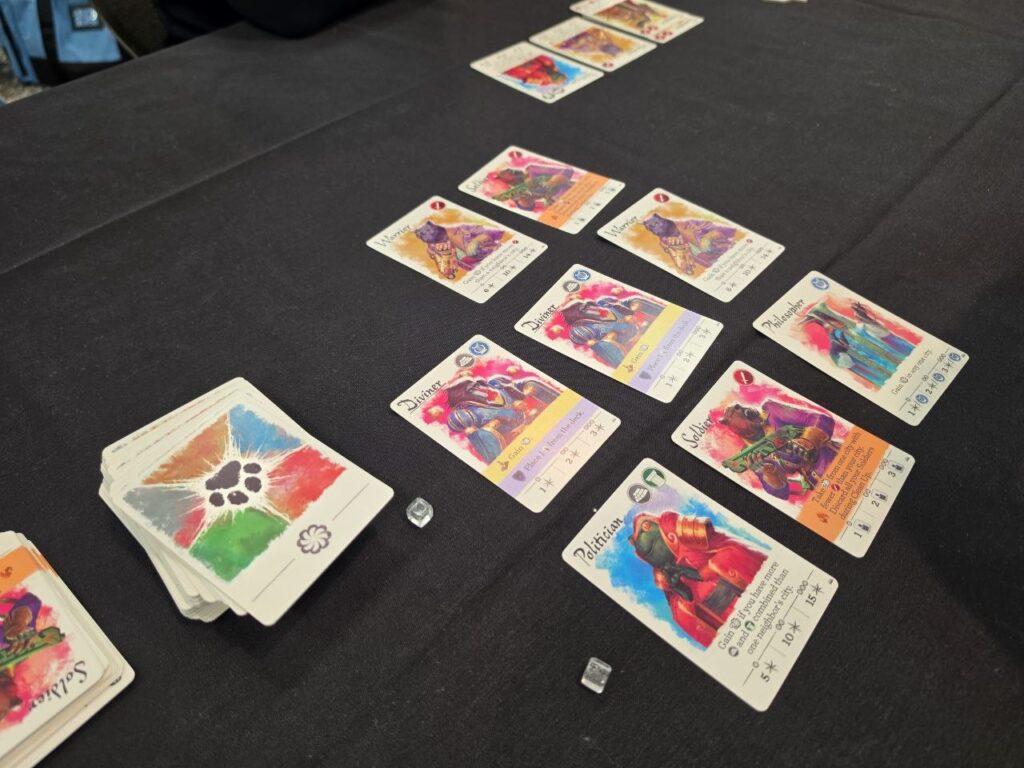
Citizens of the Spark includes 30 different citizen sets, with 7 to 10 used in a given game depending on player count. Players collect sparks, which serve as points, and the game ends when the citizen deck runs out.

The flow of play is fairly straightforward. On your turn, you take one set of three citizens from the assembly (market), and add them to your tableau. Any sets that aren’t chosen gain a spark token, which makes them more tempting for future turns.
Players organize cards by citizen type, and if that citizen is already in their tableau, the new copy is stacked on top.
Then, the active player chooses one citizen action from their tableau. The strength of that action scales with the number of copies they’ve collected. Other players can choose to follow that action as long as they also have at least one copy of that citizen in their own tableau. However, everyone who uses the action must discard one copy of that citizen at the end of the turn.

Scoring at the end of the game comes from your collected spark tokens, along with any endgame abilities in your tableau.
Interactive Citizenry
For a game with such a simple structure, there’s a lot of decision depth here. Drafting a set that contains the citizen you want may also force you to take citizens you don’t care about. It can also mean passing on a juicy pile of accumulated sparks and leaving it for someone else to claim.
The follow action is the part I enjoy most, and it’s one of the clearest points of comparison to Innovation. Being able to do more on other players’ turns makes the game feel lively, reactive, and interactive. You’re watching the table actively trying to nudge other players into choosing actions that benefit you, too. That said, unlike Innovation, there’s no bonus for the player who leads an action that others follow, and that feels like a small missed opportunity.

Another great tension comes from deciding whether to activate a citizen at a lower level just to get a modest payoff now, or wait and hope to build toward a stronger version later. Because there are only so many copies of each citizen in the deck, a little card counting can matter when you’re trying to judge whether that bigger payoff is realistically within reach. And since using the action costs you a copy of the citizen either way, that decision carries real weight.
Games like Dominion, as strong as they are, can sometimes feel low on player interaction. A lot of tableau builders end up feeling isolated or siloed, but Citizens of the Spark breaks out of that pattern. Many of the citizen sets invite direct interaction, whether that means attacking and defending, trading or stealing cards, or even converting one citizen into another.
The game also includes a large number of recommended set combinations depending on how interactive or aggressive your group wants the experience to be. Combined with the wide variety of citizens, this gives the game a ton of replayability. I’ve never finished a session without immediately wanting to reshuffle and go again.
Not every citizen set is equally exciting, though. Some feel a bit too basic or situational, and those cards can drag depending on the mix that ends up in play. That means some sessions may be less interesting than others simply because of the available sets. Thankfully, the game does include recommended setups, and there’s also a deck of randomizer cards for groups that want variety with less deliberation.
Sparks of Joy
Citizens of the Spark is a terrific time, and it’s a shame it hasn’t gotten more attention. The game has almost no downtime, and you’re constantly watching other players to see whether you can follow their actions. It keeps you engaged, and more importantly, it keeps you wanting to come back. On top of that, a full game wraps up in about 45 minutes.
And because it hasn’t become a massive breakout hit, it hasn’t yet generated the kind of demand that leads to easy expansion churn. But honestly, this system is good enough that I do want more. The core design is simple, interactive, and full of possibilities, and I’d gladly play with more citizens.
I haven’t had the chance to dig into the solo mode yet, but even if it’s only half as enjoyable as the multiplayer experience, I suspect it’ll still be worth exploring.

If you want more interaction in your tableau building, Citizens of the Spark strikes an excellent balance between depth and accessibility. Just be prepared to get punched in the face once those aggressive citizens enter the mix.
Citizens of the Spark details
- Designer: Philip duBarry
- Artists: Diego Sá
- Publishers: Thunderworks Games
- Release Date: 2025
- Player count : 1 - 5
- Age range : 14+
- Time range : 45 - 60 minutes
- Mechanism(s): Follow, Increase Value of Unchosen Resources, Layering, Melding and Splaying, Open Drafting, Set Collection, Solo / Solitaire Game, Variable Set-up
- BGG Geek Rating: 7.42408 - converted to Meeple Mountain scale: 3.5.
- More articles about Citizens of the Spark.


