

Disclosure: Meeple Mountain received a free copy of this product in exchange for an honest, unbiased review. This review is not intended to be an endorsement.
Cities (2024, Devir) was a very late cut from my list of the top 10 games of 2024. I loved Cities, but competition was fierce that year. Cities was my second-favorite “long filler” of 2024, just after Tower Up, another city builder, and a game that was such an elegant and easy teach for gamers of all shades. (This is another reason why I think 2024 will eventually go down as one of the best years in tabletop…it was such a deep year for new releases.)
Had Cities hit the market in 2025, it would have been one of the top three or four games I played. But, that’s the difference, isn’t it? With thousands of games hitting every year, it’s a crapshoot trying to figure out the best time for a game to hit the market.
A box showed up on my doorstep recently…and when I opened it up, I was overjoyed to see that one of my most anticipated games of 2026 was inside. Cities USA is a standalone expansion to the Cities system, with 90% of the rules from the base game and a host of new city boards modeling major US city tourist destinations.
As a man who is pre-sold on the Cities system, I’ll save you some time: Cities USA is great. My main question here: are there enough differences for Cities superfans to warrant the additional spend?
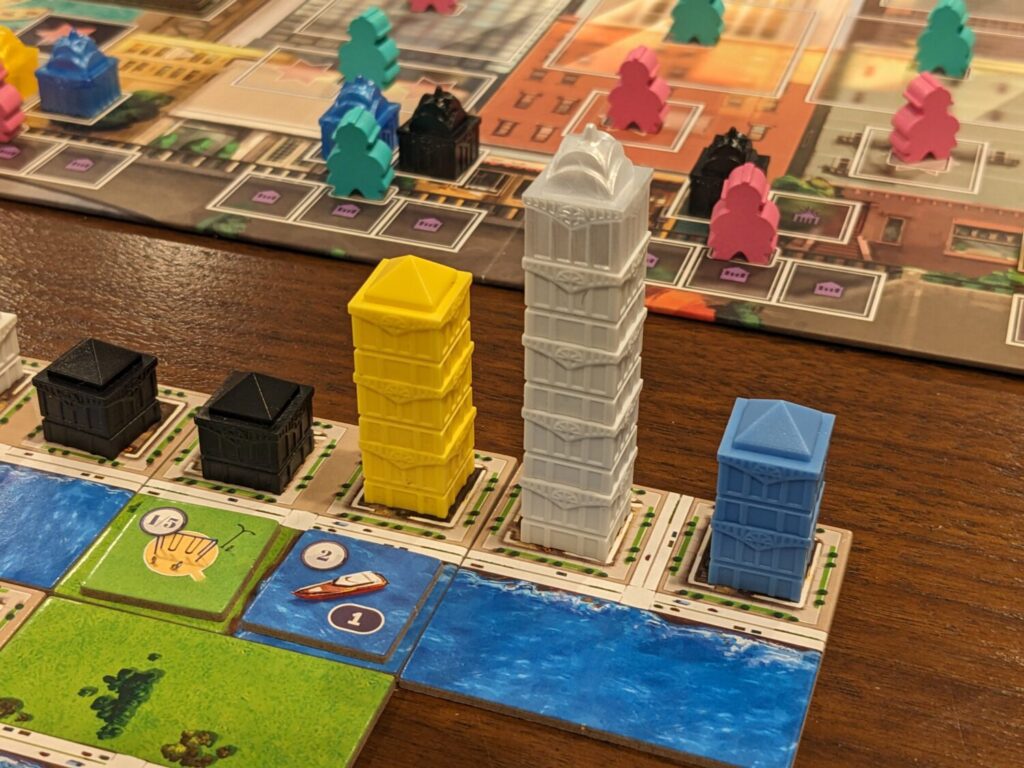
Those Bridges ARE Pretty Cute
Cities USA is a standalone title that uses most of the rules from Cities. As such, my previous review of the original game is enough to give you a sense of how to play.
Cities USA makes very subtle changes to the core concept, but leaves almost everything else alone. Players still place their workers to claim feature tiles, city tiles, scoring cards and building components on their turn. The game ends when each player has built their full 3×3 tile city. Scoring objectives listed on the major city board are still a race that score 1-7 points for each milestone achieved.
In Cities USA, each tile has a road running along at least one part of the tile. These roads often factor into a city’s scoring objective, and gives players a little more to think about when planning their grid. These roads take advantage of the new component addition to the Cities system: bridges. These bridges must be added to any tile that has a road that runs off into another placed city tile, to ensure that there is a driveable way to navigate a player’s city. (Bridges are not added to tiles where the road runs off the city into nowhere.)
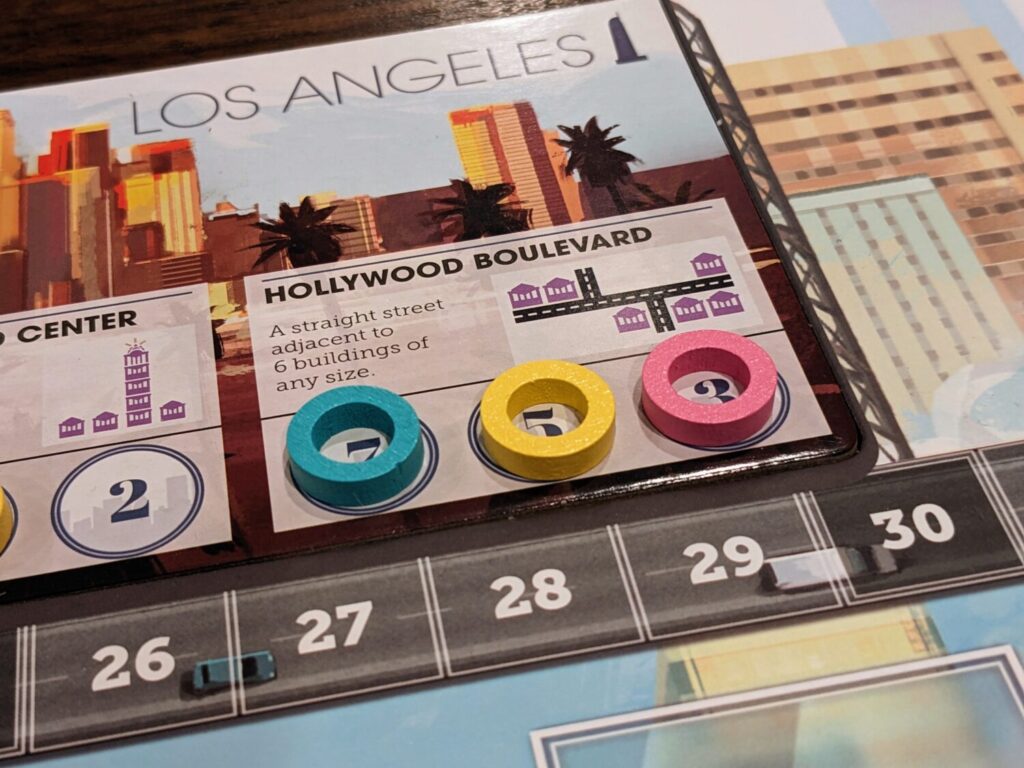
The scoring cards are an interesting mix; some are more straightforward than the base game, while others are a little harder to parse. My findings, after three plays of the new title: it’s harder to luck your way into winning with scoring cards than in the base game. I also think the city milestone features feel very thematic for each city, particularly the ones I used (Miami, Chicago, LA).
Cities USA also has new feature tiles, including park and water sets that score more points if matched with their partner. For example, there is a slide and a playground feature amongst the park feature tiles…on their own, each is worth just a single point, but if placed in the same park area, the set scores five points. There are also construction areas that can be built on to form a player’s own vision for their city; if these areas are not built on, they are worth negative points at the end of the game.
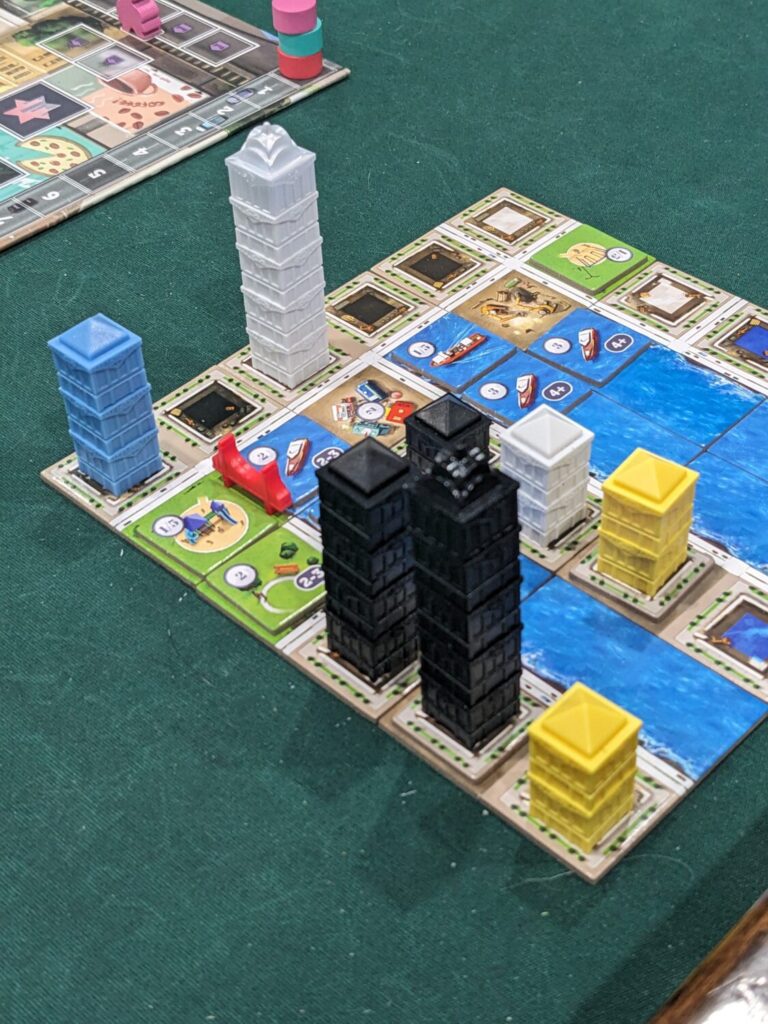
One other new addition are the skyscraper components. Buildings are capped at a height of four building blocks, and a player can draft a skyscraper “cap” by selecting pieces from the block drafting spaces. Many of the milestones play into these skyscrapers, and they make for a handsome tower in each player’s city by the end of the game.
More of a Good Thing
Devir also sent a copy of additional city board expansions for the Cities base game. Now I have like 20 city boards to use with the base game, in a title that frankly had enough stuff already.
I found this important because if push came to shove, I slightly prefer the base game over Cities USA. Both are incredible, but Cities is just barely easier to teach and table than Cities USA. That also means players who loved Cities but want an additional challenge should run out and buy Cities USA right away.
One other change: Cities USA has a solo mode. It’s a high-score challenge that pushes players to complete the major city board objectives early in each game, using a deck that blindly removes pieces from the board after you take your turn. I like that it is here, and it certainly helped me get an extra review play in…but I don’t think I will use this format for future plays. (The deck can be used for both Cities and Cities USA, so now I can play either game solo.)
Cities USA, like Cities, was designed by Steve Finn and Phil Walker-Harding, and this means I have another title I love designed by people I trust. If light tile-laying puzzles are your thing, I highly encourage you to pick up either one of these great city-building games!