Disclosure: Meeple Mountain received a free copy of this product in exchange for an honest, unbiased review. This review is not intended to be an endorsement.
Disclosure: Meeple Mountain was provided a pre-production copy of the game. It is this copy of the game that this review is based upon. As such, this review is not necessarily representative of the final product. All photographs, components, and rules described herein are subject to change.
One of the great things about being part of a regular game group is being exposed to titles you might have never seen before—because your friends also love games, and no two gamers have quite the same combination of tastes. Variety is one of my defining characteristics when it comes to playing games: I’d much rather play 6 games once, than 1 game six times. So when my friend Chas said “we’re going to play Bridges of Shangri-La”, a game I’d never heard of, I enthusiastically agreed.
Bridges of Shangri-La is an area control game from 2003. Set in the forbidding Himalayas, the goal is to earn the most points by training up masters in 7 different disciplines, then have those masters send their students to neighboring villages to “spread enlightenment”. Of course this is a friendly way of saying you’re going to beat the pants off them…except in Nepalese.
Did I mention that Bridges of Shangri-La is a bit…cut-throat? But I’m getting ahead of myself.

How to play Bridges of Shangri-La
The Bridges of Shangri-La board features 13 villages in the peaks of Nepal, each connected to several other villages by tendril thin bridges. Each player begins the game with 7 tokens, in 7 different disciplines. The goal is to have the most master tokens on the board at game’s end.
After some initial setup in which each player places one complete set of masters in villages around the board, the game begins.

Your choices are three:
Place a Master Tile
In a village where you already have a master, place a new master in a position which does not already have one. The icon of the placed token must match the icon of the space.
This is the best way to expand your placement options. New masters add to the strength of the village.
Recruit Students
Place 2 master tokens on top of any of your master tokens, anywhere on the board. A master may only have 1 student. The icon of the student token must match the icon of the master on which it is being placed.
By first placing new masters, you give yourself more places to add students. Students add to the strength of the village.
Journey of the Students
For any village in which you have at least one student, initiate a journey from that village, to a neighboring village, across an unbroken bridge. All students, including those of other players, join the journey. The masters of the originating village remain in place.
Players compare the relative strength of each village by counting the number of master and student tiles. The results of the journey are as follows.
- The bridge between the two villages is destroyed.
- If the originating village is stronger than the destination village
- A student encountering an empty space of their discipline becomes a master.
- A student encounters a master of their own color, they become a student of that master.
- A student encountering a master (with student or not) of another player, displaces that master/student and those tokens are returned to the player who placed them, along with.
- If the originating village is weaker than the destination village
- A student encountering an empty space of their discipline becomes a master.
- A student encounters an occupied space (of their own color, or another player), the traveling student is removed from the board.
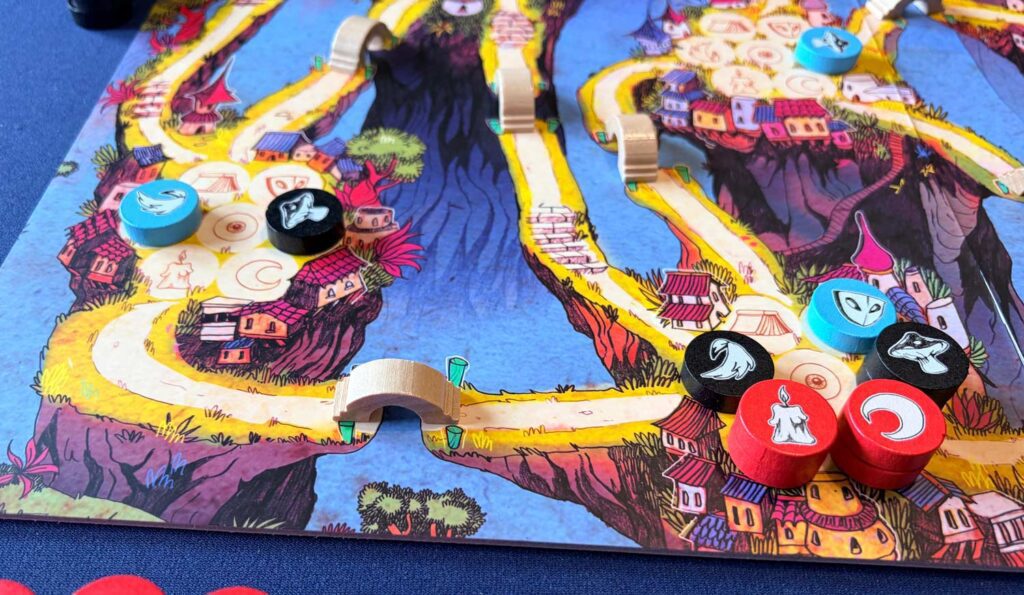
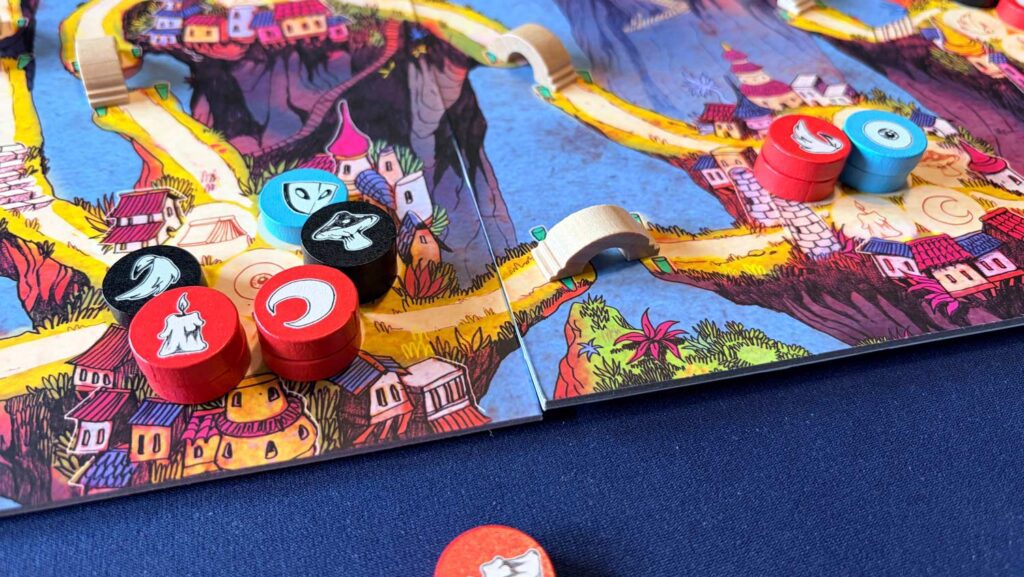
Here’s a few examples for the visual learners.
Winning the Game
The options are limited, but the branches are numerous. Bridges of Shangri-La is basically a game of chicken. Because there’s no hidden information, you can see everything your opponents are doing. And its your job to determine what they’re up to and block them.
Is your opponent placing multiple masters and students into the same village? It’s a good chance they might be looking to expand to the next village via a Journey. If you’re also in the village with them, maybe you let them spend their turn to expand, and bring your students along for the ride (that’s a favorite tactic of a player in my group). Or maybe you initiate a Journey from the weaker village, knowing you’ll lose but destroying the bridge. Not only did you protect your position, but you also made them waste the turns they spent building up their forces. Or maybe you’re being sneaky and just slowly building up your masters and students for a strategic strike?
Once the last bridge is destroyed, players tally up their masters and declare the winner. Shangri-La might be remote, but it’s hardly peaceful.

Could Bridges of Shangri-La be your “Shangri-La”?
I love this game; it just hits for me. It’s not a negotiation game, but my group definitely engages in some table talk, trying to sway other players to their point of view…shaking hands while hiding a dagger as it were.
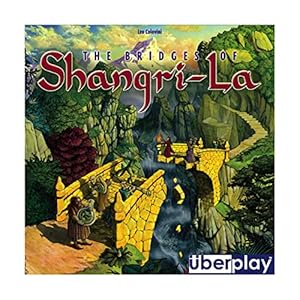
While the game itself is great, the artwork and components from the Uberplay version leave something to be desired. They’re not “bad”, just uninspired: cardboard tokens, wooden bridges, and glass stones indicating villages whose bridges are completely destroyed. And the artwork on the cover is…interesting but fairly bland.
So when I heard that Play for Keeps was releasing a new version of the game, I was thrilled. And doubly-so when I received a pre-release copy with updated components and artwork. The cover is bright and fantastical, the master tokens are thick wooden discs with easy to see icons, the bridges are still wooden, but have a more interesting shape, and the marker which indicates all the bridges have been destroyed is a bizarre orange flying buffalo or something…I love it.
The team at Play for Keeps really did a great job of revamping Bridges of Shangri-La without changing much. It’s a wonderful remake, and an even better game.
If you get a chance to play this, or even better pick up a copy for yourself, don’t waste the chance.
You can still pledge for a copy of this game on the Kickstarter late access.
The Bridges of Shangri-La details
- Designer: Leo Colovini
- Artists: Alvin Madden, Andreas Steiner, Anke Pohl, Imelda Vohwinkel, Thilo Rick
- Publishers: 999 Games, KOSMOS, Überplay
- Release Date: 2003
- Player count : 3 - 4
- Age range : 10+
- Time range : 60 minutes
- Mechanism(s): Area Majority / Influence, Map Reduction, Point to Point Movement, Tile Placement
- BGG Geek Rating: 6.95208 - converted to Meeple Mountain scale: 3.5.
- More articles about The Bridges of Shangri-La.