
Disclosure: Meeple Mountain received a free copy of this product in exchange for an honest, unbiased review. This review is not intended to be an endorsement.
I arrived home from my trip to SPIEL Essen 2025 with three bags’ full of board games, a nice assortment of jet lag, and seven boxes of board game table components and accessories waiting for me in my home’s front hallway. My wife and kids greeted me with the amount of love one would expect after being gone for a week—which totaled about three minutes
Then, my wife jumped in. “I need you to get all these boxes out of the hallway,” she started. “And most of this stuff looks like it belongs to a game table!”
After dinner that night, I decided that the best course of action (not only to stay awake and get back on the proper body clock, but also to stay married) was to assemble the new gaming table right away. So, a big thanks to the team at BoxKing for sending along a new table that I used for a couple months across my game nights to answer three simple questions:
- How does the BoxKing Ironside 2.0 augment the gaming experience, for someone looking for their first game table?
- How does the Ironside compare to my existing table, the “Holmes” modular table from Game Toppers?
- At the end of the day, what’s the better investment: an Ironside 2.0, or a plain old, basic table from a spot like IKEA?
I’m fortunate enough to have a lot of game nights at my place—every Monday, with my “review crew”; Tuesdays, once or twice a month, for the “Dusty Euro” game nights; Wednesdays, when my oldest gaming group rotates hosting duties (so I have that group over once a month); Fridays, when my wife and I do games at home; Saturdays, when I gather a group of strategy gamers for heavier stuff once or twice a month. (I also play games throughout the week with my kids, so I used the Ironside for those sessions, too.)
So how was the experience? I thought you’d never ask.

Assembly
The Ironside is a relatively simple item to put together for anyone who spent time putting IKEA furniture together with a friend or partner. That’s because some of the items used to construct the table require a second person, thanks to the weight of these components.
The Ironside is an all-metal table, with a recessed play space measuring 3’x5’. The table I requested was all brown, so that it would match the space on my main floor or stand out against the all-white walls in the nook where I set up my Game Topper in my basement. The metal here is really sturdy, with heavy legs used to support a table that says it can bear more than 300 pounds of weight when fully constructed.
The table uses five metal plates to form the base of the table’s play area, with edges that require a sturdy push to jam them all together and lay flat. An Allen wrench and some screws are all that are needed to attach the legs to the table’s four inner walls, so within about an hour, I was able to get the table completely assembled. Getting some of the screws fully twisted in at some angles proved challenging, and depending on the size and/or thickness of your hands (I wear XL-sized gloves, for example), you might find some of the assembly process a minor challenge. But, all in all, the Ironside 2.0 was relatively painless to put together.

The Topper
The Ironside does not come with a table topper by default, and I didn’t ask for one, so I was surprised to find that one of the large boxes in the set of boxes from BoxKing included a topper. I don’t have a table topper for my Game Topper, so owning a table topper was a new experience.
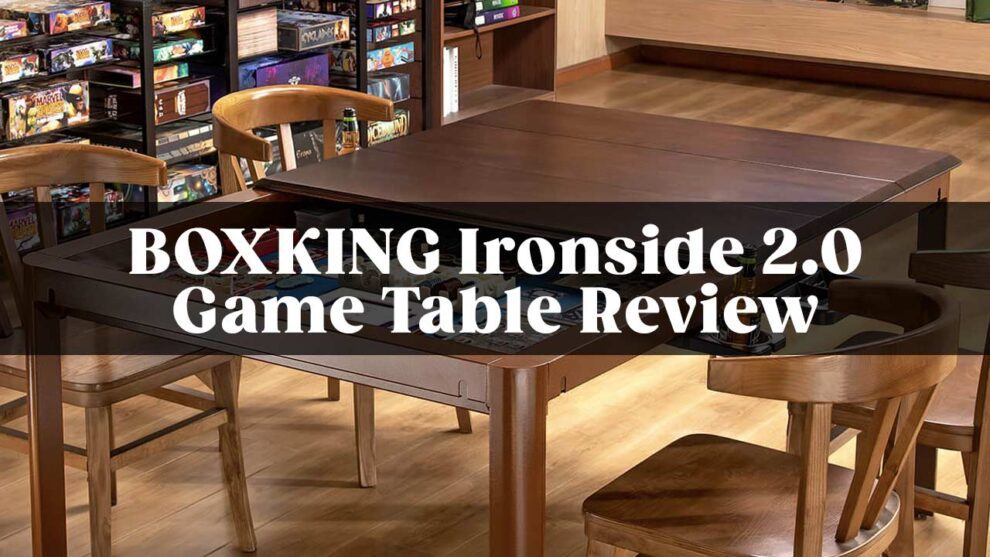
The topper from BoxKing essentially offers players a chance to convert their game table into a normal-looking dining room table. Now, this is a little weird only because the Ironside is a metal table, but the topper is solid wood (per the company’s description, the wood is 100% wood, i.e. no particle board). So with the topper on, my Ironside looks like a somewhat elegant, rounded-edge wooden table, one that from afar looks like a table I would eat dinner on every night.
This comes with a catch—the topper adds a solid 1-2 inches of height and a sizable amount of weight to the table. I don’t use adjustable height chairs in my basement, so this means that I needed two different chair types to work with the topper unless I wanted to have chairs that were a little too tall when playing at the Ironside with the topper off. (Watching my nine-year-old son sit at the table with the topper on is comedy; he has to reach UP to reach components on the table, but with the topper off, he can sit in a folding chair and play games at a normal height.)
I’m torn on what to do with the chair situation, a problem that may be unique to me because I’m not buying new chairs to go with this table. If your chairs support a range of heights, you’ll be fine, but I’m surprised that this turned out to be an issue.
Otherwise, the topper is the best thing about the Ironside experience. I can serve a meal on the topper, then remove the five topper panels to reveal whatever game I set up earlier in the day. I could game on the topper then bust out the game hiding beneath. And I can pause a game by putting the topper on the table, coming back to finish a longer play or a campaign game without issue.
The base price for the table is about $600, without a topper…but the topper is about $500 on its own. For those who are shopping through BoxKing, I think the company’s value proposition lies best in the space of targeting a budget shopper. That probably means “no” when it comes to the topper. But now that I am using the table, I think you need to get the topper to really make the package stand out.
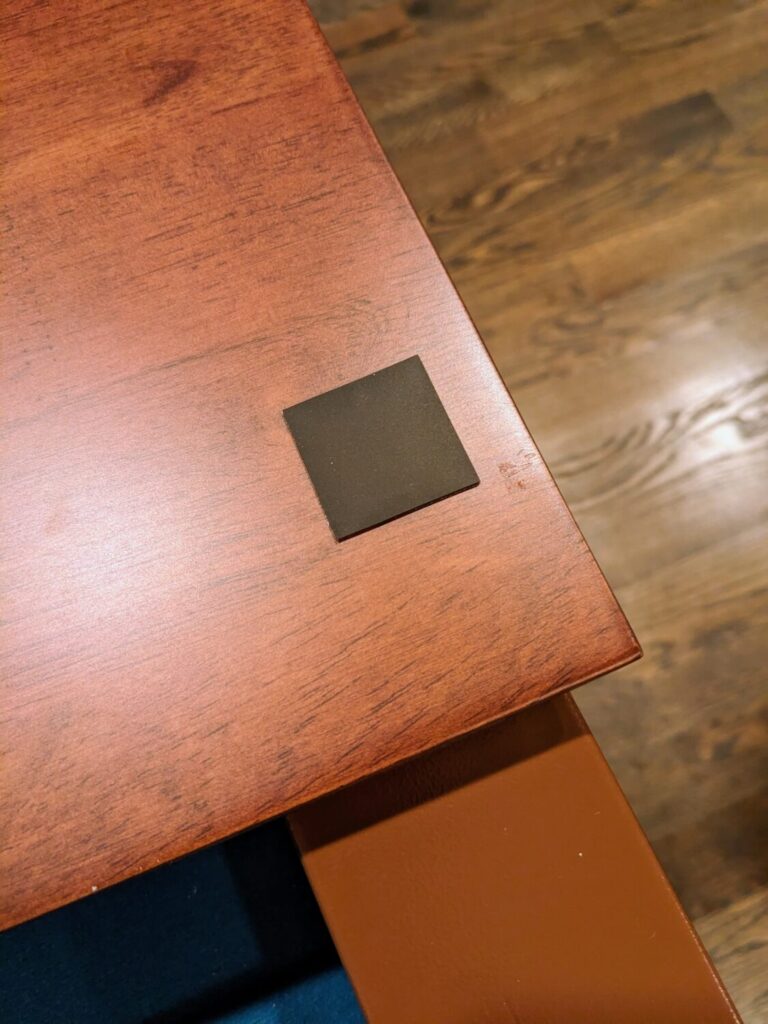
Another note about the topper: the five panels come with thin rubber stoppers that ensure the panels don’t slide while on the metal table. These are requirements. I wanted to try the topper out with no rubber stoppers first, and that was immediately a no-fly zone. Use the stoppers!!
The Mat
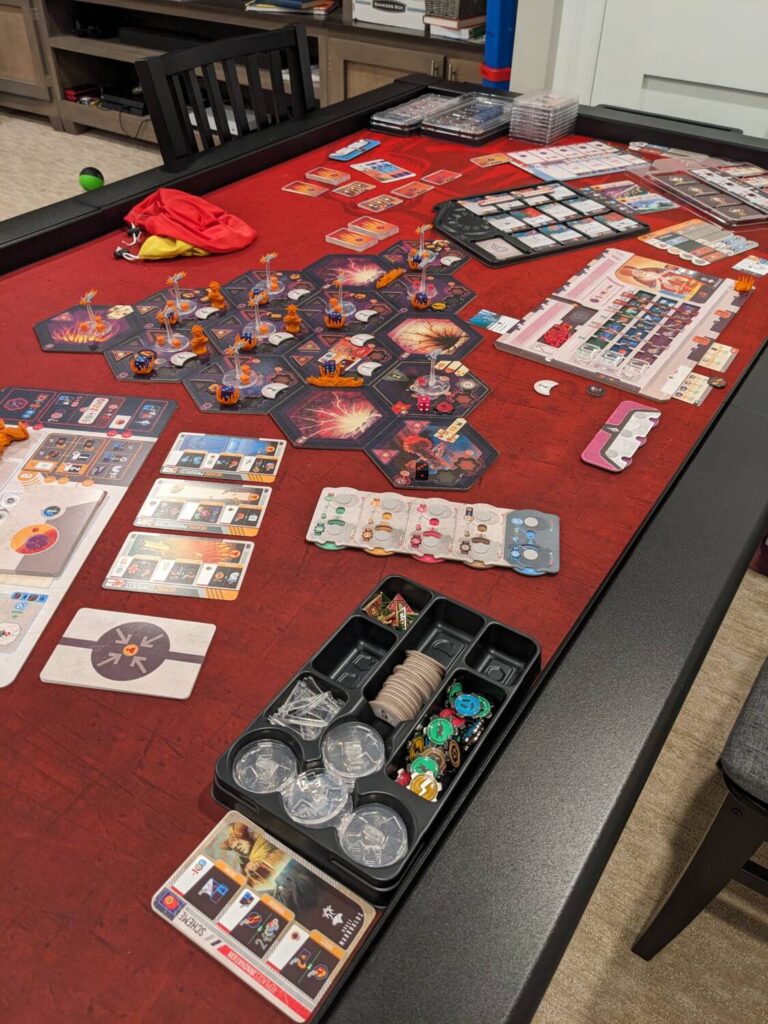
I’m not going to mince words here: the included playmat from BoxKing feels really cheap. Even during my first game night with the included mat, I actually swapped out the included mat for the 3’x5’ mat I received from Allplay as part of our board game playmat roundup
That’s because the velvet mat included by BoxKing is a little too thick, it’s not smooth enough, and the foam feels too…well, foamy, versus the neoprene mats that other vendors use. It is easily the worst thing about the Ironside experience. This is shocking because the main point of interaction for players is with the playing surface.
If you decide to pick up an Ironside 2.0, buy an extra mat elsewhere. You’ll still get a mat included with your Ironside purchase. I’m just suggesting you never use it.
“This is a Budget Table, Right?”
Once the table was assembled and trotted out to the field for game night, the reviews came in right away—the table is fine, but it’s not as good as the Game Topper I usually feature for my game nights.
Right from the jump, my first night with the Ironside 2.0 revealed a number of insights.
The arm rests players used to hunch over the table, similar to my table, aren’t really great for leaning on with the Ironside. There are options offered by the manufacturer for pads that can attach to each rail, and those would probably be worth a look if this is a table one expects to lean on with regularity.
My issue with the side rails: there are no card slots cut into the rails. That means players who are managing a hand will have to hold their cards with their hands, similar to if they just sat down at a regular table. With my Game Topper, I can slot lots of cards in front of each player, and dozens of the games I get to my table take advantage of this feature. (Even recent games, such as Recall, where players only manage a single private milestone card, get some use out of the card slots. That way, players can always keep their objective card fully visible while also out of the way with other game components.
I like the brown color of the metal with my Ironside table, but not everyone enjoyed the color as much as I did. It fits the aesthetic of my basement, but it is not sexy. “This IS a budget table, right?” one player said on the table’s debut evening. “I like that it has some of the basic features of a gaming table, but this is a pretty generic looking table. And the mat feels sort of cheap.”
Mind you, these are not gamers who have their own $20,000 gaming tables and have just randomly dropped by to play some games. Most of my friends and members of gaming groups don’t have a specialty gaming table at all; those who do have something like my Game Topper, but no one I play with has something even remotely better than a budget table or a Topper.
That made some of these comments quite shocking to me; some players asked if I would even keep the table soon after seeing it. That informed my feelings quite a bit. Have I gone from being known as a guy who had a decent gaming table, to someone who now is known as someone who does NOT?
But it was hard to argue with some of this commentary. The Ironside uses a rail system that allows for additional components to be hooked in along the bottom of each table side. But the components feel a little flimsy, such as the cup holders and detachable component holders that can be added to each rail. One player gave me the impression he didn’t feel comfortable putting a heavy glass into the cupholder, for fear that it might fall off. (Across more than a dozen game nights using the Ironside, I never once saw any component fall off. But it does look like the components might take a dive, for sure!)
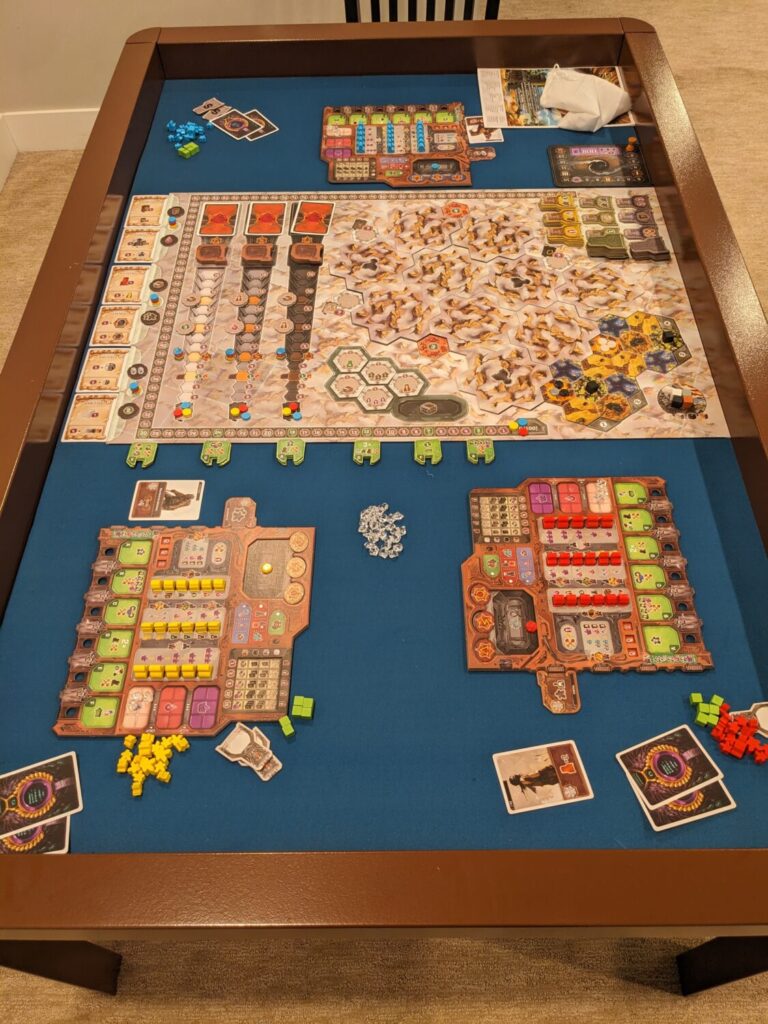
Another major issue for me is the size. The Ironside 2.0 just isn’t big enough for most of the heavier games I table. The Great Library, the Lacerda coming in 2026(?) I couldn’t even get the game board and the player boards for a three-player game night into the recessed area of the table. Perseverance: Castaway Chronicles—Episodes 3&4? Not possible, even with just two players. Covenant? Not happening. This is similar to the size issues Andy had when reviewing the Firefly Board Game Table.
That means that the Ironside 2.0—and this is my problem with most “small” game tables, in that 3’x5’ range of playable space—is a pass if you mostly play modern strategy games. If you, like me, table a hundred strategy games a year, and most of them have a trifold board with large individual player boards, side or market boards, and dozens of components, you can’t even consider a small table.
The games that do work well? Anything that only features a board, but no personal player boards. Card games of all shades. Medium-weight Euros with smaller-than-normal boards when you do two- or three-player game nights. Tile-laying games like Wispwood worked great, as long as the topper was on and players could spread out to build their 6×6 grid of tiles.
I keep coming back to one thing, though–the table is definitely “Baby’s First Gaming Table.”
Who’s the Market?
Let’s come back to our three main questions from the start of the article:
“How does the BoxKing Ironside 2.0 augment the gaming experience, for someone looking for their first game table?”
For newer players, or for experienced players who are looking to address their first foray into a tabletop-focused play area/”vault”/sunken table, the Ironside 2.0 is worth a look, with many caveats:
- You consider yourself a person who desperately wants to be able to lean over a play space on game night, with a space that can be covered with a table topper later.
- You are willing to buy a separate mat for that play space.
- You truly believe that a normal table from a department store such as IKEA is not worth using as a game table.
- You are not worried about the lack of aesthetic appeal with an all-metal table (I’m not, but I was surprised at how many people commented on this).
I’m not sure the Ironside 2.0 ever truly “augmented” our game experience. It is absolutely a budget item for a certain kind of shopper, and because it comes with essentially no game-related extras, the play experience is unaltered with the use of this table. (The accessories, including rail add-ons used to hold things like components, actually become essential when the 3’x5’ space is too small to keep all the “bits” within reach and off the main play space.)
How does the Ironside 2.0 compare to my existing table, the “Holmes” modular table from Game Toppers?
This is not a fair question, in part because I sought out my Game Topper after reading extensive reviews and lining up a table purchase with my specific gaming requirements:
- I intentionally bought a table that can be quickly assembled and disassembled each time I have a game night, so that I can get the table out of the way. The Game Topper is perfect for my needs, as a person who has limited floor space in my dining and living rooms, but exceptional storage.
- The Holmes’ play area is large enough for my heavier game nights. Voidfall fits on the Holmes fully set up for as many as three players, which is more than I would ever want to play Voidfall with anyway! I regularly put Lacerda games on the table, and the Holmes is perfect for that purpose.
- The component quality is high: the neoprene mats are exceptional, the cup holders and detachable dice towers are sturdy, and the pre-cut card slots running along the entirety of the table get used almost every time I play games.
- The price of my Game Topper was $1200 for everything,about the same price as the Ironside 2.0 if one includes the main table and the table topper, with some of the accessories. If your budget is $1000-$1500, and you have an existing six-foot foldable table, the Game Topper is the superior choice.

At the end of the day, what’s the better investment: an Ironside 2.0, or a plain old, basic table from IKEA?
A number of people in my network considered this question when they came by to join me for plays on the Ironside 2.0. The response was unanimous. For $1500 (the total cost of the Ironside 2.0 table, the topper, and the accessories), you should absolutely buy a normal kitchen/dining room table. At IKEA, you’ll still have to put the table together, but that budget will likely get you a table and 6-8 chairs. If you’re into DIY, Reddit has some examples of board gamers who have converted standard IKEA tables into gaming tables.
Sure, you won’t have a recessed “vault” space in which to play your games. If you care about that kind of thing, I don’t think the Ironside 2.0 is your best option unless you are hard-limited to a budget of about $600. If you are, and you can afford playmats from a different manufacturer, the Ironside 2.0 is not bad. One friend of mine built his own table, and while he certainly saved some cash, the time investment (and my general lack of carpentry experience!) made self-production a non-starter.
The BoxKing Project Ironside 2.0 is best suited for players new to the hobby looking for a budget-friendly option for their gaming space. I think it will live best in the space of a player who wants to buy multiple tables (maybe for a gaming cafe) and has the space for 3-4 tables with no frills. It will certainly stand up to a lot of wear and tear thanks to its build quality, but I don’t think it will truly augment the playing experience for seasoned gamers.