
When Restoration Games launched the Unmatched series in 2019, the system was praised for its diverse character roster, a claim that’s stuck with it ever since. At the time of writing, there are now 75 hero decks, based on fictional characters and real people from around the world, with a Hellboy set due imminently. With an average of just over 15 new heroes released a year, we’ll hit 100 heroes before the end of 2028. The future as tabletop’s most accessible and diverse miniature fighting game looks safe, right?

Back in 2020 Kathleen Hartin wrote an article titled ‘Representation in Board Games Matters’. In the article, Kathleen highlighted a lack of representation of women in board gaming, with compelling evidence including poor representation in game covers, rulebooks, designers and reviewers.
It’s nice to think the tabletop world has moved on; whilst not perfect, things are certainly better than they were. At the time of Kathleen’s article, Unmatched felt like a sign of things to come. The then-released sets (Battle of Legends Volume One, Bruce Lee, Robin Hood vs. Bigfoot and Ingen vs. Raptors) drew on Greek, Arabian, British, Asian and North American sources and included 3 female and 5 male hero decks (plus cryptid Bigfoot, whose gender isn’t stated). Throw in all the sidekicks and we’re looking at 9 female characters and 11 male. More than acceptable, given the sample size.
Six years and 67 heroes later, are things still as rosy?
Uncovering Unmatched
Sticking with gender, that near equality has plummeted to an almost 1:2 ratio. Of the 75 hero decks available, 25 are female and 46 are male, with one dual (Cloak and Dagger), one gender fluid (Loki) and two unknown (Bigfoot and Chupacabra). The sidekicks are even worse: there are more than twice as many male sidekick entries as female(1). Out of the 25 Unmatched releases to date, 12 sets have more male than female hero decks, compared to just 3 where it’s the other way around. Eight sets consist of all male heroes. This bias permeates the whole series: there are female characters, but they are consistently outnumbered and often completely absent.
What about the race of Unmatched characters? Of the heroes whose race we can identify, ~27% are people of colour, whilst for the sidekicks the figure is around 31%. In 12 of the sets the heroes are all white, with the reverse true in only 3-4 sets(2). In a single box, white heroes are never outnumbered. The primary markets for Unmatched are the USA and Europe, where non-white demographics are reported around 40% and 20% respectively. Restoration Games is an American company, so whilst the numbers aren’t level with US demographics, representation of race isn’t as heavily skewed as with gender.

Unmatched fares incredibly well for ethnicity, with many cultures and geographies represented. Character influences come from Africa, China, Japan, the Middle East, North and South America, and Europe. Again, the United States and Europe are still highly represented as you might expect, but even within them there are characters from different groups, religions, regions and histories. Characters stem from myths, legends, folk- and fairytales, gods, Victorian gothic fiction, comics, Elizabethan theatre, 90’s cult TV, and more.
Unmatched includes at least 5 heroes canonically from the LGBTQ+ community. That’s 6.7%, less than the current estimates for the USA of 9-10%. However, there are other characters who may also fall under the LGBTQ+ umbrella. Some scholars argue that Shakespeare was bisexual, and Titania and her sidekick and husband Oberon are often discussed as queer (the artwork in Titania’s deck also suggests this). Dr. Jill Trent is sometimes implied to be in a relationship with Daisy (her card ‘Sisters in Arms’ nicely mirrors Achilles’ ‘Brothers in Arms’), whilst Spike is widely felt to be bi-coded. Throw all of them into the mix and Unmatched exceeds real-world demographics, although the number of openly LGBTQ+ characters is still low.
Then there are heroes battling (pun intended) with a physical disability. Daredevil and Phillipa are both blind, the Winter Solider has a prosthetic arm, Yennefer has scoliosis, and the Invisible Man had albinism. Medusa, whilst not disabled herself, has often been used as a metaphor for living with a disability. Meanwhile, other heroes are thought to be neurodivergent: Nikola Tesla and Donatello had/have signs of autism, Michelangelo appears as having ADHD, and both Jekyll & Hyde and Moon Knight famously have dissociative identity disorder (multiple personalities). Whilst the numbers are less than the percentage of people living with disabilities (most estimates range between 15-40% in the United States), it’s at least close to the lower end of that range.
What does all this mean for Unmatched and Restoration Games?
Understanding Unmatched
There’s no denying that Unmatched does indeed have a very diverse roster of heroes and sidekicks, especially in the context of an industry that still has a way to go when it comes to representation.
The figures for race, disability and LGBTQ+ are especially encouraging, and instances where they don’t exactly reflect real world demographics are often down to the source materials. Buffy, The Witcher and Jurassic Park are all licensed properties with predominantly white characters, so the resulting heroes and sidekicks are white (although I personally feel the world missed out on a Dr. Henry Wu vs. Ray Arnold set from Jurassic Park – Hold on to your butts!). Many of the source materials also originated long before LGBTQ+ rights; any potential queerness that a modern audience might read into older stories could only be implied.

With all that in mind, there are still some weird gaps. I don’t know that there’s a single Latino character in the whole series. One of the personas of Moon Knight is in the MCU series (and Moon Knight is portrayed by Guatemalan-born actor Oscar Isaac) but that’s in contrast to the original source materials and there’s nothing of that in the game (understandable, given the Unmatched set was released the same year as the TV series). There’s also Chupacabra, a nice nod to Latin American folklore, but a single cryptid isn’t exactly a true representation players can identify with when after someone that looks like themselves. And what about Native Americans or the First Nations? Whilst undoubtedly unintentional, it’s a bit odd that a company based in the United States hasn’t depicted a single Latino or Native American, real or fictional, across 75 playable heroes.
And then there’s gender: Unmatched has half as many female characters as male ones. Most years the male bias for heroes hasn’t been huge; indeed in 2023 and 2024 it was 50:50. But for all other years, that number has crept up, slowly but steadily. It’s not too bad. It’s not too bad. It’s not too bad. Oh my god, how are there twice as many men as women?!?
The Marvel sets didn’t help, with four out of five of them containing heroes that are either all male or two males and one female. Most popular Marvel comic book heroes are male, and it’s hard to know how much Marvel pushed for certain characters to be included. Similarly, the Teenage Mutant Ninja Turtles are all male so it’s a set of four male heroes (and Shredder and Krang are also male when counting their playable hero decks).
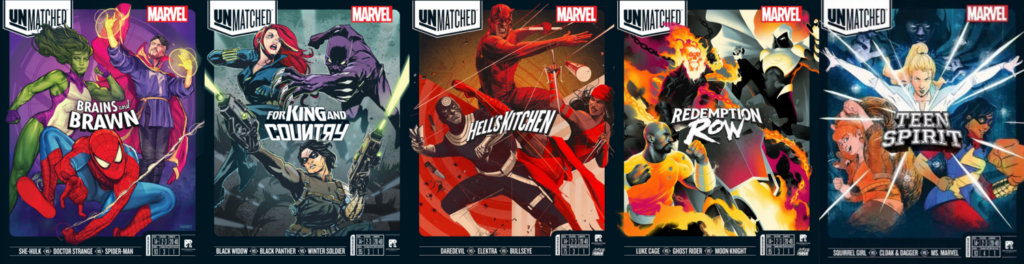
So there are some explanations for the male bias, but Restoration Games is hardly blameless. Sets like Houdini vs. The Genie, Robin Hood vs. Bigfoot, Lee vs. Ali, and Cobble and Fog are gender representation own goals, even if you discount Bigfoot (often coded as male but not assigned a gender here).
Not every set must be 50:50, not everything needs to mirror real world demographics precisely. And there may be marketing reasons why a company chooses to create more male and/or white heroes, potentially appealing to an audience that is still predominantly male and white. But regularly putting out male-biased sets moves the needle further and further away from what good representation looks like. Which makes choosing the heroes that do appear, both male and female, more important than ever.
A Study of Stars and Stripes
Stars and Stripes is particularly galling (and not because I’m British!). It’s a four-hero set, featuring Wyatt Earp, Rosie the Riveter, John Henry and George Washington. “American heroes come to life in a new historical Unmatched set” reads the tagline on the Restoration Games’ website, which says it pays “homage to the folklore and legends of American history”.
With only four heroes the set can’t capture all of American history, but were there no other women that could have been honoured? What about other legends and heroes from American history or folklore who weren’t white? It’s fantastic to see John Henry there, but are there really no Latino or Native American heroes, real or otherwise, that could also have been celebrated? Or, frankly, characters from any other race?

And were there no real-life women at all that could have been celebrated? Because, whilst there are some women who were claimed to be ‘Rosie’, she’s originally a piece of wartime propaganda. Hugely important, inspirational and influential in the war and for women’s empowerment subsequently, there’s no doubt about that, but fictitious and originating from a song written by two men and two paintings by men (the Westinghouse poster and the Saturday Evening Post cover).
Stars and Stripes, then, is a set of three real men and a male invention, which feels a little off, especially if you consider a ‘real’ character to be in some way honouring the person they’re based on. 20% of Unmatched characters are based on real people, but Stars and Stripes exemplifies a trend across the whole system: men are far more likely to be honoured like this than women.
And here’s the rub: three of the characters in the set came from the Unmatched design contest: Rosie won, whilst John and George were runners up. Presumably they prompted the idea of a USA-flavoured set, released perfectly for the 250 celebrations. All well and good, but that means that the Restoration team added Wyatt Earp. A third white man based on a real person. A problematic white man, in fact.
This is a man who was a corrupt boxing referee and gambler, was fired as a lawman and was arrested multiple times (including for theft, pimping and murder). Nobody’s perfect and times were different, but still, he was hardly good or inspirational, not in the way you might expect an ‘American hero’ to be, and certainly not in comparison to the other two men in the set. Controversial and complicated is the most charitable way of looking at his life. Even his most famous shootout isn’t as clear cut and heroic as the tales have you believe, a shabby minute of questionable morality. The stories about him are just as fairytale-fictitious and rose-tinted as stories of the Old West itself, his character as much a piece of propaganda as Rosie.
This is who Restoration chose to fill that fourth space.
Not Sacajawea, who helped lead Lewis and Clark’s expedition. Not Harriet Tubman, former slave, scout and spy who rescued the enslaved via the Underground Railroad. Not the pioneering aviator Amelia Earhart(3). Not NASA human computer Katherine Johnson. Not activist and Nobel Peace Prize recipient Jane Addams. Not civil war nurse, suffragette and author Louisa May Alcott (or any of her heroines). Not ‘Beloved Woman’ Nanyehi. Not folk hero Annie Christmas, who instead randomly features in Tales to Amaze. If the team really wanted an ‘Old West’ character, they could have chosen trick-shooter Annie Oakley or frontierswoman Calamity Jane.
There were plenty of other options for that fourth space. Sure not all of them are squeaky clean, and a couple are almost at self-aggrandising as Earp himself, but none of them have anything close to his rap sheet. None of the real characters in Unmatched are 100% accurate, they’re mythologised versions of the original people. But none take such a rotten starting point and then celebrate them as a hero worth paying homage to(4). Even Blackbeard owns his crimes.

Representation matters. Who you include is just as important as who you exclude, doubly so when you say a character is a hero that should be celebrated and paid ‘homage’ to. Comparatively short though it is, US history is rich in heroes and legends that could have been chosen instead of the dubious Wyatt Earp.
The decisions behind Stars and Stripes send an uncomfortable message about who is honoured in a country’s history, and who is not. What is the box saying about America with its character choice and framing? It seems to suggest that the truest representation of the land of the free is a corrupt and trigger-happy law enforcer prioritised at the expense of underrepresented groups and honoured on the basis of misinformation and self-promotion. If I believed it was intentionally satirical I’d applaud.
Unmatched Undone
In fairness to Restoration Games, the team has curated an incredibly diverse set of heroes and sidekicks from a wide range of sources, and there are plenty of playable heroes who are not white and male. I’ve loved discovering heroes like Yennenga, Oda Nobunaga and Tomoe Gozen, characters who I wasn’t even aware of and am please that I now am. Unmatched is far better than a lot of series in the tabletop space, and it’s easy to praise the system.
But representation is ensured by consideration with every decision. It’s clear that, much as we might celebrate Unmatched for its diverse character roster, this hasn’t been happening with every decision. Stars and Stripes is just one set but it’s a symptom of a wider issue across Unmatched. Biases in representation still remain, and some of the decisions behind the character selection process need further consideration.

Restoration Games is a publisher built around bringing older games and ideas into the modern world. I’m a big fan and have a lot of respect for their goals and ambitions. I’ve just been pretty darn positive about competitive (the two Witcher releases) and cooperative (Unmatched Adventures: Tales to Amaze) sets, and look out for even more positivity coming soon about the Teenage Mutant Ninja Turtles set.
This article isn’t intended as an attack, but a request. I’m sure the next few sets are already planned, but I hope that there’s still time to correct the course before we reach 100 playable heroes, before we reach a decade of Unmatched. Don’t keep one foot in the past. Consider every decision of who to include and who to omit. Embrace the diversity that you are known for. Entertain and educate us with characters we might not be immediately familiar with but are delighted to discover. Each Unmatched set is somebody’s first, help them to recognise that everyone is welcome, that this system is truly unmatched.
–
- To get the numbers I’ve combined groups into one entry (e.g. the 3 Ingen Workers count as a single entry), and I’ve made some assumptions based on artwork and the stories they’re based on. I’ve also not gendered groups like the Red Riders where they could be a mixed group, animals like the Squirrels or Wolves, or any of the cryptids. Perhaps not completely perfect, but splitting groups out doesn’t really improve matters much either.
- It depends on how you count the four Teenage Mutant Ninja Turtles and Splinter. The Turtles are thought of as mutated turtles, but some stories portray them as Black or Asian (sometimes even as humans transformed into mutated turtles). Splinter is heavily coded, and sometimes even portrayed, as Japanese. That being said, it’s a generous interpretation, and if we’re going to do that then we might as well start looking at She-Hulk, Spiderman, Moon Knight and others who are typically portrayed as white but occasionally black or Latino.
- Back in early 2024, I was asked during a workshop to try ChatGPT for the first time (you can safely assume that I’m not a huge AI fan). I asked it to tell me about Unmatched Adventures: Tales to Amaze, which had only recently been released and about which I was curious. Ameila Earhart was one of the playable heroes that the AI claimed was included in the set. Sadly, she wasn’t and I’ve never returned to ChatGPT!
- It could be argued that the crimes of the character are acknowledged with the descriptor: “He’s a marshal and an outlaw, and when he fans the hammer, the bullets start flying. With the crack shot Doc Holliday at his side. Justice is served.” But that “outlaw” is the only suggestion of anything other than the marshal side of the character, in the text, imagery or mechanics.