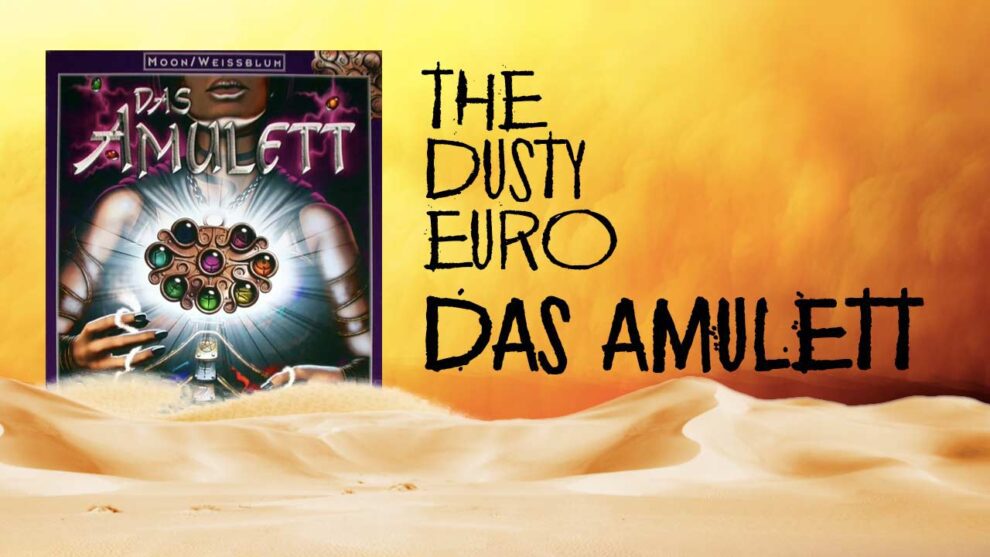

The guys in my Wednesday gaming group started a push to play more of the old, dust-covered games at the bottom and backs of our respective game closet shelves. The premise was simple: let’s try to remember why we keep all these old games when all we ever play now are the newest, shiniest things in shrink.
Right on the spot, the Dusty Euro Series was born, and I’ve enlisted multiple game groups to help me lead the charge on covering older games.
In order to share some of these experiences, I’ll be writing a piece from time to time about a game that is at least 10 years old that we haven’t already reviewed here at Meeple Mountain. In that way, these articles are not reviews. These pieces will not include a detailed rules explanation or a broad introduction to each game. All you get is what you need: my brief thoughts on what I think about each game right now, based on one or two fresh plays.

Das Amulett: What Is It?
Das Amulett is a 3-6 player auction game that plays in about an hour. Designed by Alan R. Moon (Ticket to Ride) and Aaron Weissblum (a frequent Moon collaborator who also co-designed San Marco), Das Amulett was a nominee for the Spiel des Jahres when it was first released in 2001. I won’t call Das Amulett themeless, but it’s hard to put the story together: basically, players have access to “energy stones” that are used to bid on spell cards, cards that also generate a player’s metals income on a turn.
Then, using those metals (here in the form of cards in one of four different flavors), players will move a cute black wizard’s hat token around a small map to establish the active bidding region for jewels. Then another round of auctions kicks off each time the wizard’s hat moves to a new space, with as many as six auctions taking place during this phase, each round. Whenever a player acquires seven jewels in seven different colors, or eight total jewels, that player immediately wins the game.

Everything is An Auction
Das Amulett was quite novel as an auction game almost 25 years ago, because it turns everything into an auction. There’s a one-pass auction to acquire spell cards, then after all players collect their income every other action in the jewel acquisition phase is also an auction. So, there’s not much sitting around here and all players (hopefully) have the stones and/or the metals to bid on cards and resources that can help them win the game.
But at three players—we did a play with my friends Beth and John—the auctions were often toothless, and when one player simply had more cards than anyone else (even without knowing what those cards were), they had a run of the table on getting more jewels, which turned our game into a very snappy 40-minute affair.
My big issue with Das Amulett is my big issue with all games that require players to know what everyone at the table is capable of: the spell cards not only include a player’s round-to-round income, but also any powers they have access to in the current round. (Yes, newer games like Arcs also have this problem.) In our final round, no opponent was familiar with the fact that one person had a card that earned them a double-jewel reward when they won an auction in a specific region type…so, the active player, thinking that there would be another round, simply let this player win an auction, not knowing that this would end the game.

At larger player counts, the auctions would be better, but trying to remember what, say, five other player’s powers were on each turn would have been a nightmare. Maybe in 2001, no one had an issue with this, but in 2025, I have a big issue with this!
Prior to Das Amulett, Moon’s big hit was Elfenland, the 1998 release that won that year’s Spiel des Jahres. Soon after Das Amulett hit the market, Moon’s fortunes took off with the release of San Marco before, most notably, Ticket to Ride arrived in 2004. It was fun to play one of Moon’s earlier releases to see where the designer’s mind was headed prior to the release of a modern classic.
My vote? Play Ticket to Ride, or even San Marco…but Das Amulett, unfortunately, has not aged well. With dozens of better auction games released in the last 20 years, you have a wide berth of great choices!