
While our Diamond Climber Awards are on hiatus, we still want to make sure we, as a team, talk about our favorite games of 2025. These are the games that stand out, stand up, and won’t stand aside. Maybe it’s a light card game, or maybe it’s an hours-long space odyssey, the games on this list are our collective favorites that we played in 2025. Please join our team as we celebrate the best that board gaming has to offer.
Tom Franklin

Ingenius 3D
Thanks to my friend W. Eric Martin. I borrowed his copy of Ingenious 3D at the end of 2024 and forced it on all of my gaming friends in January 2025, from North Carolina to Maryland.
If you’ve played Reiner Knizia’s original Ingenious, you know how good the game is. Now, condense the board into a much smaller hexagonal shape and allow players to randomize the colors in the corners. The pieces are thicker, with a bar on the underside, across your pieces two hexes. This means you can only play on top of two adjoining pieces, and not completely cover a single piece.
Play starts on the first level of the board, but you can place a tile atop two other tiles at any time. The playing field rises quickly as players chase scoring color lines before they’re covered by other pieces. Eventually, single gaps between pieces will appear, creating holes in the board that grow deeper with each new level, hindering your scoring possibilities.
Ingenious 3D is such a great game.
Bob Pazehoski, Jr.

Castle Combo
Without a doubt, Castle Combo takes the cake as my favorite play of 2025. From the lightning quick setup, to the simple-yet-not-so-simple gameplay, to the flick-of-the wrist teardown, this little tableau-builder is a stroke of genius. It has served well multiple audiences and in various circumstances.
Throughout the game, players draft cards from two marketplace rows to build a 3×3 tableau in which the cards score based on their position in the grid and their relationship to one another. I am hardly surprised at my affection here. One of my favorite games of all time, Warsaw: City of Ruins, uses the same mechanism, only with a bit more heft. I celebrate Castle Combo for its ability to scratch a similar itch in a fraction of the time with jolly artwork and an inviting atmosphere. Pitting nobles against peasants within one finished kingdom, the game’s theme is surprisingly present, and it is pure joy.
To offer one more word of superlative praise, I might be so bold as to say that Castle Combo tops the list of review copies I have received in my time at Meeple Mountain, the sort of game that warrants purchasing a spare for when we inevitably wear this one out.
 Ada’s Dream
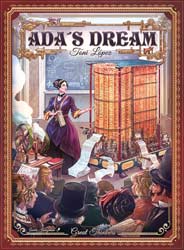 Ada’s Dream
On the other end of the spectrum, Ada’s Dream is a beast of bandwidth, colorful and complex. The sales pitch does not boast universal appeal— a multi-hour brain buster aimed at building a calculator. And yet, the calculator just works.
Players strive to win Ada’s approval by assembling a functional 3×3 grid of colored dice and mathematical functions. (I know, another 3×3 grid.) Half of the turns involve selecting dice from a rondel, the other half placing said dice into the machine, triggering one of the game’s four key action sequences. The sequences are broad in scope and application, but none are so demanding as to be difficult. Ada’s Dream derives its complexity from the breadth of the decision space. Every play so far has left me believing I can play better and wanting to try again.
Having played now at two, three, and four players, I can say this is my heavy hitter of the year. I am excited for 2026 knowing that Ada Lovelace will play a major part.

Café Baras
The family favorite this year, based on the number of plays and the lingering delight, is Café Baras. Like Castle Combo, KTBG’s anthropomorphic coffee shop appeared at the end of 2024, but developed traction with every passing month.
The cards in this café contain beverages, sweets, savories, and décor. The beautiful tension is in the multi-use functionality of the cards and the race to acquire three “regular” customers. The early game is fairly straightforward as players spend to build their menu (use 1) or serve customers (use 2) on the way to gaining cash. The late game is an exercise in awareness as players decide whether to chase a more effective coffee establishment or race to the edge to cut off the opposition’s efforts. The fact that the cards are dressed in cozy artwork, lovable puns, and love letters to gaming are the icing on the family-friendly cake. My wife and kids adore this one, too, so it’s been easy to table and easy to enjoy.
Café Baras is the most flawed of my selections, but its whimsy easily outweighs its blemishes. The barrel-nosed rodents are here to stay.
Andrew Lynch
Earthborne Rangers
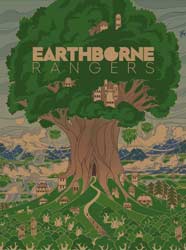 Earthborne Rangers
2025 has been a great year for board games. Despite the tumult and uncertainty of tariffs, the hobby as a whole has blossomed. Players have reaped the benefits of board gaming’s increasing cultural prevalence and an increase in the diversity of voices heard. I personally have reaped the benefits of a broadening of my own awareness of the nooks and crannies of the ecosystem.
I can’t be bothered to check this claim, but I am sure I’ve written more 4.5- and 5-star reviews in 2025 than in any other year since I started writing here. I promise I’m not getting soft. I remain as picky and fickle as ever. But the games; they’re good. Tack and High Tide were passion projects that resulted in great games. Embers showed that the 18 card format has loads of oxygen left. Azure, which doesn’t come out until next year, electrified me. For two weeks, I was obsessed. D.V.C. is doing some of the most exciting and inventive work in the space. And CMYK put out an absurd double-offering of Hot Streak (my Game of the Year for wider audiences) and Magical Athlete.
In a year of spectacular and special titles, none stood out more than Earthborne Rangers. If I were to describe it as a meditation on the wonders of nature and exploration, you’d likely imagine a subdued, pastoral experience. In reality, this is a rich, engaging card game, one with an enormous world to explore and a vast, satisfying narrative. The real beauty is that the designers saw fit to make that story as unobtrusive as you want it to be. The world changes and grows around you, but you’re free to turn over stones, pet deer, and find whatever surprises await around the next bend in the path. It may truly be my favorite board game I’ve ever played. It’s certainly one of the best.
Joseph Buszek
Campaign Trail
 Campaign Trail
It was a brutally cold February morning. Myself and six other members of my friend Tyler’s Heavyweight Game group, who meet regularly at a bar on the weekdays, had gathered at his home on a Saturday. We were there to play a full session of a game, Martin Wallace’s Struggle of Empires, that we had not managed to finish in the 4 hours before the bar closed during our normal Wednesday meetup. Once all the bulky coats, hats, and scarves were off and we had settled in, Tyler broke the bad news: he had left the game in the trunk of his car, which was currently at the detailer’s…which didn’t open until Monday morning.
With few options for 7 players outside of party games (which was a non-starter in a group of heavyweight gamers) we scoured his gaming shelves and found Campaign Trail, a game about winning the US Presidency. Mind you, we were just a few weeks past the real inauguration day and, frankly, none of us were in the mood to relive the last election cycle. Still, we soldiered on, determined to make the most of what was a long drive for many of us. We watched a couple YouTube videos, since none of us had played (the game was still sealed), randomly split into teams of President and VP candidates, and begrudgingly jumped in. What followed was the best tabletop gaming I experienced all year.
Over the next 4 hours, we crisscrossed the country, made ridiculous promises, and backstabbed our opponents. Snacks and drinks flowed liberally, and there was not a single dull moment as our candidates worked to earn, steal, and buy votes by any means, in this card-based area-control game. In the end, it came down to a single card. On the final turn, Dan and Tyler’s Democrats played a “pick through the discard pile” card (which at that point was the entire deck) to easily find one that gave them the 6 electoral votes needed to win the election over Kristin and myself, the Republicans. Normally, a card like that, played at the end of the game, would have driven me bananas–the sign of a broken game–but for this particular playthrough, on this freezing Chicago morning, it was perfectly fitting. A game none of us wanted to play had become an event none of us would forget.
Will Hare
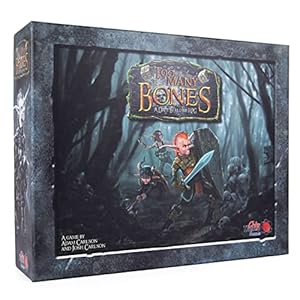
Too Many Bones
Last winter, my husband Brock and I began our return trip from PAX Unplugged with an SUV packed to the brim with new games and merch. We knew this would take us a while to work our way through, but one game was important for us to prioritize: Too Many Bones. Within a couple of weeks of returning with our haul, we had the game on the table and had watched many YouTube tutorials on how to play it. We sat down with a friend of ours for our first playthrough and… well, we got stomped. Repeatedly. It was ugly. Over and over again, we were dying to swarms of angry monsters and felt like we had no chance! We finally put the game back in the box, assuming we had just messed up a rule somewhere.
In the box it sat until very recently, when a friend visited for Thanksgiving, and we decided to give it another go. This time, whether it was a fresh read of the rules or just a lucky combination of characters, things went swimmingly. We were firing on all cylinders, each of us performing our unique, specific roles well. Rolling fistfuls of dice and shouting and cheering at the results is always a good time, but what really struck me was how unique you could make your character. Each “run” of Too Many Bones has you building a party that has to kill a big, bad, evil guy within a certain number of game days. Each day, you start by drawing an encounter card. Sometimes, this will just be a narrative choice with a reward. Other times, it’ll throw you into combat against some number of enemies from a randomized stack.
Each encounter will reward your party with loot or experience points to level up your characters. This is where the game shines, with each character having a myriad of upgrade paths. The character I played, Nugget, could build to specialize as a hybrid damage dealer, or as a specialist in dealing with hordes of enemy characters rather than single target damage, or I could specialize in dishing out bleed to enemies to drain them over time, or I could go for a build focused on finding more loot for the party, or… You get it. The joy in this game is discovering new party compositions that work well together, or figuring out what new broken combo you can do with the right abilities. Games play out over a micro-campaign, so you’re getting the fun of progression as you would in a game like Gloomhaven, but it’s doled out over a much more compact run-time.
And don’t worry, once you’ve exhausted the four characters from the solo box, there are a ton of expansion options to enhance your experience. To wit: two other core boxes that are ready to play out of the box with new baddies and play modes, about a half dozen upgrade packs to increase component quality, several expansions to add new encounters and baddies, and nearly a dozen single-character expansions offering new options for player characters. I’ve barely scratched the surface with my handful of playthroughs, but I am beyond excited to let this game hit the table as much as possible in 2026.
Andy Matthews

Thunder Road: Vendetta
Last January I was playing games at my friend’s birthday party and one of them pulled out Thunder Road: Vendetta. This was a game I’d heard lots about, but never had the chance to play it. After spending some time going over the rules and setup, we dove head first into play, and it was fantastic. It felt like watching a big budget Hollywood movie unfold on the table. Cars shot at each other, assault choppers were deployed, oil slicks were hit, acid pools dissolved competitors, and complete chaos took place in front of our eyes. By the end of the night I knew I had to pick up a copy.
Fast forward a few months and I found a copy of the base game for sale at a local board game flea market. I immediately bought it, and brought it home to play with my sons. After our first game, I knew this was going to be a keeper. And since my regular gaming group had 5 people I know I needed to pick up the 5th player expansion Thunder Road: Vendetta – Carnival of Chaos, which also includes an alternate game mode. I also made a point of buying the Thunder Road: Vendetta – Carnage at Devil’s Run expansion which adds loads of new hazards (ramps, nitro, road fires—along with a new “fire die”) along with 5 new road boards for maximum variety. I even did something I never do…painted all of the cars to give them a weathered look. It was so easy using a bit of shoe polish and some rubbing alcohol.
Suffice to say that Thunder Road: Vendetta was easily the most fun I had playing games last year. Due to the lengthy set up, it’s not something that gets pulled out too often, but I know that when I do, it’s going to be an epic time.
K. David Ladage

Butterfly Garden
I have a lot of board games. Perhaps too many. I am not really sure, as I write this. According to BGG, if you exclude the expansions, I have 264 base game titles. I know that is a bit shy of reality, as I have not been good at maintaining that collection list this year. That said, being someone who loves board games, plays a lot of board games, writes about board games, and so on… I am still sometimes surprised by a title I had no idea existed. Meeple Mountain’s own Andrew Holmes completed this year an alphabetic masterpiece looking at the entire catalog of Dr. Reiner Knizia, all before capping it off with an amazing interview of the prolific designer. I loved this series, and tried not to get in on the editing of the articles, as I returned to fan mode and got giddy each time one of these was released.
I was overjoyed when the letter B came along, and I was mentioned in relation to my obsession with the game Blue Moon. It was an honor, to be sure! I knew of all the B-games, and had played several. I agreed with Mr. Holmes in every way. Two of my favorite articles in the series were the letter Q and the letter X.The article for the letter Q was an artistic reminder that when we look at anything, especially those things in the past, we need to be reminded that ours is not the only perspective. The article for the letter X brought up my beloved Blue Moon again (as the most expanded upon of the good doctor’s games), but it also had this simple line:
Given Knizia’s simplicity mantra, small additions can make a big difference: a promo such as the Black Butterflies promo for Butterfly Garden fundamentally changes how you approach the game.
Butterfly Garden? What is this? I asked the Meeple Mountain team about this game and was told that it was Dr. Knizia’s take on Tsuro. I like Tsuro, so I looked for this game; not the easiest to find. Luck would have it and I stumbled onto one at the auction store of Congress of Gamers.I purchased it, and when I got home and my wife and I tried it—we loved it.You can see and feel the Tsuro bones under the Knizian rules. In the end, my wife and I decided that this was, in our minds, the superior game. In fact, Tsuro has not come off the shelf since we found this. We found a copy of the aforementioned expansion (Black Butterflies) and have played with it a few times as well. As always, Mr. Holmes is correct: it fundamentally changes how you approach the game. I love the addition; my wife, not so much.
Butterfly Garden was my best experience in board gaming for the year because it is always a joy to be surprised: by a new game you had no idea existed, by a take on a beloved game that exceeds the original, but mostly for the joy of something that leans into its own simplicity and succeeds to amazingly well.
Justin Bell

Vantage
My third play of Vantage took place last August; it was a three-player game that included fellow colleague Kev Brantley and another member of my Chicago-area review crew. Up to that point, I enjoyed my first two plays, and this third play was also going well, although it didn’t feel like anything particularly special.
Until, of course, it happened. Vantage is a narrative adventure game where players crash land in separate locations around a mystical world teeming with secrets. The game features nearly 900 different location cards and hundreds of other cards—items, characters, and a whole lot of other things I won’t spoil here. Midway through this third game, Kev’s turn allowed him to move to a location that turned out to be the exact same location I was in. The game’s rules—which begin pretty loose, and can be loosened further thanks to designer Jamey Stegmaier’s approach that players should also pivot towards results that maximize the fun factor—allow players in the same location to travel together for as long as they would like.
This turned our play of Vantage into Intergalactic Date Night, and date, we did. We made choices together. Raiding an area then splitting the loot in a secret location was great. Other secrets surfaced, and we faced those secrets together. The play didn’t last very long; maybe the whole game lasted an hour, maybe 75 minutes. But that experience was the best of the seven plays I put in with Vantage, and that’s before I can even discuss some of the very cool secrets Stegmaier and his team stuffed into the very massive box.
Whether you love narrative games or not, Vantage is absolutely worth a look. In a tabletop environment where publishers seem to take fewer and fewer chances every year, Vantage was the biggest standout title of 2025 and the best game I played last year.
Kevin Brantley
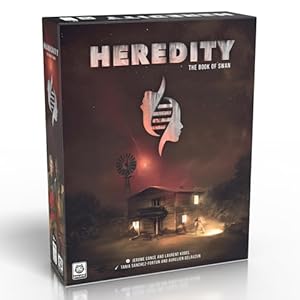
Heredity: The Book of Swan
I love narrative adventures, but the genre is overloaded with giant campaign boxes that promise the world and then ask for a lifestyle commitment. Heredity does the opposite: it delivers a full, satisfying post-apocalyptic story in five chapters, with a compact footprint and a pace that makes finishing it feel realistic. By the time I hit the final mission, I didn’t just feel like I’d played a campaign—I felt like I’d lived one.
What makes it special is how cleanly the system drives the story without drowning you in rules. You’re controlling a family of four, and the game’s timeline creates constant tension: you can act in whatever order makes sense, but events are always creeping closer. Your characters aren’t just “health bars,” either—damage literally steals your options by blocking action spaces, which turns every hit into a hard choice. Add in equipment that slots into body sections, map exploration that unfolds in cards, and the karma deck that can swing outcomes in dramatic ways, and you get an engine that’s smooth, thematic, and endlessly readable at the table.
But the real reason it’s my 2025 standout is that it earns its narrative with meaningful decisions. Heredity isn’t just combat-and-loot with flavor text; it constantly asks what you’re willing to do to keep the family human. Violence can be efficient, and sometimes unavoidable, but the game repeatedly rewards curiosity, clue-hunting, and restraint—often in ways that pay off later when a past choice comes back around. Chapters don’t feel like reskinned missions, either; the scenarios evolve so much that after chapter two I genuinely wondered if I was still playing the same game (in the best way). It’s rare for a board game story to hit twists and turns this confidently without the system wobbling underneath it.
Even with minor flaws—some typos, occasional “did I miss a condition?” moments, and a few fiddly tokens—the experience is a near-perfect intersection of storytelling and gameplay. By the end, I cared about these characters, felt the weight of decisions I made, and had that exact “tabletop RPG drama” feeling where every check matters and every outcome leaves a mark. It’s the kind of game that makes you immediately want to compare notes with someone else who played it—and then reset everything to see a whole new set of outcomes. If 2025 taught me anything, it’s that you don’t need a giant box to tell a giant story—you just need a design this smart.