Symbiosis – Justin Bell
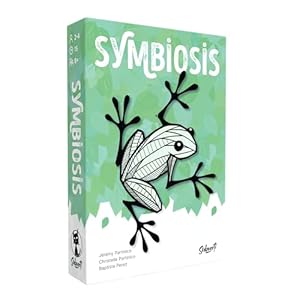
When it comes to a quick, easy-to-teach tile-laying/tableau building game in the vein of games such as Castle Combo or a more recent title like Pondscape, I just want something cool to look at while I place or flip cards to score points based on the conditions in my play area. Symbiosis is fine, even above average, at that task, while adding one wrinkle to the build of a 2×4 grid of cards: you are forced to care about what your neighbor is building, giving the game a chance at slightly more player interaction than other comparable titles.
On a turn, players take one of the four face-up cards from a market, then swap it with one of the cards in their personal grid of cards. The four inner cards are scoring conditions tied to your final grid layout…but the two cards on either edge score based on what your neighbor to that side of your play area is doing. So, placing a card in your upper left corner that scores two points for other pink cards can be huge if the neighbor to your left is going hard on playing pink cards.
Scoring is easy, as is the one-page teach from the rulebook. Our play took six minutes, after a one-minute teach and two minutes to run around the table and score. For a 10-minute exercise, Symbiosis is interesting, and it’s a game I am more likely to try with family over the holidays than the core gamers in my playgroups. One production callout: the clean, large tarot cards are perfect, because it is so easy to stare at other play areas to see what your neighbors are going for.
Ease of entry?
★★★★★ – No sweat
Would I play it again?
★★★☆☆ – Wouldn’t suggest it, but would happily play it
Read more articles from Justin Bell.
Batam – Thomas Wells
Playte has been re-releasing old Stefan Dorra games like crazy, and Batam is a redo of a game called Tonga Bonga, which doesn’t sound like it’s a super respectful nod toward Tonga, but what the heck do I know?
Anyway, the game is a deliver game (no pickup) where you move ships around a hex map to try and drop cubes off for money, which is your points. The catch is that at the beginning of a round, you place money on your personal player placard to attract the dice of other players. Huh? Well, everyone has three dice they roll and place on other players’ placards, the sum of which determines the total movement for that player for that round. So, you’re making offers for hypothetical high-rolling dice, which will result in the other players getting paid for giving you big numbers.
Overall, it’s a zippy and fun race game with some interesting decisions, and on top of that, die roll luck is almost completely mitigated through the sheer volume of rerolls you can do for very small amounts of money. A great opening game that keeps everyone engaged as you count out the necessary number of hexes to get maximum cash.
Ease of entry?
★★★★★ – No sweat
Would I play it again?
★★★☆☆ – Wouldn’t suggest it, but would happily play it
Read more articles from Thomas Wells.
Graphic Novel Adventures: Season 5 – Kevin Brantley
Did you know Van Ryder Games produced more than just board games? I certainly didn’t! Graphic Novel Adventures is a collection of gamebooks featuring gorgeous artwork, offering players an analog puzzle adventure that takes around 1–2 hours to complete. This box set contains five new adventures, each offering a different theme and variety of puzzles.
- The Obsidian – Take command of a mercenary army in the middle of a medieval war. You’ll make strategic decisions, navigate betrayals, and lead your troops into battle as rival rulers fight for control.
- Sherlock Holmes: Darkness Over London – Put on your detective hat as Sherlock Holmes or Dr. Watson and work through three interconnected mysteries. Gather clues, question suspects, and uncover a larger conspiracy lurking beneath the streets of London.
- Sherlock Holmes: Supernatural – Holmes and Watson return, this time alongside supernatural investigator Thomas Carnacki. Three strange cases have you investigating seemingly paranormal events while trying to figure out whether something otherworldly is actually going on.
- Zombie – The zombie apocalypse is upon us, but this time you get to experience both sides of the outbreak. Play as Judy, a human survivor trying to stay alive, or Ben, a zombie looking for his next meal. Each perspective offers a different take on navigating a town overrun by the undead.
- Zone 25 – In a post-apocalyptic world where robots have taken over, you play as Carl, a survivor forced to leave the safety of his underground bunker. Your goal is to find a cure for a mysterious disease while dealing with hostile machines and whatever remains of humanity.
These books were a nice change of pace from your typical board game, offering puzzles of varying difficulty, with some adventures leaning more heavily into a traditional “choose your own adventure” style narrative. While a few puzzles left me scratching my head, the solutions generally felt logical and well thought out, which isn’t always a guarantee with gamebooks.
The story quality varies from book to book, and not every adventure is a masterpiece. I personally enjoyed Zone 25 and Zombie more than the Sherlock Holmes adventures, mainly because I’ve seen the Holmes detective formula done better in titles like Sherlock Holmes: Consulting Detective. That’s not to say the Sherlock adventures are bad, but they didn’t quite capture the same sense of discovery and intrigue I was hoping for.
If you’re into gamebooks or simply looking for a different flavor of analog gaming, the Graphic Novel Adventures series offers a nice little experience. Luckily, the books are also sold separately, so you can gravitate toward whichever theme interests you the most. It’s not something I see myself returning to often, but there’s a solid few hours of entertainment tucked between these pages.
Ease of entry?
★★★★☆ – The odd bump or two
Would I play it again?:
★★★☆☆ – Wouldn’t suggest it, but would happily play it
Read more articles from Kevin Brantley.
Bamboo Smash – Justin Bell
My favorite thing about the games published by the Ares Games umbrella is the sheer range of wargames and battlers they put into the market. Bamboo Smash, an Ares release through the Pendragon label that I picked up at Gen Con, is a silly race to “summon” two Pandemons—yes, evil-looking pandas—by placing matching color clan cards on a set of totem spaces and battling opponents by smashing rivals.
There are curses, steal actions, power-ups, and even battle chants that must be recited each time a Pandemon is summoned, adding to the shenanigans on display during this 30-minute tableau-building race. The gameplay is snappy, and action cards that can be added to smash actions make for lightly dramatic fare. But the luck-based nature of the summon action means that a player might be able to steal a matching color card to win before a player summons even their first Pandemon, leading all players to wonder if a game like this will consistently work for a playgroup.
Bamboo Smash has a bunch of great illustrations by The Donatz, and teaching this to almost anyone should take about five minutes, despite a 20-page instruction manual. I thought the commentary after our first play was telling: “silly, fun, and not a game I expect to ever play again” was the general consensus, so I’ll keep Bamboo Smash around for my kids to try at some point. I really like the fact that battles are table-wide, so no one player is targeted during each smash…and those action cards feature many ways to flip the rules on who will win each battle.
Ease of entry?
★★★★★ – No sweat
Would I play it again?
★★★☆☆ – Wouldn’t suggest it, but would happily play it
Read more articles from Justin Bell.

Dicey Waters – Thomas Wells
Dicey Waters is a Farkle or “bar dice” variant that doesn’t really have much to say for itself, mainly because the aforementioned games often encourage you to bet some actual money to be interesting. It’s just not that cool to throw 100 hands of dice and count faces without something to sweeten the pot.
You roll 8 custom dice, and you can reroll as many times as you like, with two caveats: you cannot reroll skulls, and you must reroll at least 2 dice. You can also reroll dice you saved. Sets of same-faced dice score points, while gold/diamond faces score additional points in addition to the sets they form. Skulls, when you get 4, cause you to bust and pass your turn. If you roll 4 on your first turn, you get to keep rolling to score zero points, but each additional skull you roll loses everyone else 100 points.
There are also cards that give you a little special rule at the beginning of your turn. In spite of all that, it’s just rolling lots of dice with no strategic considerations or risk calculations, because ultimately, in a game to EIGHT THOUSAND POINTS, there’s no escaping the tedium of the exercise. A game can take 10 minutes, or a full hour! Just play Farkle with pennies or something, yuck.
Ease of entry?
★★★★★ – No sweat
Would I play it again?
☆☆☆☆☆ – No chance
Read more articles from Thomas Wells.