Arkham Travel Guide – Justin Bell
I’ve now played the En Route gaming system—designed by Daniili Zaitsev, who also uses the pen name Dan Lièvre—nearly a dozen times, between plays of En Route: Special Edition through Innsmouth Travel Guide, the second game in the Travel Guide series. I recently got in a couple plays of Arkham Travel Guide, and although these are different games, they scratch the same itch: elevated roll-and-write (or flip-and-write, using En Route’s base system), higher interaction, high-score affairs, perfect for solo play or exactly three players thanks to the game’s dice choice system that gets all players involved. (En Route was one of my top 10 games from 2025.)
This time around, players have to guide tourists around a 6×6 grid of Arkham, with a final route that scores the most points. There are four choices of “Old Ones”, boss characters which change the scoring rules for a given game, along with in-round bonuses if players hit specific spaces during their turn. All the hallmarks of the series remain: personal objectives, boosting scores by running routes along the appropriately-colored city blocks if players can get matching tourists, 10 rounds, solo challenges, a 30-to-40-minute playtime.
The ending of Arkham Travel Guide might turn some players off, because a die roll is required at the end of play and coming up with a bad roll could actually lead to a player not being eligible to score their board. Outside of that extreme example, Arkham Travel Guide mostly works…but, it’s a system that I’ve seen a bunch now. I continue to gravitate back to the original En Route, thanks to the variety in the Special Edition version of that box. The Travel Guide productions are tidy, fitting into a very handy, very mobile, plastic case that holds everything a player needs. While I still recommend these titles, En Route is the best of them, and that’s a great place to start for new players.
Ease of entry?
★★★★☆ – The odd bump or two
Would I play it again?
★★★★☆ – Would like to play it again
Read more articles from Justin Bell.

Wingspan: Hummingbird Module – K. David Ladage
While attending the Congress of Gamers convention this time, I had an opportunity to play two 4-player games of Wingspan. The first included everything that has been released for the game with the exception of the new hummingbird module, the second put them into the mix as well. Both games were a lot of fun!
The first game is not what this mini-review is about, but I wanted to say something: this was the tightest game of Wingspan I have ever played. Literally, one point separated first place and last place. I won that game by one point against a three-way tie for second place. It was glorious!
The next day, we added the final module: the hummingbird spaces to the player boards, the hummingbird garden, and the hummingbird deck. At first, I was not sure if I was going to like this. But after about three turns of hummingbirds fluttering into and out of each player’s player board, I could not only see the appeal, but I realized I would not be playing this game in the future without these little guys! They are amazing!
Yes, I know this mini-review is about the hummingbird module…but there was a thing that hit all of us as we were playing. The various expansions (most especially the addition of nectar) has altered many things about the game. For example, given how plentiful nectar is on the dice, it seems that the 2-for-1 exchange you can make to pay for a bird when playing it is not something that needs to exist any longer. And while we are on it, between the dice and the hummingbirds… we all agreed that nectar might be just a bit too plentiful. For example, all four of us had well over 100 points that last game. I had six birds on my board that required three food to purchase and I never felt that any of those was difficult to get into play.
Ease of entry?
★★★★★ – No sweat
Would I play it again?
★★★★★ – Will definitely play it again
Read more articles from K. David Ladage.

Whistle Stop: Rocky Mountains Expansion – Justin Bell
I busted out my train game hat and got Whistle Stop: Rocky Mountains Expansion to the table with the review crew. I enjoyed the base game and was curious what, if anything, the expansion (released one year later, in 2018) brought to the experience. As it turned out, my big takeaway is that Rocky Mountains slows the game down quite a bit, from a potential train rush where players try to scoot their trains west as quickly as possible to end-game scoring tiles and now spend more times in the middle of the map, which as grown by three columns and includes more ways for players to build up their mid-game economy, grab upgrade tiles, and build track that could help players navigate a better route to the tiles they really want.
I’m always a fan of expansions that add more stuff without adding more complexity…and, for anyone who has played Whistle Stop, adding Rocky Mountains will amount to a very quick two-minute overview to get new players acclimated. In fact, this is also the type of expansion that can be added for new players even during their first play, which I normally don’t subscribe to. For this first play, I introduced three new players to the game, and everyone was dueling until the end, when sneaky stock majorities arrived and boosted one winner to a decisive victory.
The downside with Rocky Mountains is the playtime. With five players, you could knock out the base game in an hour. With this expansion, our four-player game (granted, with three new players) took a hair under two hours, without any meaningful yield on new goodies. That’s too long for a game where you might take just one or two actions to move a train westward one measly space in a given round, and this is also the kind of game where downtime can stack up with more deliberate players around you. While this does take away a player’s ability to rush their first train or two to the finish line before anyone else, I still think Whistle Stop: Rocky Mountains Expansion is for Whistle Stop superfans only. For me, I’ll keep the content handy but continue to stick with the base game for a more efficient, lively experience.
Ease of entry?
★★★★☆ – The odd bump or two
Would I play it again?
★★☆☆☆ – Would play again but would rather play something else
Read more articles from Justin Bell.
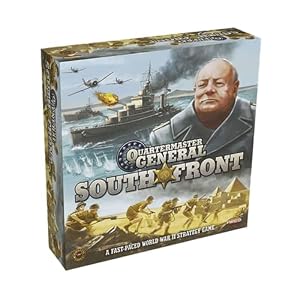
Quartermaster General: South Front – Joseph Buszek
I have really enjoyed the games I’ve played in the Quartermaster General series from Ares Games. I tend to agree with fellow Meeple Mountain contributor Justin Bell who, in his review of Quartermaster General: East Front, mentions how well the game works especially for those with minimal wargaming experience. I was surprised at the depth of strategic, card-driven, area control, and supply line mechanics it packed in a quarter of the time of heavier war games. Given that Quartermaster General: South Front is a more direct sequel to the 2-player-only East Front (as opposed to QG:WW2, which plays up to six), I was looking forward to what additions it had in store for me when it hit the table.
Right off the bat, the rulebook boasts that all the key rules from East Front are unchanged in South Front, and that the biggest difference is each player has only one action per turn, so it actually plays quicker. I can tell you now that one of those things is true: the game plays pretty much like East Front. The new rules for aircraft carriers and naval transport (which is the most significant change from previous games in the series) adds a pretty hefty amount of game time to the play. Fleets have their own separate rules for combat now, a full page of rules on how (and when) to actually use the fleet and carriers to load, transport, and unload other units, plus specific naval cards that will otherwise be useless in your hand outside of very specific scenarios.
After a few plays, all of which got bogged down with checking and re-checking the rulebook for these naval combat rules, none of my games was under two hours in length, removing what was, for me, is the biggest selling point of the series, highlighted right on the front of each box: “A Fast-Paced World War II Strategy Game”. None of the new naval elements or card powers increase the gameplay experience so much that it’s worth the extra time and rules to get through. While South Front doesn’t spoil what is, otherwise, a very solid series, it’s definitely a misstep and one that I would not recommend.
Ease of entry?
★★★☆☆ – There were a few questions
Would I play it again?
★★☆☆☆ – Would play again but would rather play something else
Read more articles from Joseph Buszek.

Zombie Princess – Justin Bell
Our man Mark Iradian is hard at work on a full review of Zombie Princess, but I was still able to play a copy of the game during a recent game night…and, sadly, Zombie Princess is no Rebel Princess. They are both, however, deluxe in every way. Like the packaging for Rebel Princess, Zombie Princess (which I believe comes in both a Deluxe and a Standard edition) has all the fixins, including new skull tokens and coins used to count bids for players during a round. And, just like Rebel Princess, a host of different Princess power tiles are handed out in Zombie Princess, so each player has a power that can be triggered at just the right moment or has an ongoing power that can be used at any time.
Zombie Princess is the card game classic Spades, so, if you played Spades every night for years in college (me), the game is not only easy to teach, but it brings back some of the great memories of those college years…at least, until you have to sift through the rules. This is a weird thing to say, but I was surprised at how hard a time we had parsing the rules for Zombie Princess because there are so many ways to “make” your bid. In Spades, teams of two players play until meeting a certain points threshold. Although players will try to make their individual bids, only the team bid counts at the end in Spades, unless one player bids “nil” (zero) and commits to a round where they will not take any tricks. But even in teams, each individual player has to make their bid in Zombie Princess…and there are a ton of ways to make your bid, whether you overbid, underbid, or bid JUSSSST right.
This made all of us feel like Zombie Princess is “Baby’s First Spades”; for a newer player, this might prove to be a handsome on-ramp. For a seasoned Spades player, you’ll want to skip this because you’re going to struggle just as much as I did to figure out how to win tricks. Also, the Princess powers here were all over the map. A mini-expansion Princess, The Little Mermaid, can only be used in Teams games (Zombie Princess does accommodate solo Spades play), but pushes players to ask a question of their partner that must be answered with a single-word answer. Absolutely broken, in a game where you shouldn’t be able to say to your partner “Got any Princes [Spades] left?” and they can answer with a yes or a no! Other Princess powers, such as Schererazade, weren’t used once during our four-round game. Here’s the most telling takeaway from Zombie Princess, compared to its recent predecessor: I’ve stopped playing Hearts and now only play Rebel Princess…and I’ll don’t think I will ever play Zombie Princess again, because I’d rather whip out a standard 52-card deck and play Spades.
Ease of entry?
★★★★★ – No sweat
Would I play it again?
★★☆☆☆ – Would play again but would rather play something else
Read more articles from Justin Bell.