
Yogi – Justin Bell
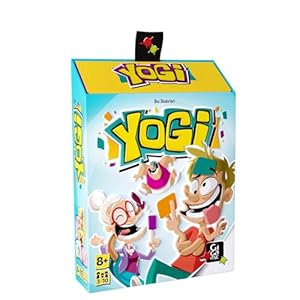
I picked up a pile of party games from our friends at Gigamic at SPIEL Essen 2025. One of those was Yogi, a new release with 60 cards, a simple set of rules, and an interesting note: the rules indicate that the cards are waterproof.
Why should that matter? Yogi is a ridiculous time at the table that asks players to simply draw a card and follow all the rules on that card. That might mean ongoing rules for the rest of the game, like “each time you draw a card, sing the words printed on that card” or “compliment another player at the table before you take your next turn.” Many more are physical, like holding your elbow above your shoulders while tucking a card underneath your chin before drawing a card, but only with a certain hand.
If a player can’t keep up, they immediately lose the game, and remaining players keep going until only one remains. Is Yogi a game? I think so, but it’s a game that is a little hard to monitor, judge, rule, etc. because the conditions stack in crazy ways. When my son won our first family game, even he wasn’t sure if he should have been named the winner. “I had fun, but I feel like we need a referee,” he said after securing the win. In some games, you might bow out after your second or third card, while other players might have the stamina to last longer. As a one-off play, it wasn’t bad, but Twister might be the easier game to table and the one that generates the funnier series of memories. As a short game of physical challenges, Yogi ain’t bad.
Ease of entry?
★★★★★ – No sweat
Would I play it again?
★★★☆☆ – Wouldn’t suggest it, but would happily play it
Read more articles from Justin Bell.
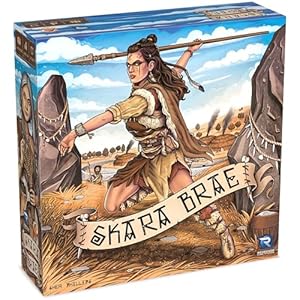
Skara Brae – David McMillan
Skara Brae, part of Garphill Games’s Ancient Anthology line of games, drops its players, five thousand years in the past, into the Orkney Islands of Northern Scotland where they will compete to build the best settlement. In this particular village, generations of settlers discarded their waste into midden heaps which broke down over time, and were eventually dug into to create shelter for future generations.
In the game, the players must balance the needs of growing their settlement whilst also managing the waste which such rapid growth produces. Players will take turns drafting cards from a lineup to add to their personal tableau. These cards produce goods which must be stored on their player boards. Then, they will use their workers to take actions to convert these goods into other things such as shelter or food for their people. As their storage fills up, it begins to produce midden which cannot be used for anything and just takes up a lot of space. If it isn’t dealt with by the game’s end, it will cost the players a lot of points, and there’s A LOT of midden produced over the course of the game.
Whereas most games only give you 3 or 4 resource types to contend with, Skara Brae gives you a whopping 16, so your storage fills up quickly and keeping it tidy becomes a bit of a challenge. Couple the need to keep things clean with the need to expand (which is where most of the points you’ll need to win the game come from), and you’ve got a recipe for an intensely engaging game.
I enjoyed my first playthrough, although it did start to feel like I was on rails for the last few turns of the game. Aside from the initial card draft, there’s not any player interaction, so there’s not much you can do to influence your opponents’ fortunes (or misfortunes). Still, it’s a well designed game, and it was engaging enough that I can see it hitting the table again soon.
Ease of entry?
★★★★☆ – The odd bump or two
Would I play it again?
★★★★★ – Will definitely play it again
Read more articles from David McMillan.

3 Chapters – Bob Pazehoski, Jr.
I love card drafting as a sole mechanism. Games like 7 Wonders and Sushi Go Party! thrive by passing cards over and again. I also love card drafting as the driver of some other central action—games like Bunny Kingdom that employ the cards for selection and fortification on a central map. I’m finding that I also love games that involve a draft at the outset as a means of revealing and selecting the cards involved in the game. Surrealist Dinner Party comes to mind as one I thoroughly enjoy. Enter 3 Chapters, the small box card game from Amigo.
Chapter one is the draft, in which players pass cards to select a hand that they will employ for the remaining rounds. Chapter two is a trick-taker where the highest number card wins a prize, but cards are often played more for their side-hustle than their number. Various effects trigger at the trick, granting bonuses regardless of the outcome. Where 3 Chapters stands apart, however, is in the fact that cards are retained even after the trick for the denouement. The final chapter is played in-house, with each player’s cards riffing on one another for yet one more set of rewards. For a game that hardly exceeds 15 minutes, the depth here is charming.
Adding to the charm is the theme. Familiar fairy tale characters lend life and personality to every play. We learned the game and played twice in no time, and I’d be ready to play again if I had the chance. I don’t find the cover art particularly inviting, but everything inside the box makes 3 Chapters a solid choice.
Read our review of 3 Chapters.
Ease of entry?
★★★★★ – No sweat
Would I play it again?
★★★★★ – Will definitely play it again
Read more articles from Bob Pazehoski, Jr.

3 of a Kind – Kevin Brantley
I’m always searching for party games that are accessible but don’t insult your intelligence. In today’s gaming world, party games often fall under a reskin of either Codenames or Cards Against Humanity. Every now and then, a new entry comes into the fold that gives a fresh spin on the party genre.
In 3 of a Kind, players try to guess things that fall into a category’s three adjectives. The kicker is that points are scored for matching answers, so everyone is channeling their inner psychic abilities. However, the adjectives can be a bit offbeat for the category. Grocery aisles, you say? Should be easy! But then you’re listing three aisles that match Most Romantic, Most Likely to Win in a Fight, and Classiest. Not so easy anymore, eh?
By the way, the most romantic aisle in the grocery store is obviously the bakery.
There are moments of excitement when multiple matches occur, and points scale up with the number of players who match. It makes for great table talk afterward, especially when trying to explain how players came up with their answers.
It’s a goofy but fun little word game that doesn’t overstay its welcome. The game creates wacky associations that reward creative thinking (and hopefully, the others are thinking the same way!).
In a sea of party games, this one is solid. I’d recommend cycling it in during your next family game night.
Ease of entry?:
★★★★★ – No sweat
Would I play it again?:
★★★☆☆ – Wouldn’t suggest it, but would happily play it
Read more articles from Kevin Brantley.

Ra and Write – Andrew Lynch
Makes sense to me, to turn a set collection tile game into a roll & write. Set collection in general is an easy match for roll & writes, whose quests to check off boxes and fill columns are basically set collection by a different name. Thing is, Ra, one of Reiner Knizia’s masterpieces, is first and foremost an auction game. The set collection aspect is how you get to scoring, but it isn’t the meat and bones of the gameplay. Ra & Write keeps the set collection, but chucks the ability to take chances, get messy, and make mistakes straight out the window. Instead of a game whose endpoint is in part a result of the risks you and your fellow players have taken over the course of the round, Ra and Write is a game that goes until it…doesn’t. It isn’t “push your luck” so much as it’s “good luck!” That’s much less fun.
Ease of entry?:
★★★★★ – No sweat
Would I play it again?:
★★☆☆☆ – Would play again but would rather play something else
Read more articles from Andrew Lynch.