Disclosure: Meeple Mountain received a free copy of this product in exchange for an honest, unbiased review. This review is not intended to be an endorsement.

I’m an easy mark for Rosetta, publisher DVC’s entry in the spontaneous language creation subgenre. It tickles the same part of my brain as Gibberers, which is a brilliant and singular experience, but Rosetta is much more approachable. Gibberers is a game in which you create a language and speak only in that language. It demands a good deal of time and the space for a tremendous cognitive load. Rosetta is significantly faster, and, rather than create and speak a new language, you work together to decode a logographic writing system for a language you never once have to speak.
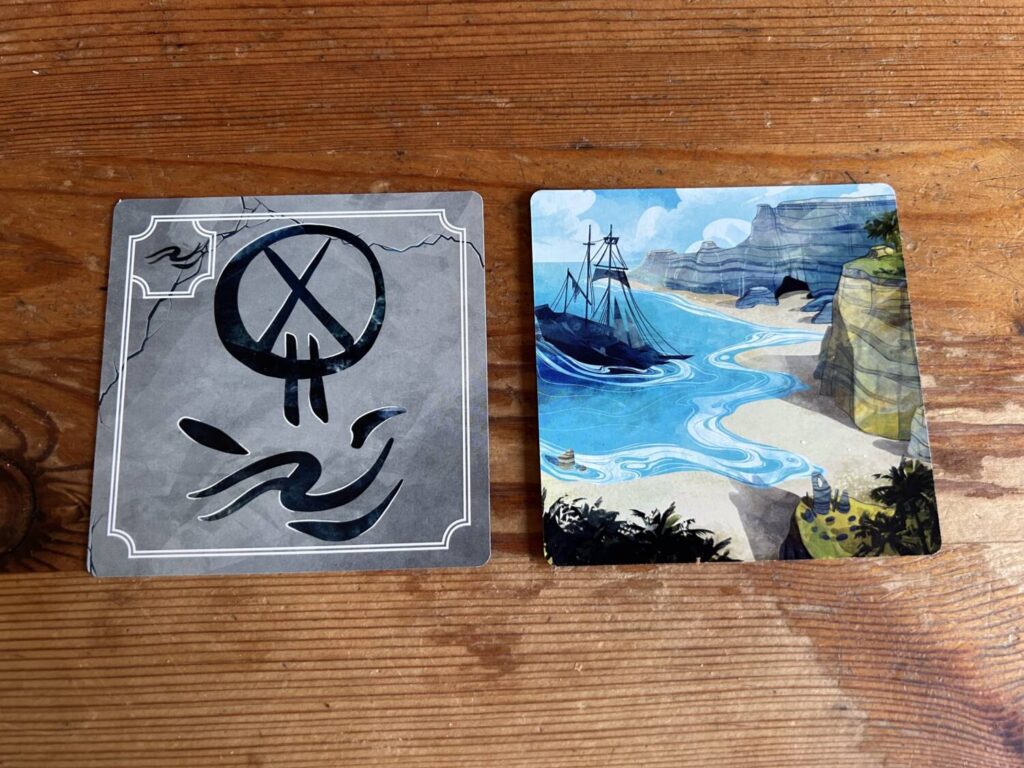
One player takes on the role of the Author, the voice—albeit a mute one—of the lost civilization with which this writing system originated. They draw a random Inscription and Location, and set both out on the table for all to see. The Location is there for inspiration and to provide a little bit of context and grounding. The Author secretly picks a meaning for the Inscription associated with what they see in the landscape. You can’t pick something that is visible on the Location card, though it’s best to choose something directly related to what you see. A field of wheat may lead the Author to choose “farmer.” A snowy mountain might suggest “avalanche.”
At this point, everyone else at the table starts making guesses. The current Expert, as the rulebook calls all non-Author players, writes a word on a card. This word is their guess for what the Inscription means. If the guess is right, the group wins. Most likely, it’ll be wrong, but then it becomes a question of how wrong.
This is when Rosetta becomes a test of creativity on the part of the Author. It’s not a role for everybody. You know how people have strong feelings about being the clue giver in Codenames, be those feelings positive or negative? Players quickly form similar stances in the crucible of Rosetta. When an Expert submits a card with an incorrect guess, it is up to the Author to create the Inscription that would denote the guessed word, and to do so in a way that will lead players towards the correct interpretation.
How do you do that? Through cunning usage of radicals. If you’ve ever spent time learning about the Chinese writing system, which is also used in Japanese, this will be a familiar concept. A radical is a portion of a logogram that lends some amount of independent meaning to the whole. Take for example one of my favorite Japanese words, 証人, “witness.” See how the first character, “証,” is made up of two chunks, to the left and to the right? Each of those is a radical. The radical to the left, “言,” connotes ideas related to speech. It’s in the characters for “language (語),” “speak (話),” and so on. The second character, ”正,” appears in words that have to do with justice, honesty, and accuracy. A witness, then, is a person (人) who speaks the truth. Hopefully, anyway.
To play well as the Author, for Rosetta as a whole to be at all satisfying for all of the players, everyone has to think of the Inscription as a similar series of interwoven smaller concepts. The game becomes a wonderful mix of deduction and improvisation.
Say this is the combination of Inscription and Location:
The first Expert guesses “Pirate,” and receives the following Inscription in response:
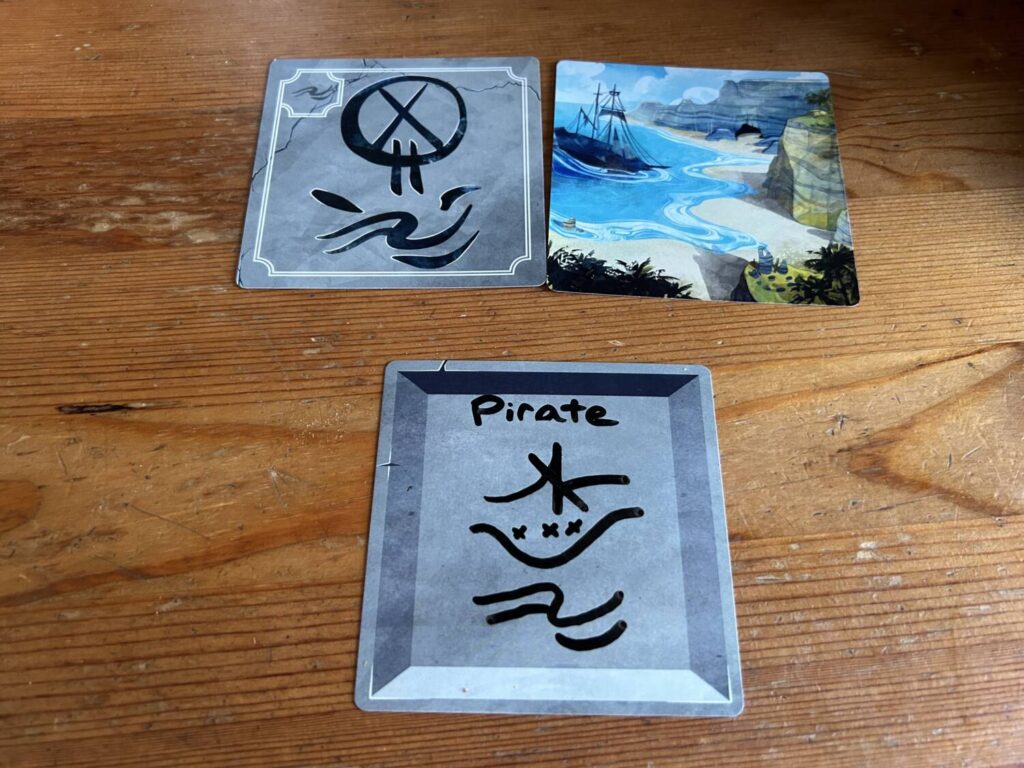
There are two radicals repeated from the first Inscription; the swirls at the bottom, and the X in the circle, which now appears in triplicate along the middle of what we can safely assume is a boat with sails. These give the Experts something to work with. If they wanted to, they could guess “Water” to confirm their suspicion that the swirls are water, or “Boat,” to confirm that the inverted bellcurve is what it appears to be, but both of those feel pretty obvious at this point.
Without a solid guess as to the final answer, the next Expert decides it would be helpful to see what makes a pirate different from a sailor:
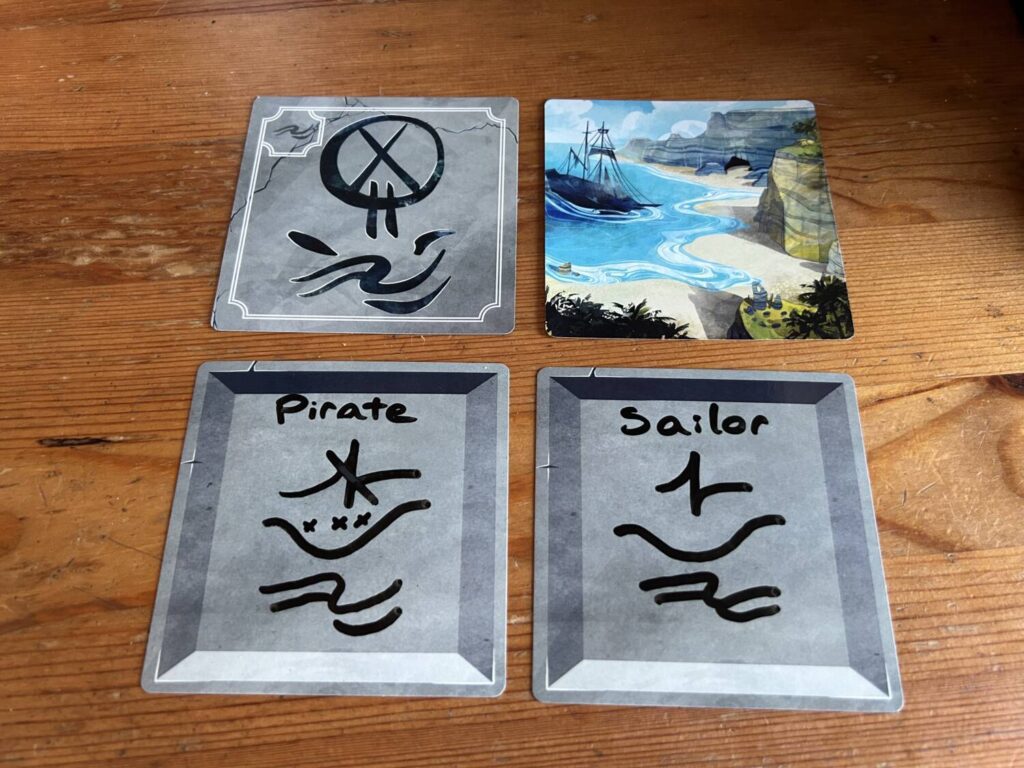
No cross line, and no Xs.
At this point, perhaps inexplicably, let’s say the next Expert guesses “Person.” That may seem nonsequitorial, but those kinds of guesses do happen, and in this case it provides a nice illustration of the flexibility available to the Author:
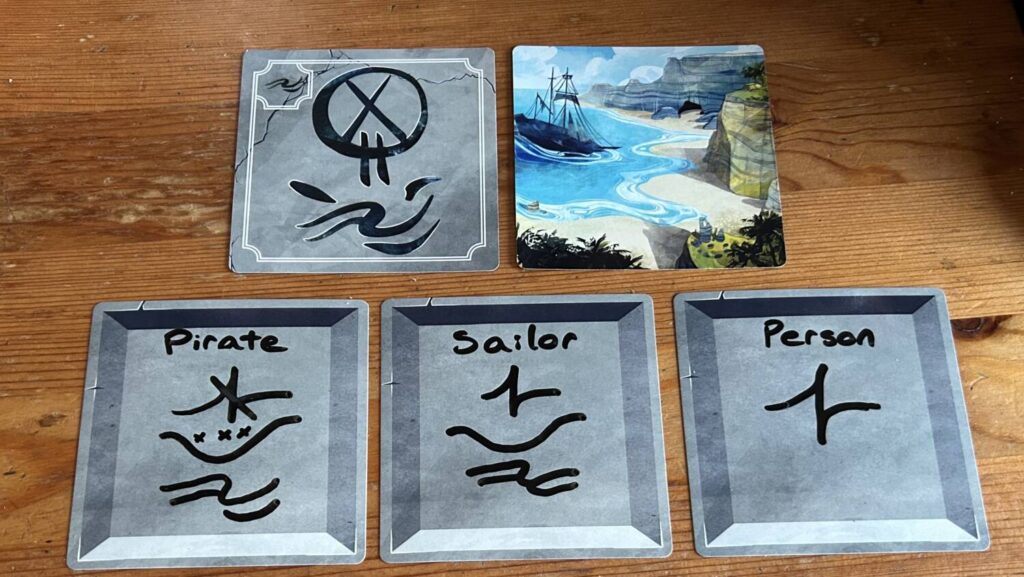
I didn’t draw “pirate” or “sailor” intending for that top flourish to be “person”; it was a sail. But I realized it could be a person, and why not?
After the third guess, the Author gets to use one of two ability cards they drew at the beginning of the game. Ours reveals a card that says “Choose the category of the meaning below” and points to “Tool.” So now we know the Inscription is a tool of some kind. Weapons are a tool, and the Xs for “Pirate” are positioned like cannons, so let’s try that:
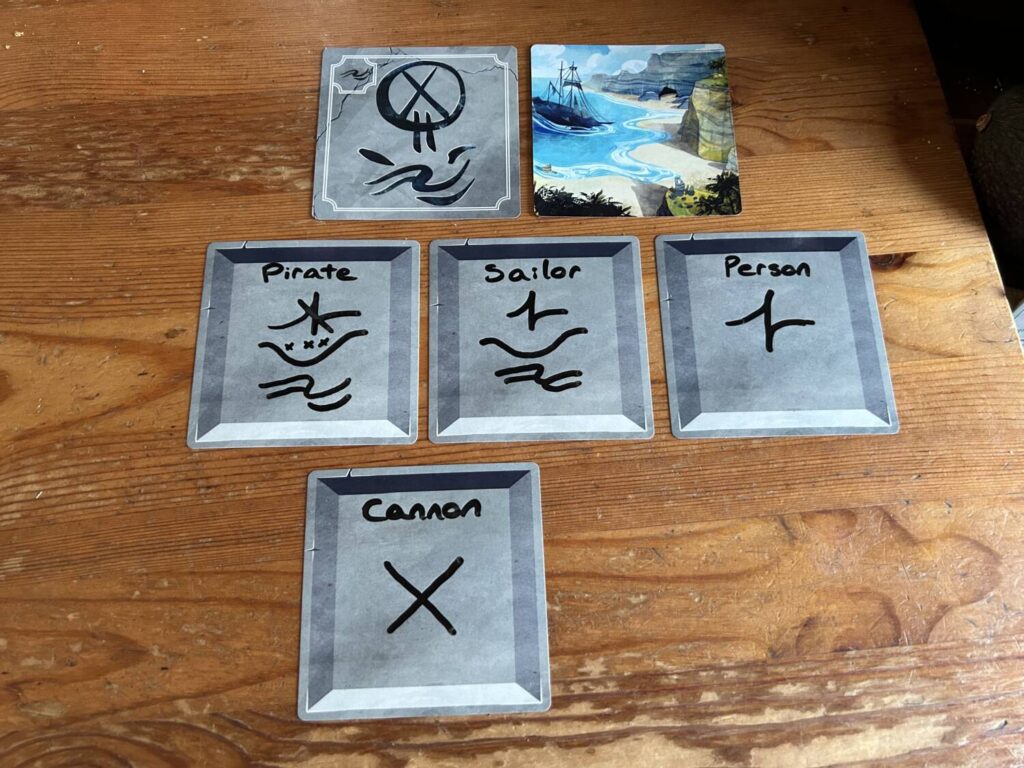
And so the process goes, until someone either gets it right or the group runs out of guesses. Through careful shepherding, the Author can lead the Experts to all sorts of fun discoveries. Through careful inquiry, the Experts can push the Author into moments of invention.
This is something that DVC does incredibly well, games that require one player to be the odd man out without them feeling left out. Signal and Here Lies put one person in the driver’s seat, give that player all the answers, and yet that player is always given the same opportunity to play as the others. They can display creativity and discover just as much as the players who are entirely in the dark. That’s a hard thing to do. Rosetta does it magnificently.
It was “Cannonball,” by the way.