Disclosure: Meeple Mountain received a free copy of this product in exchange for an honest, unbiased review. This review is not intended to be an endorsement.
Scales of Fate is a strange beast, an uneasy marriage of strategy, bluffing, and deduction. It gets points for originality, ambition, and aesthetic, but I’m not sold on the whole. It’s like eating a cake in which you can taste the eggs separate from the flower and the sugar. Worse than that, none of the elements feel fully baked.
Each player is secretly assigned two Demigods out of a pool of nine. Your goal, over the course of the game, is to manipulate their Renown through clever use of the Quest and Action tiles on the board. You’re also trying to suss out your opponent’s two assignees, but we’ll come back to that.
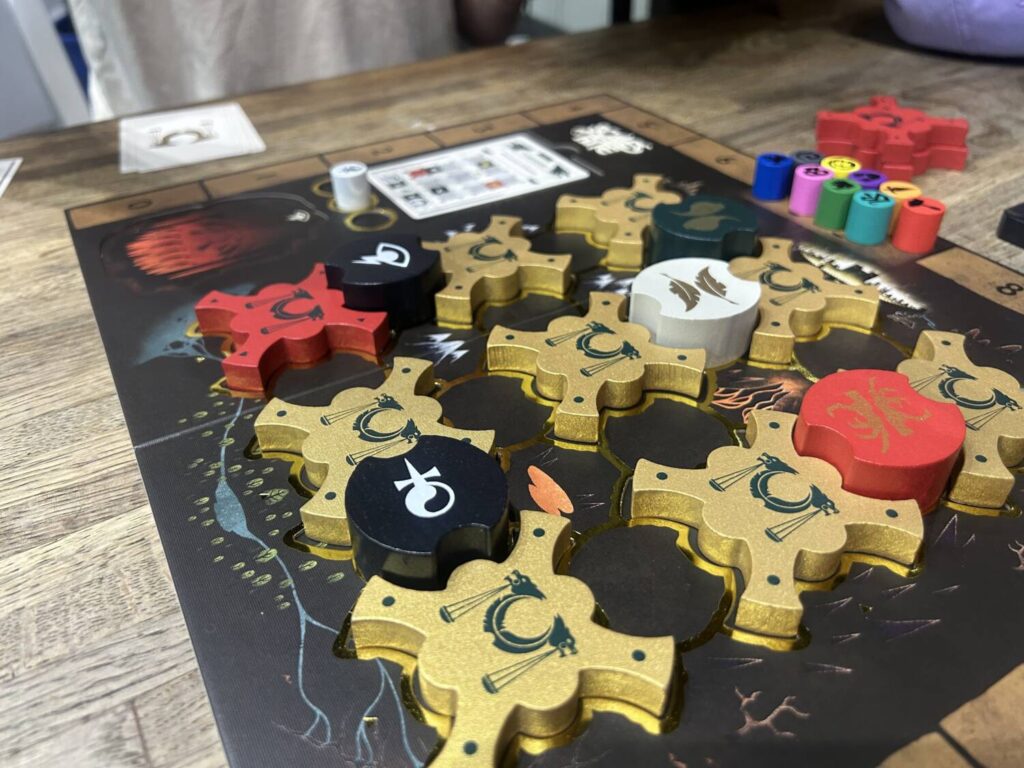
Scales of Fate is hard to explain without a visual of the board, so let’s get that out of the way:
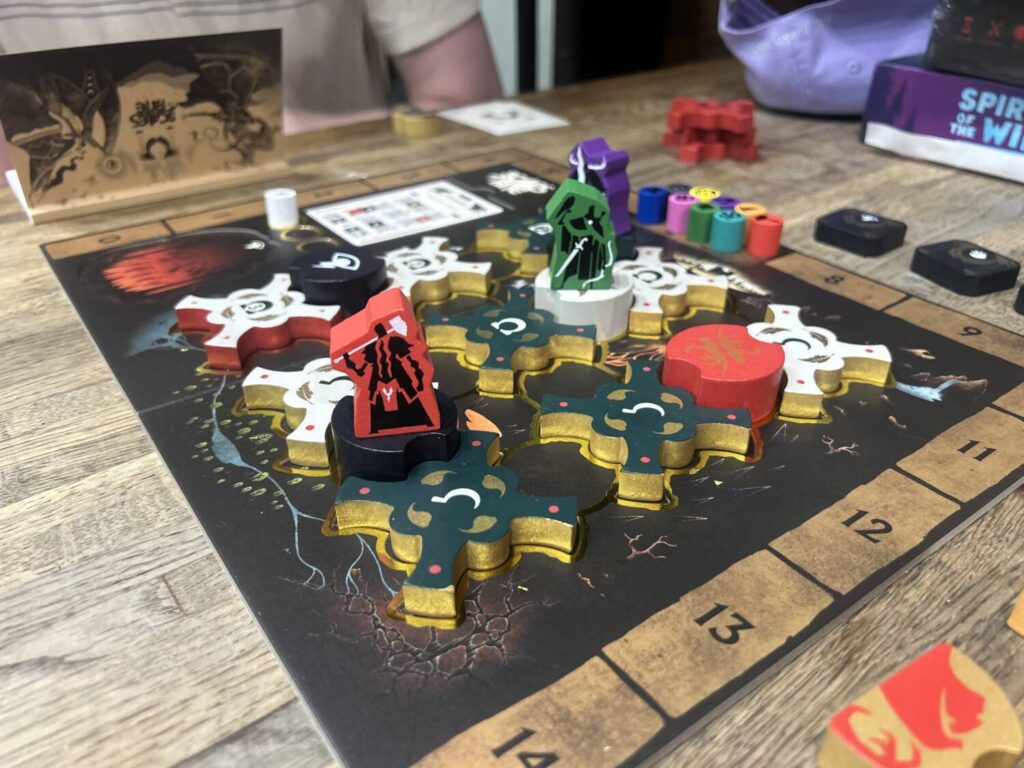 The big X-shaped pieces are Quest Tiles. The smaller in-betweeny pieces are Action Tiles. Those golden pieces you see to the lower right of the photo are Servants. I usually shy away from foisting this kind of nomenclature on my readers, but here it’s necessary. As we begin this journey together, remember that everything in the game comes back to increasing or decreasing a Demigod’s Renown.
On your turn, you can either place any one Demigod onto an Action Tile, place a Servant along the edge of any row or column, or use a God Power. Placing a Demigod lets you perform the action indicated on the tile, whether that’s claiming a Servant, sending an unplaced Demigod to the Abyss, or deciding what happens to the Demigods in said Abyss.
Beyond the action itself, players also need to keep track of what Quests are adjacent to the Action Tiles where they place their Demigods. Quests come in two shades, white and green, and those colors are not incidental. When the white or green Servant is placed along the outside of the board, they activate all the matching Quests in that row or column. Every adjacent Demigod gains and/or loses the indicated amount of Renown.
You can now see the puzzle start to take shape. You want, in theory, to place your own Demigods around the board in such a way that they gain Renown when Servants activate the different Quests, but it’s not as simple as that; you are trying throughout all of this to keep the identities of your Demigods a secret from your opponent.
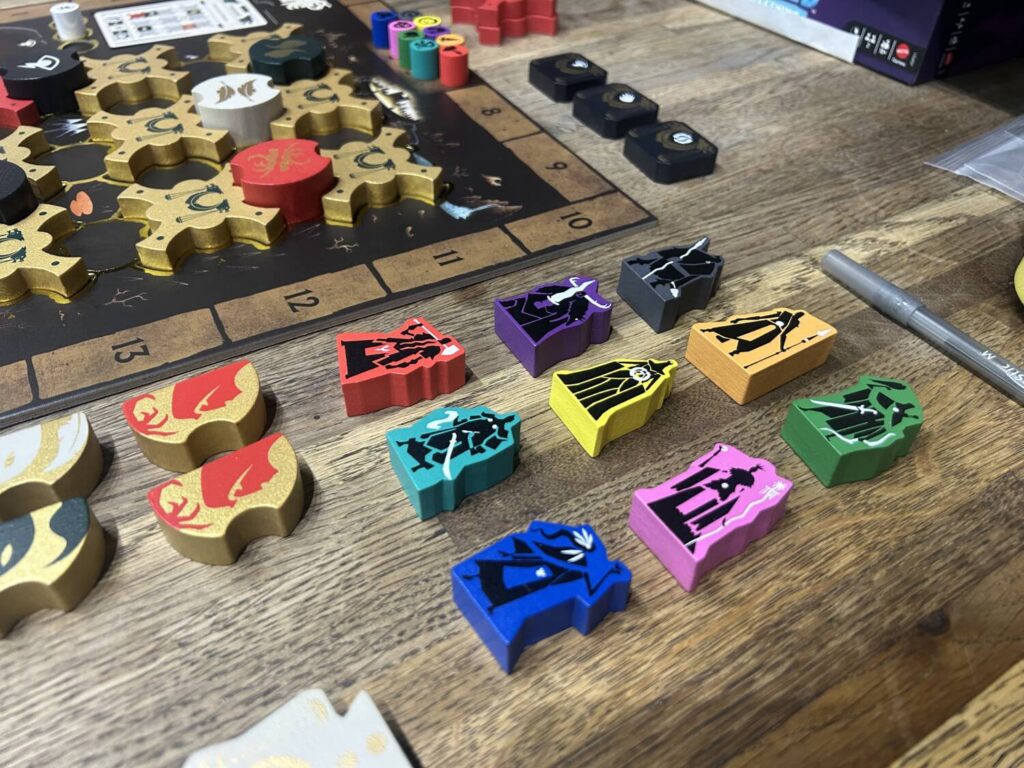
It is generally to your benefit to keep their identities a secret, of course. If I know who your Demigods are, I’ll place them in disadvantageous locations around the board. But there are also specific reasons for wanting to do so: Scales of Fate includes a deductive element. Come the end of the game, you score points if you can correctly identify one or both of your opponent’s Demigods. You even lose a point if you can’t identify either.
To assist players in their sleuthing, each round includes a yes-or-no question that has to be answered before the next round can begin. Do either of your Demigods have between 6-10 points, are any of them in the Abyss, that sort of thing. And scoring gives some indication too. If your two Demigods end up with the same Renown come the end of the game, you score points equal to their Renown. If they don’t end up together, you score points equal to the difference in their positions.
This creates the theoretical framework for a fun game of cat/cat-and-mouse/mouse. In a game where you had more control or more actions, that might work. The action economy and the duration of the game are both so tight that you aren’t left with much in the way of wiggle room.
None of Scales of Fate quite works for me. The placement puzzle is a little too dry and procedural. Incorporating deduction elements is a smart idea, a clever way to try and add an extra layer to those placements, but accurate deductions are so under-valued in scoring—three points for identifying both—that they become an after-thought. It’s almost very cute. I almost find myself obfuscating, ducking, dodging. I can see a world in which this game sings for the right people. I’m not one of those people, unfortunately.