
What is the problem?
I love games. That statement should be an obvious truth, given that I regularly write for Meeple Mountain. Some of the games that I love have, over time, lost their luster. It is not that my tastes have shifted, or that I have joined the cult of the new. It is that, to some degree, the game has been solved, in the sense that they have a single dominant or obviously correct strategy.
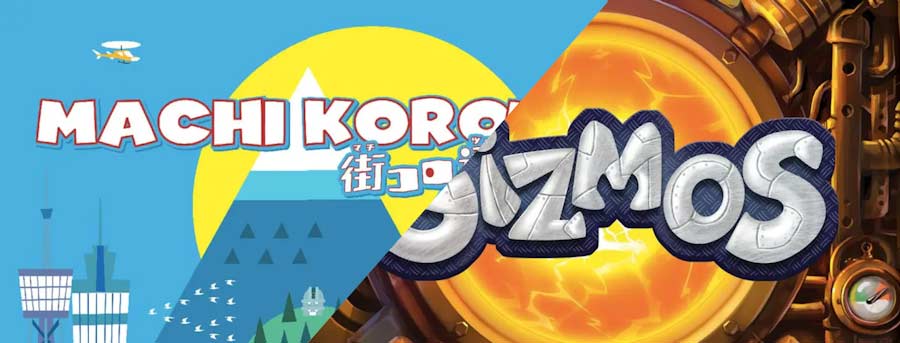
If you were around in the first couple of months after Machi Koro came out, there were several people on the innerwebs (especially on BoardGameGeek) discussing the order in which you should purchase the properties. A couple of games after reading those articles and it was rather obvious they were right. Machi Koro has had some expansions over the years and managed some attempts to fix the issue (such as no longer showing all cards in the market). This created a slew of other issues. To their credit, Machi Koro 2 did move forward some.
If you enjoy the game Gizmos and you spend any time on Board Game Arena playing the people who are rated with a 300+ ELO, you will quickly find that there exists one and only one strategy employed by high-rated players. If you aren’t constantly focusing on the cards that get you energy when you build, then you will quickly fall behind those who do.
And there are others. Many others.
In these games, if you play against people who know the singular working strategy, you will lose. Very often you will not just lose; you will be stuck in a game where each and every turn feels like a time-warp where you have been given a front-row seat to painfully watch yourself lose in slow motion. Nothing you do will stifle it, unless you also learn and employ this singular working strategy.
Be honest: how much fun can that possibly be? If everyone knows the strategy, then the game is reduced to being the first player—or in some games, a series of pure, blind turns of luck—that allows one player to gather the needed parts of the strategy before others do.
At that point, it would be less frustrating to just flip a coin.
Side Note
There is an argument that can be made that Splendor is also like this. The seemingly singular strategy employed here is more subtle and nuanced. Thus, when I wrote about this, my colleagues suggested that I was simply describing knowing how to play Splendor well. I am not so arrogant as to dismiss such thoughts, especially when they come from people I greatly respect. When I play those who have a 300+ ELO rating, they appear—to me—to be employing a singular strategy. This could very well be caused by my lack of skill at the game. So I will continue to play and see what I can learn. To the Meeple Mountain team: thank you all for keeping me alert to my own biases!
House Rules?
In my youth, if the rules of a game were broken in some way, there was little you could do other than to come up with house rules. The problem with this solution is that, unless you understand the game in a truly fundamental way, you are likely to break something else, making the game even worse.
For example: there are many people over the years who have used the Free Parking house rule in Monopoly. This house rule sometimes starts with $500 of seed money in the center of the board. Then, anytime someone has to pay money to the bank (not to another player), that money is added to the seed money. This continues until someone lands on Free Parking (a space that was designed to do nothing) and they collect all the money in the center. Then, $500 of seed money is added back in and the game continues.
No other rules are changed – there are still auctions and the like. Besides, this rule seems innocuous enough until you dig under the hood of the game and realize that the $200 you get for passing GO is meant to be the only open-element in an otherwise closed economy. Introducing the Free Parking house rule does not generally alter the outcome, it just delays it. Sometimes for hours—painful and excruciating hours for those who are looking at a player with the majority of the property all loaded with a bunch of hotels…
House rules are band-aids at best; they are salt in the wounds at worst.

Is there a Solution?
We live in an incredible age of board gaming plenty! In my youth, the idea of a board game with expansions or second editions was relegated to the dark and musty corners of a few isolated (and often obscure) wargame publishers. But today we get expansions and new editions all the time. With each expansion or new edition comes the opportunity to tweak this and fix that. This is something that I love about Stonemeier Games: with some of their games, they have taken the time to collect data about the games people play and use that data to adjust things in the future.
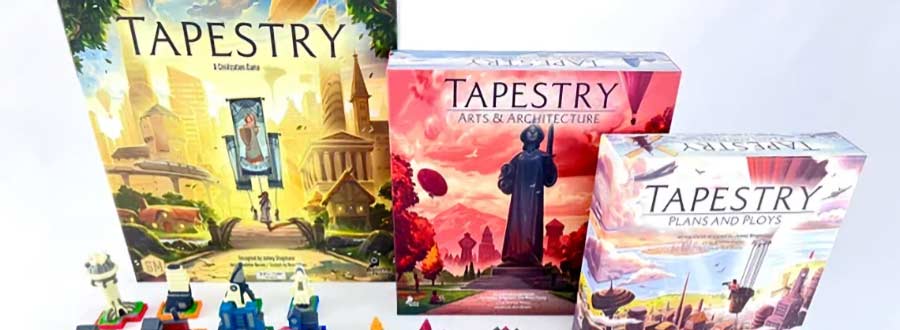
For example: the game Tapestry is a wonderful and fun experience at any player count. Jamey Stegmaier recognized early on that in such a game—one with variable player powers—it was possible that no matter how much playtesting they did, one or more factions could be too powerful or too weak compared to others. On their website, they had a place where people who played the game could record their results with data like the number of players, which faction won, what was the score, and so on. This data was collected and used to make a downloadable sheet that allowed you to adjust some things for each faction to better balance things.
In the end, once all the factions and expansions were released, they finalized all the data they had collected and released a product called the Revised Civ Pack. This is a set of replacements for the civilizations in the game, adjusting them to their final, far more balanced states. Future printings have included these sheets as the default, but the company did not want those who had been there from the beginning having to replace their old copies of everything.
So what does this mean?
Every board game company is different. But I think that in this aspect most of them should follow Stonemaier Games’ lead. Board Game Arena has a lot of games, and if you want, you can go back and review just about any game you like to see what happened. If this data is something that game designers and publishers can gain access to, this seems like a resource of incalculable value! If the people in charge of Machi Koro, Gizmos, and others could look at the fact that the games have become flat, they could release updated rules, updated components, or new editions that seek to correct things.
Obviously, there is the issue of costs and risks. If the game is not popular enough to generate sales of an expansion or a second edition, this will create issues. And this is a spiral that many games may never be able to escape. Even so, I think a lot of games could use some tender loving care to adjust them into a game that lasts for generations.
- Consider, for a moment, the game Carcassonne. In the initial editions, the way farmers scored was quite different from the way they score today. One small tweak in the rules, and a complex rule was simplified and streamlined.
- Consider, if you will, Magic: The Gathering. Many powers and abilities have been removed from the game because they were confusing players (e.g. Banding), or retooled into other abilities when it was shown that the ability did not work in an intuitive way (e.g., Fading became Vanishing).
- Andrew Holmes, an individual whose opinions I hold in very high regard, recently wrote about chess and the fact that it has had many alterations of its rules over the centuries. Chess has seen changes in how the pawns move, how the queens move, and introduced castling at different points in its 1,500-year lifespan.
I think that any game which suffers from balance issues or counter-intuitive rules or has been reduced to a single working strategy could, with good data, be adjusted, modified, or—yes—fixed to become a game we can continue to enjoy for decades (or even centuries) to come. I mean, it worked for chess. And as Andrew Holmes points out, there are many games available today that are better. Seems like we could tweak a few of those and have a plethora of games that will be enjoyed a millennia or two from now. I wrote an article on games that (in my opinion) are almost perfect, any of those could be tweaked a bit for the next century. My game group and I love(d) the game Princes of Florence. That essentially ended when my friend Mike (the one with the Ph.D. in Applied Mathematics) calculated the exact value of a Jester for every turn of the game. Auctions became boring and predictable.
The point, in the end, is the fact that we live in a time of board game plenty. This means that the playtesting of a game cannot detect what a few million rabid fans can find in the few weeks after a game’s launch. This should not result in a death-knell! Thank those players, see what needs to happen, make the needed adjustments, and ensure that this is a game which stands the test of time.