
Hello and welcome to ‘Focused on Feld’. In this series of reviews, I am working my way through Stefan Feld’s entire catalogue. Over the years, I have hunted down and collected every title he has ever put out. Needless to say, I’m a fan of his work. I’m such a fan, in fact, that when I noticed there were no active Stefan Feld fan groups on Facebook, I created one of my own.
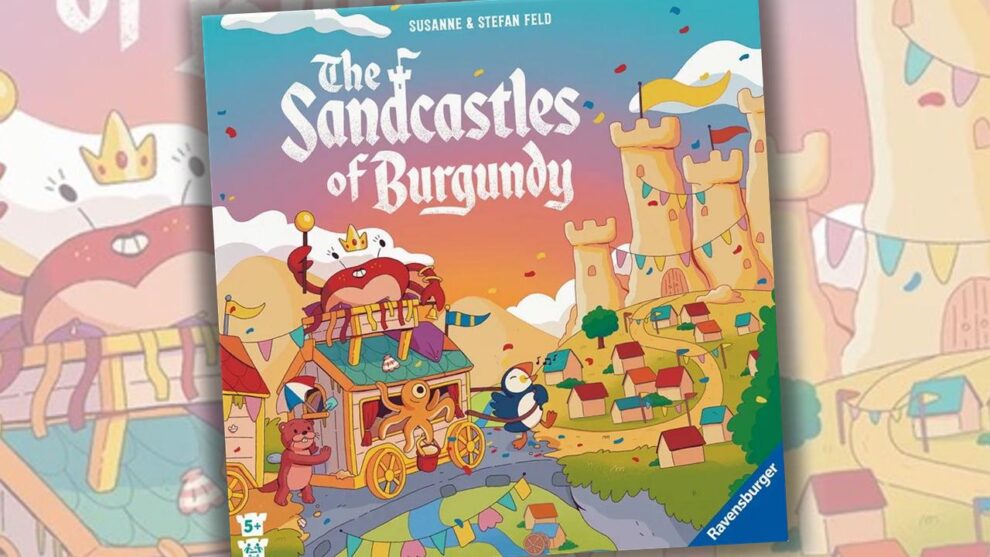
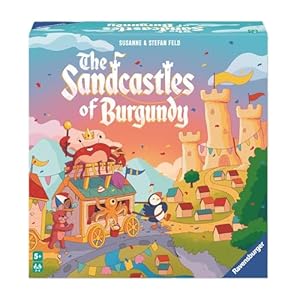
Today we’re going to talk about 2025’s The Sandcastles of Burgundy, his 44th game. The Sandcastles of Burgundy (Sandcastles) stands out from all of Stefan Feld’s other designs in two notable ways. Firstly, this is Feld’s first foray into designing a children’s game. Secondly, this is Feld’s first co-design with his wife Susanne who, as an elementary school teacher, brings her professional experience with children to bear, working with Feld to simplify the game down into the experience it is today.
In Sandcastles, a foreign dignitary, Queen Crab, has announced her intention to come visit your kingdom. As a way to show her gratitude for you being such a gracious host, she has sent ahead some beach-themed decorations from her kingdom and has asked that you decorate your village in preparation for a beach party that she plans to throw when she arrives. Sandcastles is a race to the finish. Players start at the starting line and try to become the first to reach Queen Crab at the finish. Each decoration placed into a player’s villager moves them one step closer to victory.
The story is very thin and the connection to The Castles of Burgundy’s (CoB) theme is tangential at best. Still, some of the mechanical elements are present in both. In CoB, you’re using your dice to collect tiles and place those tiles into your estate in order to score points. Those things exist in Sandcastles, but unlike CoB, the tiles in Sandcastles do not have special powers and abilities attributed to them. Hence, the action in Sandcastles isn’t focused on the way the tiles interact with one another as much as it is about the race around the board and the slow motion shell game, sitting front and center, that accompanies it.
How It’s Played
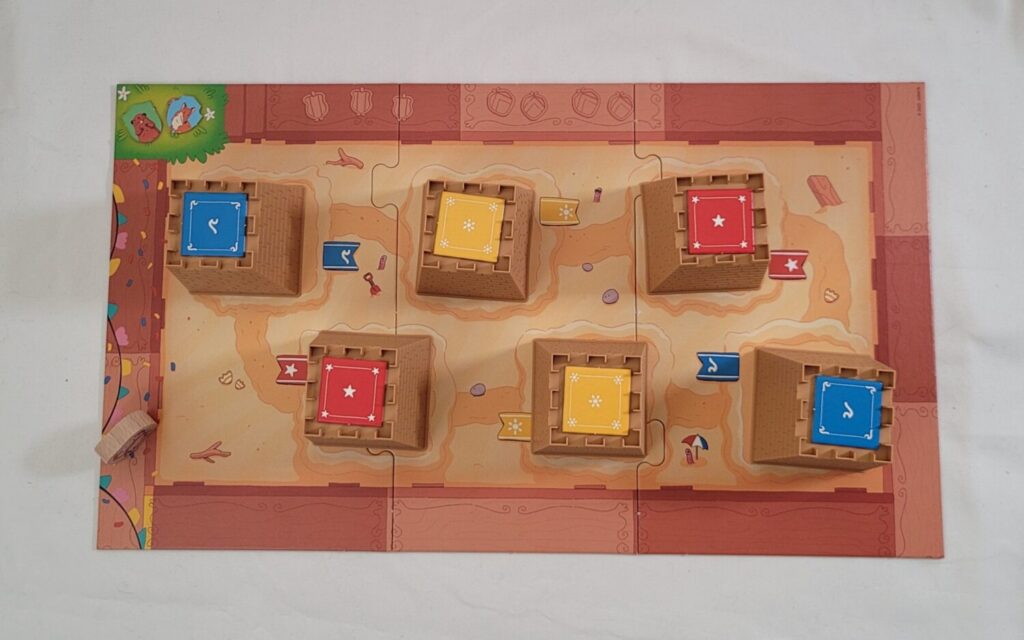
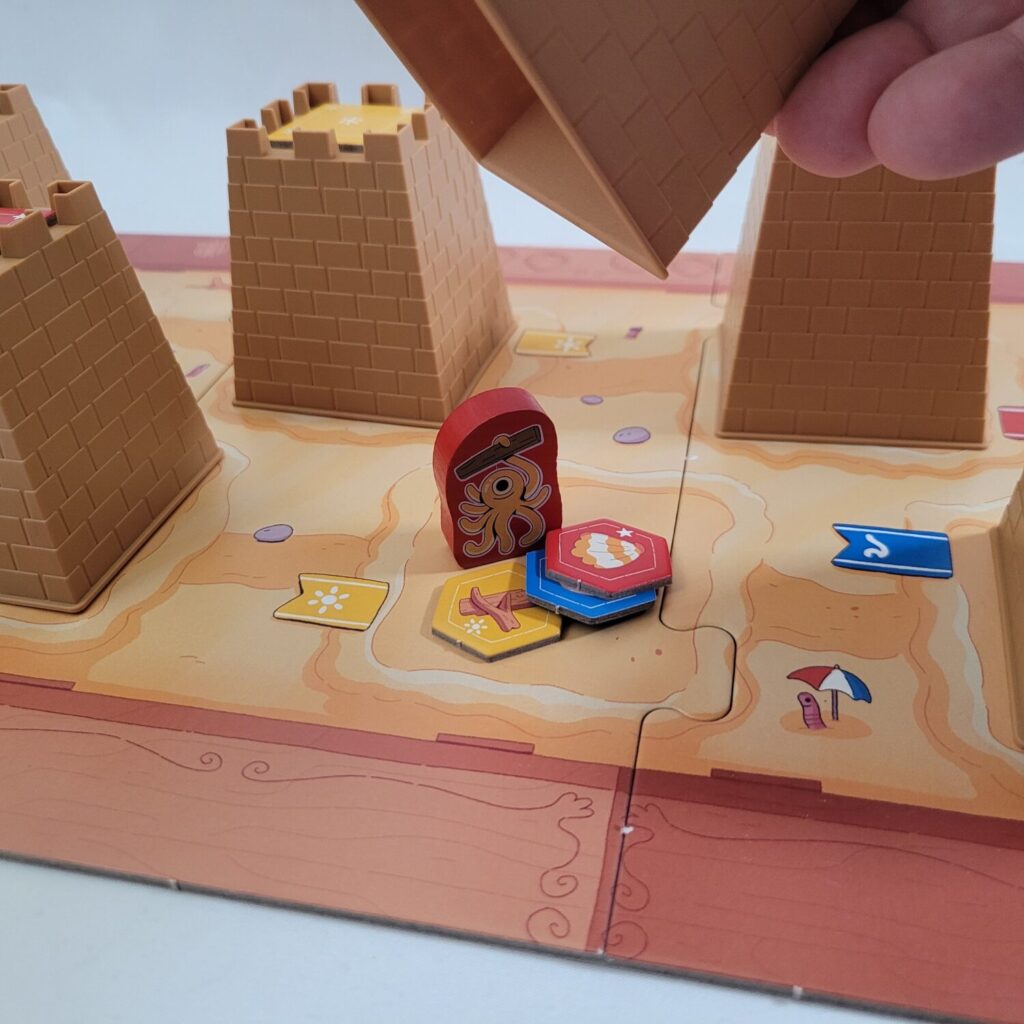
In Sandcastles, there is a central board containing six plastic sandcastles. Each of these castles is representative of a specific color—red, blue, or yellow. During setup, a number of decoration tiles of each color (red, blue, or yellow), equal to two times the number of players, are shuffled together into a pile. This pile is divided into six even groups, and each group is hidden beneath a different sandcastle. There are also three animal figures (a red octopus, a blue otter, and a yellow puffin) randomly placed beneath three of the castles.
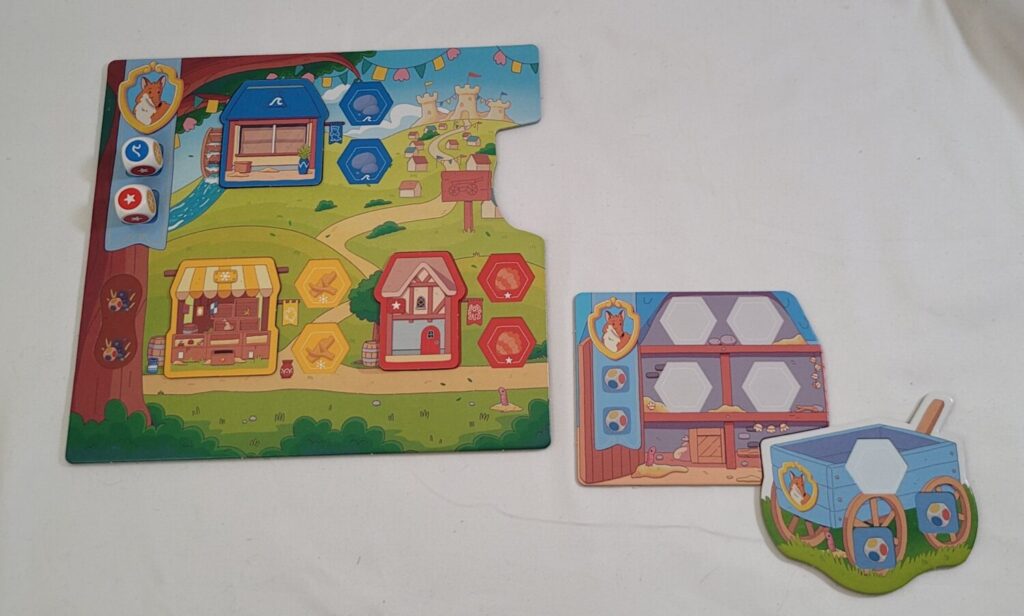
Each player selects a color and receives the player board, cart, storehouse, and coat of arms matching their color. They will also receive two dice and one of each type of shop (red, yellow, and blue). The shops are placed onto the player board in their marked positions, undecorated side face up. The coats of arms are placed onto their marked starting locations on the track that runs along the edge of the central board. The Roller Beetle tokens are set in a supply close by. Finally, the Queen Crab figurine is placed at the finish line, a starting player is selected and receives the Bucket tile, and you’re ready to go.
At the beginning of a round, each player rolls their dice. Then, in player order, players take turns selecting one of their dice to perform one of two possible actions: search for decorations or transport a decoration to their village. After they have performed their action, the next player takes their turn, then the next, and so on until it returns to them. Then, they use their second die to perform their second action. Once all players have used both of their dice, the round ends, the Bucket passes to the next player in line, and a new round begins.
When searching for a decoration, the player picks up one of the sandcastles matching the color of the pip on their selected die and looks beneath it. Then, they collect one of the decoration tiles there and move it to their storehouse, provided they haven’t previously collected two of that color. If there are no legal decorations to collect, they will take a Roller Beetle token instead. Roller Beetle tokens can be traded in during future actions to change a player’s die to a die face of their choice. If a player’s storehouse is already full they cannot take this action and must take the transport action instead.
During the searching action, a player may reveal one or more of the animal figures. If they have a valid spot in their village for the animal to move to, the animal will move there, scoring them a point (a single movement along the track on the central board). If they cannot accommodate the animal, then it moves and hides beneath one of the adjoining castles (their choice).
So, how does a player’s village accommodate an animal figure? The only way to add an animal figure to your village is to have a decorated shop matching the animal’s color. This is accomplished by using the transport action to deliver decoration tiles from their storehouse to their village. To transport, the player selects a die matching the color of the decoration tile they wish to add to their village. Then, that tile is placed into one of the matching spaces on their player board. This placement will earn them a point and a movement along the track. If the decoration tile is the second tile of this color added to their village, then the matching color shop tile will flip to its decorated side, earning the player a point and a movement along the track.
That’s it. That’s how you play. If you wish to add some extra complexity to your game, there’s an included mini-expansion that adds special powers the players can unlock by performing specific actions. The special powers allow you to do things like manipulating dice or other board elements. My family doesn’t play with this expansion very often, as we find the base game is challenging enough without it.
This is because of the challenge that arises from the need to be able to keep up with multiple pieces of information at the same time. As the game begins, things are fairly easy with almost every selected castle revealing viable decorations for you to collect. But, as those decorations start becoming more scarce, it becomes much more difficult to recall where a specific color was, and whether someone has already collected it. Add to this the constant shuffling of the animal figures, and you’ve got a real puzzler on your hands.
In a recent game that I played with my 7 year old, I was in a good position to win, one or two steps from the finish line with just a single decoration tile to collect and transport to get me to the finish line. He was several points behind me. However, because I couldn’t find that last stubborn decoration tile, he was able to catch up to, and surpass me, clinching the win. I’d been beaten fair and square and, despite the loss, it felt great. As soon as we finished that game, he asked me to set it up again for another play.
It’s hard to complain about a game that’s able to accomplish that. In this age of constant digital entertainment, it can be a challenge getting a child to put down their screens and sit down to play a board game. It can be especially challenging to find a game that has them wanting to play it again and again. And, that’s exactly what Sandcastles has done for this household. My kid loves it, and I love it, too.
Not bad for Feld’s first foray into kids’ games. If current success is any indicator of future success, I’m excited for what the future brings.
The Sandcastles of Burgundy details
- Designer: Stefan Feld, Susanne Feld
- Artists: Stefan Feld
- Publishers: Ravensburger
- Release Date: 2025
- Player count : 2 - 4
- Age range : 5+
- Time range : 20 minutes
- Mechanism(s): Dice Rolling, Matching, Memory, Set Collection
- BGG Geek Rating: 6.55052 - converted to Meeple Mountain scale: 3.5.
- More articles about The Sandcastles of Burgundy.