
Disclosure: Meeple Mountain received a free copy of this product in exchange for an honest, unbiased review. This review is not intended to be an endorsement.
My Nucleum journey has really been on the upswing.
When I reviewed the base game—released in 2023 by Board&Dice, designed by Simone Luciani and David Turczi—I had a lot of good things to say, but I wasn’t sure Nucleum was on the list of all-time classics. Now, about 15 plays in, I’ve landed on higher ground: this is some of the best medium-heavy strategy gaming out there, particularly perfect for fans of games that combine the best of Euro-style asymmetric power titles and route-building extravaganzas such as the Brass system (Age of Industry, Lancashire, and Birmingham).
Nucleum is something else. My love affair has only grown since late 2025, when the base game appeared in alpha on Board Game Arena. While a solo mode was not included in the first pass on alpha, it’s been easy to find multiplayer games with others who love the Nucleum system.
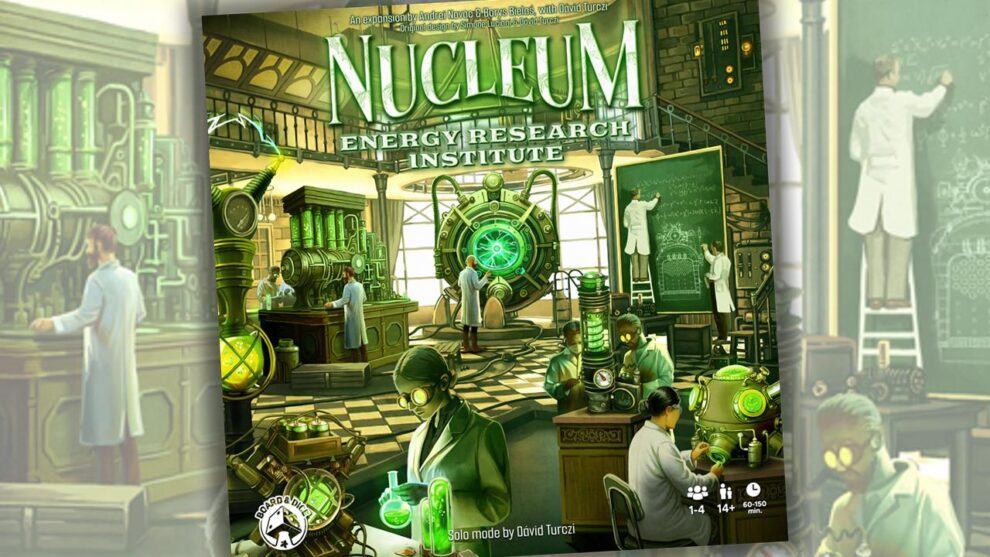
“I’ll make Nucleum expansions as long as [Board&Dice] keeps letting me,” Turczi told me during a conversation I had with him at SPIEL Essen 2025. “I love Nucleum.” Turczi, along with a team that includes Borys Bielaś and Andrei Novac, designed the latest expansion, Nucleum: Energy Research Institute. It’s an expansion that keeps things simple: Energy Research Institute is for Nucleum superfans, or those who think they will graduate to that level in the near future.
More Plus More Equals More
Nucleum: Energy Research Institute is an expansion for 1-4 players. The Nucleum base game is required for play. I will not be covering how the base game plays in this review; for that, please take a look at my review of the Nucleum base game.
The main draws here are twofold: eight new Experiments (each featuring at least 8 technologies) and Patron cards for all Experiments, including those from the base game and the Nucleum: Court of Progress expansion. There are also extra components included for each Experiment for players using Court of Progress as well as the Nucleum: Australia expansion.
The rulebook for Energy Research Institute includes an Expert variant that asks players to auction Experiments before each game. (This Expert variant is the same as the one used in other Nucleum formats.) With this variant, players lay out a number of Experiments equal to the number of players plus one, then players bid in victory points for the right to choose first, second, etc. from the pool of that game’s available Experiments. At the end of the game, the pre-game Experiment bids lower a player’s overall score.
This is more than a suggestion. In fact, the print is bolded in the manual: “We strongly recommend using the Expert Variant…for a balanced game play.”
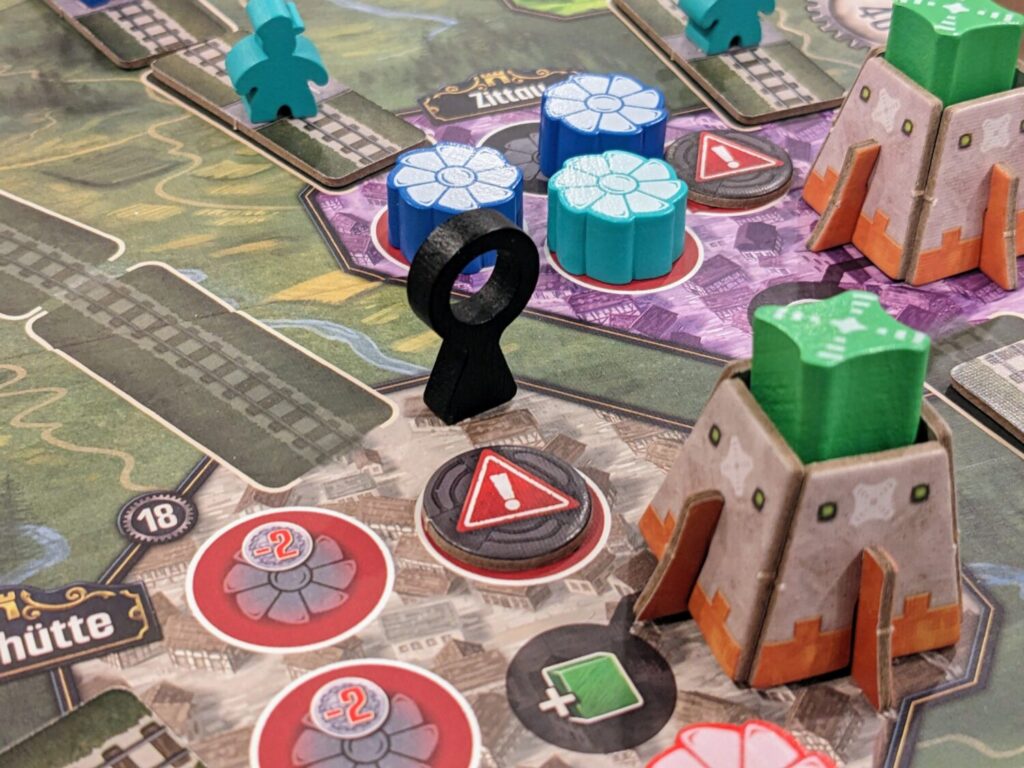
That’s because the designers know what I have now experienced: some of the Experiments in this expansion—especially in the hands of experienced players—are strictly better than some of the others. This is not to say that any of them are overpowered or unbalanced. But, if a very experienced player was able to draft one of these new Experiments without having to pay anything for it, that would set off a few alarms.
For this review, I did four plays with Energy Research Institute, including three plays on the base game map and one play with the Australia map. I played with the following Experiments: Experiment G (the Marketeer), Experiment I (Madame Governor), Experiment K (Genius), and Experiment N (Scholar). The Experiments are ranked in complexity, from one diamond to four, so I found it extremely helpful to use these rankings when considering which Experiments to include with each set of players who joined me for plays.
On that front, the new Experiments really delivered the goods.
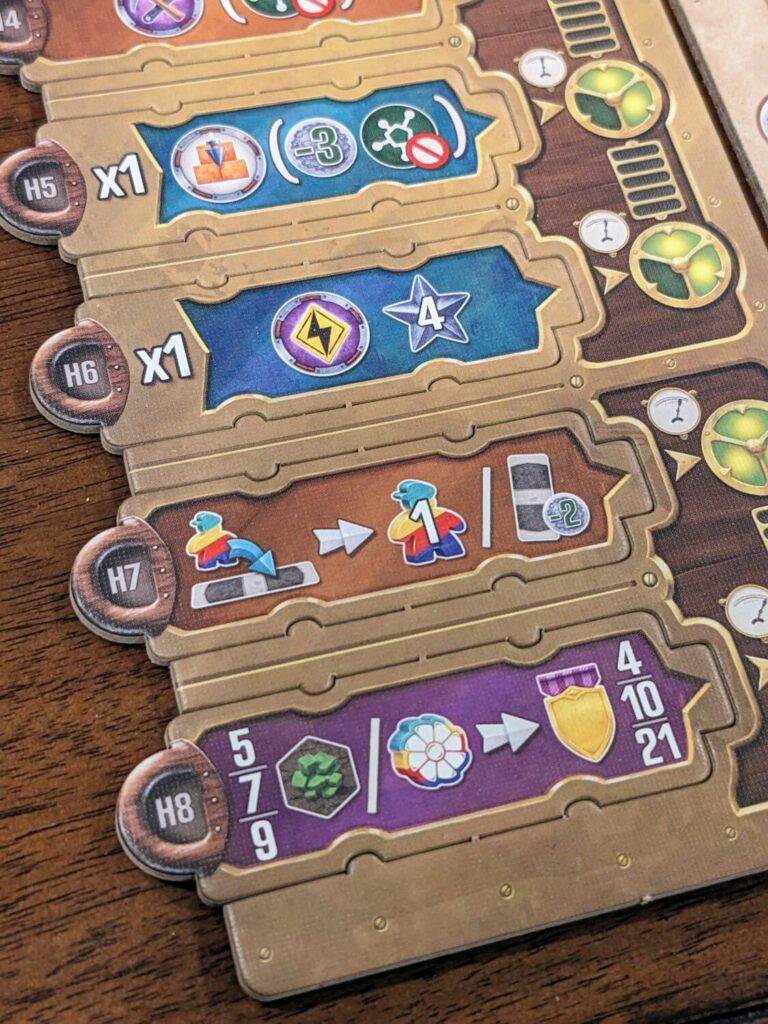
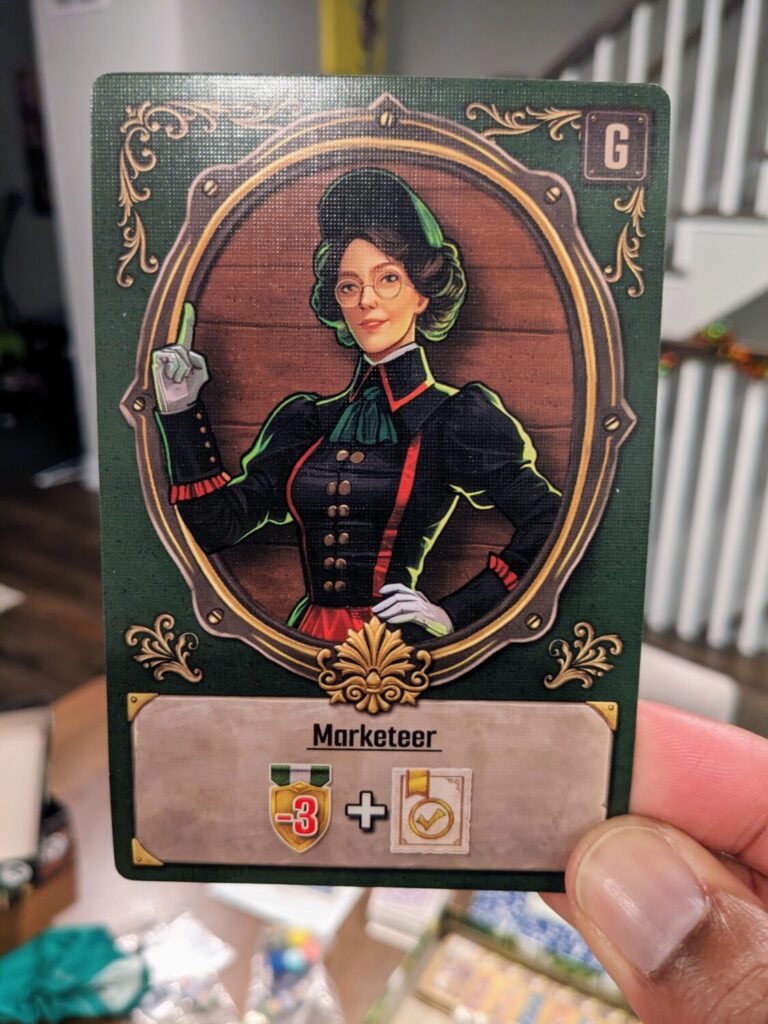
The Marketeer’s “Ultimate Scoring” goal is to complete 7, 9, or 11 contracts for 4, 10, or 21 points respectively. Getting 11 contracts done is a solid challenge, and it made rushing Silver contracts really interesting as a way to cheat up on the goal early. The Marketeer can gain new Chaining Deal action tiles that can be played above the player board to get a Contract tile before taking another action, which I used to get multiple contracts on the same turn. The new techs get better: the Marketeer can stack new contracts on top of existing ones, helping to pivot towards more achievable short-term goals, and the level 7 tech is fantastic: a permanent discount of one requirement on every Silver and Gold contract.
That means you could complete a Silver contract requiring the build of two Factory buildings with only one Factory on the map. Like the other Experiments, pushing to get your level 7 tech completed early really opens up the game.
Experiments I and K were equally interesting, although there’s no getting around it: you are gonna feel like a BOSS if you try to work Experiment K. Experiment K has sixteen technologies, using a double-wide Experiment Board that has so many goodies you almost feel like you are cheating. (One player thought I really was cheating. I don’t blame him, even now.) Experiment K uses a specialized component called Technology Point tokens, and when this Experiment’s owner completes anything that grants a Level One, Two, or Three technologies, they get tokens equal to the technology level that can be spent against any of the techs on the Experiment K board…with costs ranging from 1-3 tokens.
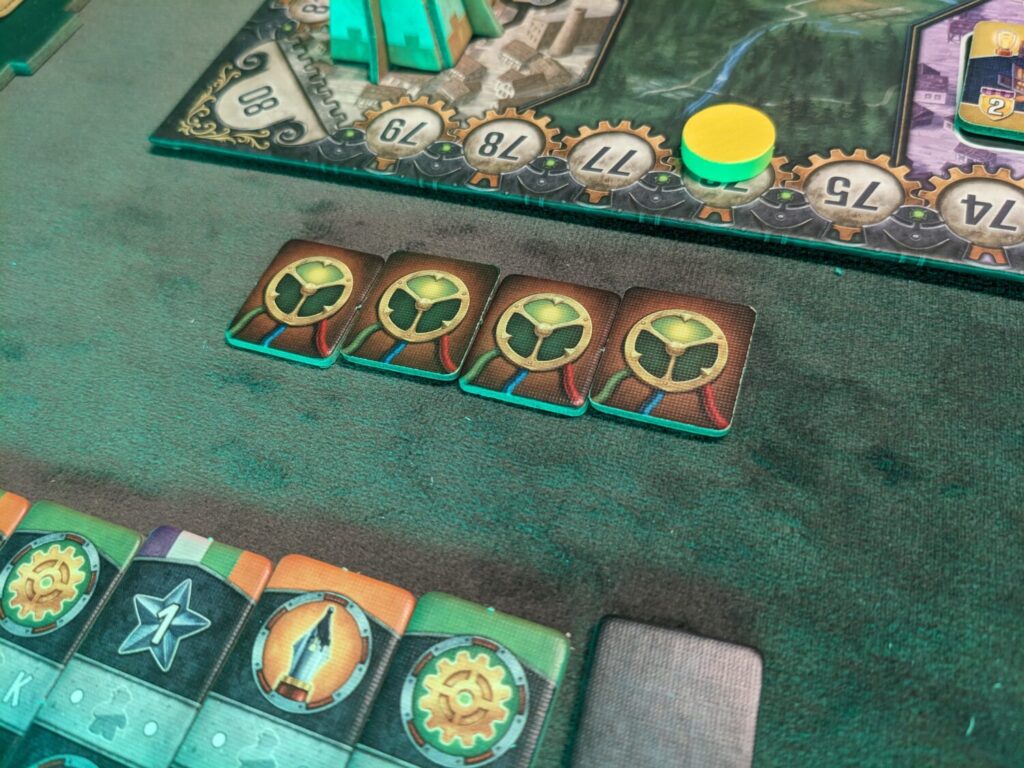
The Ultimate Scoring goals for K are tough: unlocking 15 of the 16 techs is one way to score 21 points, but if someone really goes gangbusters, they could do the second Ultimate Scoring goal too: have at least 12 Technology Point tokens left over by the end of the game. (I look forward to hearing the legend of other players getting all 16 of these techs done in a single game!)
For a skilled player, this is both an exceptional challenge but also a fun way to play, because the techs on Experiment K’s board are a blast. I would always try to get this board if it is available for draft, but knowing that I would have to outbid other players with victory points means I might put myself in a sizable hole before play begins. That tradeoff means that a player who is already experienced with the game could get away with taking a lesser Experiment and still win, so I like that the gamble is tied to victory points and not another resource.
Nucleum: Energy Research Institute also comes with Patron cards, which grant each player a once-per-game ability that costs them points. Many of these powers are so minor that they often surprised me with their inclusion: the Chief Miner (Experiment H) can spend five points to gain a Level 1 technology. The Madame Governor can spend three points to take the cheapest action tile in the market (a tile that normally costs zero when taking the Develop action).
Players can choose to include Patron cards separately from the use of Experiments, and now that I’m done with my review plays, I am going to leave Patron cards in the box. These cards just don’t add enough game-breaking juice to the game, because the Experiments already do that so well.
Yep
If you own Nucleum, Energy Research Institute is an absolute must. The eight new Experiments do an excellent job of shaking up the base game—a game that already has a lot of variety baked into its design. By giving players new ways to attack the game state, I am really impressed by how different my plays were using these new Experiments.
I cannot stress the use of the Expert variant pre-game auction enough. If you are using the new Experiments, you must use the Expert Variant to force players to bid victory points to pick the ones they want. One of my plays included the Mistress of Espionage, and we did not use the auction variant before the game. The Mistress doesn’t have a player color for buildings on the map…because every neutral building, along with the 12 neutral buildings included for this expansion’s Experiment board, belong to the Mistress!
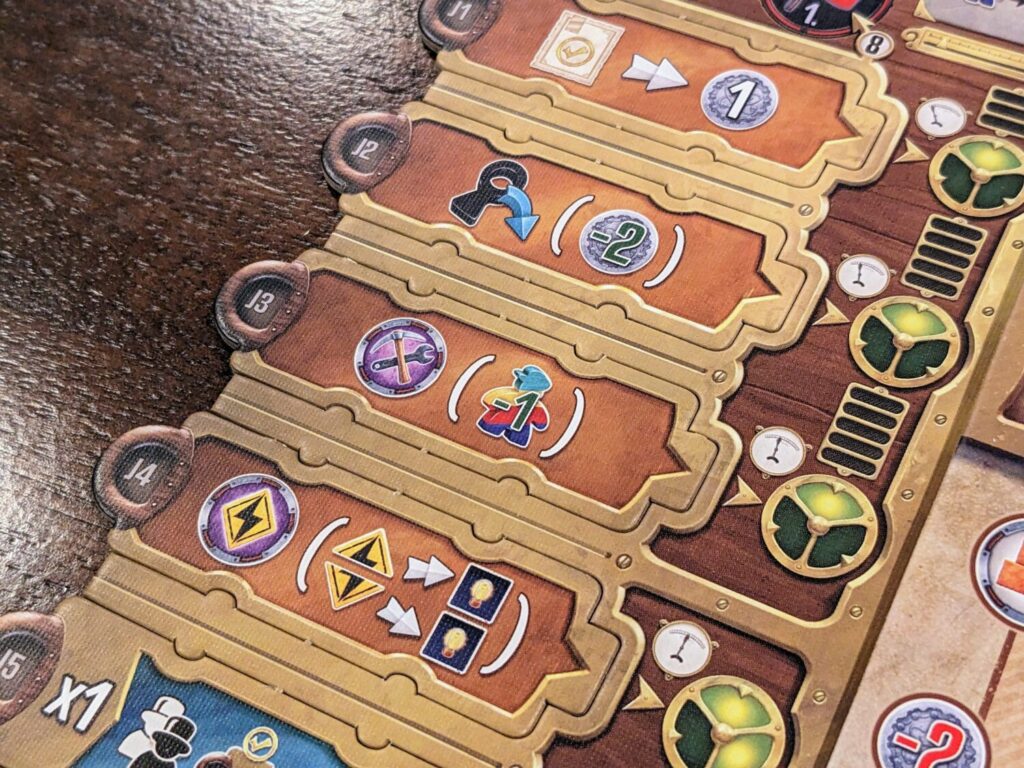
Just the way this changes a player’s approach is wild, but achieving some of the Purple contract goals are much easier if the board is seeded with a lot of the things that can be matched with energized neutral buildings. This also changes the way players approach energizing those buildings; usually, I would energize a couple of neutral buildings to jump start my income tracks or gain a worker, depending on the rewards. When the Mistress is in play, that completely changes things and gives that player a handsome boost because of how they can seed the board.
Looking back, a player should have to pay for that ability, so make sure you avoid mistakes like mine and use the Expert Variant for your plays.
The Nucleum system has a bright future. Nucleum: Gibraltar is coming later this year and features a new map. Mixed with the experiments from Energy Research Institute as well as the variety offered by the maps from the base game and the Australia expansion, Nucleum continues to kill it…and I can’t wait to get my hands on whatever the designers want to throw at us next.