
Disclosure: Meeple Mountain received a free copy of this product in exchange for an honest, unbiased review. This review is not intended to be an endorsement.
Do You Like YROs?
Off the bat, the title of the game is, to me, funny. YRO…as in Euro? Why yes, yes it is. But it’s not a euro…? Also, yes.
I stumbled upon YRO at Origins in 2025. Though I’m a casual anime fan (stuff like JoJo’s Bizarre Adventure, DanDaDan, and Cowboy Bebop), I’m not really drawn to anime-style aesthetics outside the medium. But my interest came from the promise of a fun, quick tableau builder—and if you follow my writing, you’ll know that mechanic is one of my absolute favorites.
Designer Masato Uesugi has a bit of a following from previous titles like Paper Tales and Welcome to the Dungeon (and even a small Oink Games box: Durian). I’m always praising designs that come from Asia because they often bring a different approach to gaming—and as an Asian myself, it’s great to see that kind of representation getting a warm reception.
The 3×3 Road to 40
YRO is played over turns until one player has completed their 3×3 tableau or scored 40 victory points or more. Gameplay is relatively simple and straightforward, and it’s conveniently printed on everyone’s player board, which also includes a tracker for Magic and Technology.
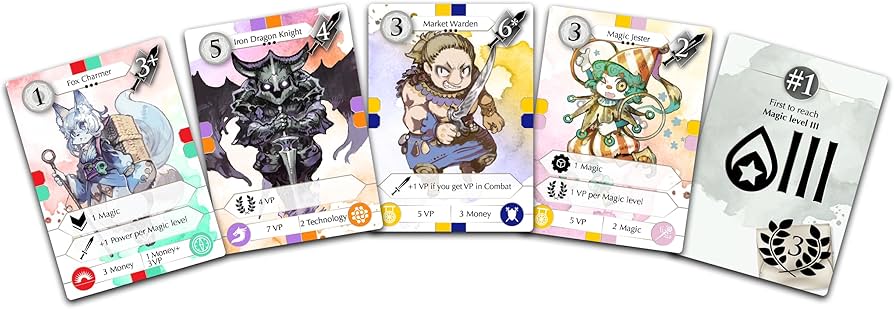
Players discard and draw new adventurers into their hand, then choose whether to recruit them into their tableau. Each card has a cost, and players choose one of the following: recruit 2 at full price, recruit 1 and gain 1 money, recruit 1 with a -1 discount, or recruit none and gain 2 money. Some adventurers have effects that trigger once placed, like gaining Magic or money.
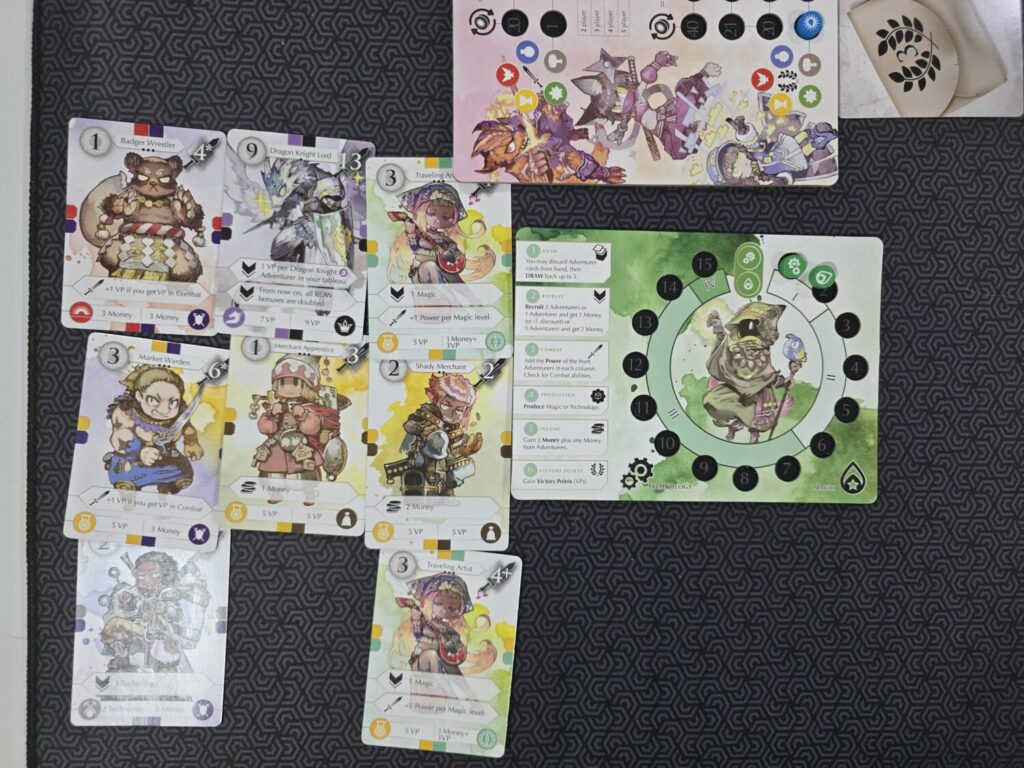
Adventurers also have two colored tags on their sides, and when you establish a same-color link across 3 cards, you receive a bonus from one of the linked cards.
Next comes a combat check that compares the strength of all players’ top cards, awarding VP based on the pecking order. This is followed by an income phase based on card symbols, and it wraps with a victory point phase, also based on symbols.
The game also includes optional quest (public goal) cards that are first-come, first-served, plus additional variants, including solo and drafting. Once one of the endgame triggers occurs, one final turn happens—and the highest score wins!
Cute, But Choppy
I was excited to break this out due to my love of Castle Combo. It’s probably the game I play most frequently on Board Game Arena, and it’s easy to knock one out in under 10 minutes. Both games have polar-opposite art, but they center on the same principle: drafting into a 3×3 grid.
YRO has a little more game baked in than Castle Combo and pulls ideas from the euro space, like income phases, status checks, and incremental point scoring (ahh, now the name makes sense…?). As a heavier gamer, that’s enjoyable for me, but it also makes the game a bit more advanced to bring out with more casual players. And while the rounds are procedural, timing becomes important—some cards are more lucrative late game than early, and vice versa. That can lead to moments where the simultaneous play stalls if other players are prone to analysis paralysis…or AP (wait…just like in Euros!).
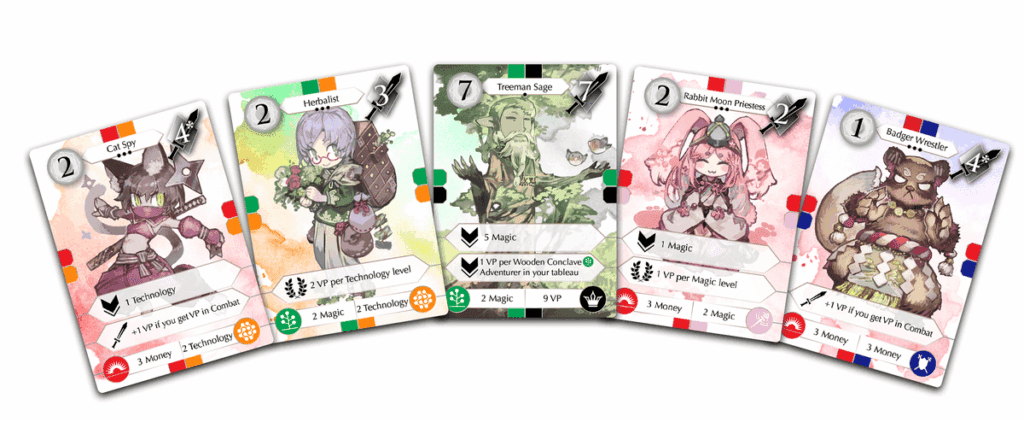
Side note – there has to be a better way to write out those recruit options!
While the individual systems are interesting, they didn’t flow together in a way that led to “ah-ha” moments for me. Everyone does a thing, then waits for everyone else to finish, then we check for stuff. It was a little too start/stop.
It can also feel flat if you can’t get your synergy going. One player, for example, maxed out their Magic track but didn’t really have cards that fed into that potential scoring. And while the game is generous in letting you fish for what you want, it’s also a race, so spending time digging for synergy can put you behind.
I also found that combat had a bit of a runaway leader issue. If someone (myself, one game) built a strong combat engine early, they could end up scoring 5 VP every round, and other players had to disrupt their own plans just to keep it in check.
The balance of building strong scoring, production, and income cards sounds like a fun puzzle, but it felt a bit shallow here. It was a tad too easy to fish for the exact cards you want instead of being forced to pivot your engine plan.
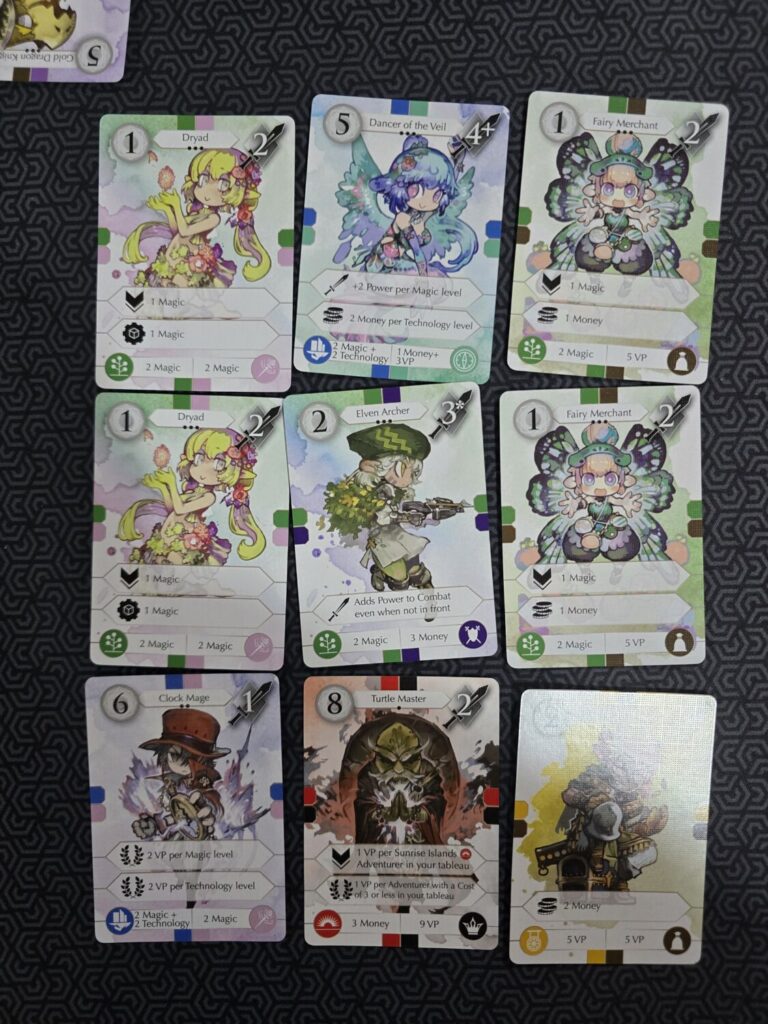
The cards, for the most part, are easy to decipher, with effect symbols that match the phase they trigger in. The art is well done in a chibi style—though others will find it cuter than I do. Still, it’s refreshing to see an anime art style in a game that isn’t necessarily an “anime” game.
Chibi Closing
Overall, I think it’s a solid game with its own audience. Maybe because I’ve played way too many strategy games (and many games of Castle Combo), this one bounced off me. The issues I’m pointing out are pretty minor on their own, but they compounded into an experience that wasn’t especially fun or memorable for me. For everyone else, though, the art is a fantastic draw, and the fun of card-comboing is absolutely there.
It’s a fairly snappy play; there are tons of cards to explore, and solo fans will get a kick out of the system. Otherwise, I’m fine leaving YRO to go back to the euro.
YRO details
- Designer: Masato Uesugi
- Artists: Takashi Konno (今野隼史)
- Publishers: HeidelBÄR Games, Play to Z, Studio Supernova
- Release Date: 2024
- Player count : 1 - 5
- Age range : 10+
- Time range : 20 - 30 minutes
- Mechanism(s): Hand Management, Push Your Luck, Set Collection
- BGG Geek Rating: 7.45423 - converted to Meeple Mountain scale: 3.5.
- More articles about YRO.