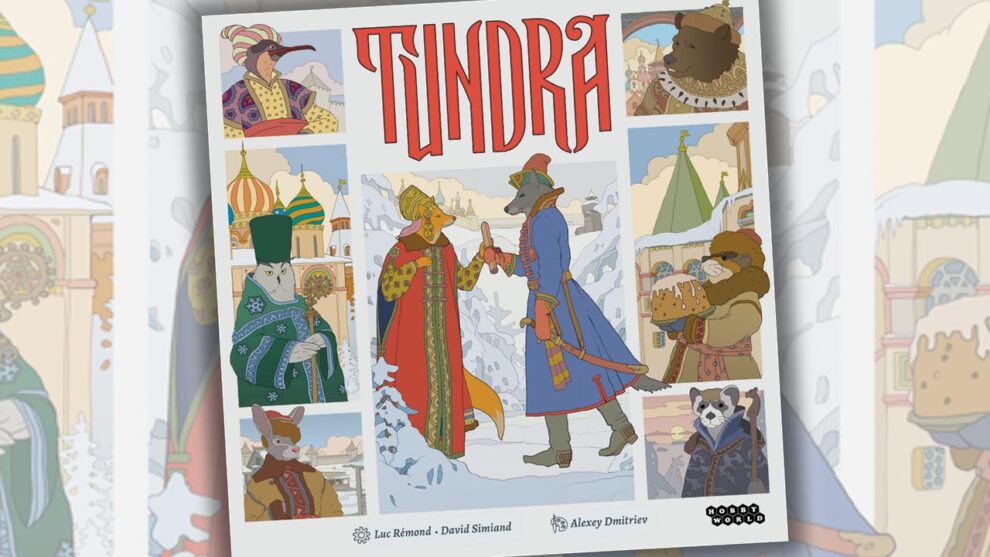

I picked up a review copy of the medium-weight, engine-building title Tundra, designed by Luc Rémond and David Simiand. Rémond is best known for one of the most popular two-player-only designs of the last 10 years, Sky Team. That, alone, made Tundra an instant “yes” when I had the chance to grab a copy during my visit with the Hobby World team at SPIEL Essen last year.
Tundra gives it to you straight. Over the course of four rounds, players take on the roles of estate managers in the fantasy world of Tundra, using workers and towers to gather resources to score the most points. Tundra, the game, begins every round with each player using the same set of die results across four dice—rolled by that round’s first player—before players use one die per turn to activate a space on one of their four action boards, known as “Order” boards.
These Order boards are not unique across the player pool, so each board does the same thing for each individual player…at least, when play begins. The tasks are very vanilla—gather one or more of the game’s three resources (firewood, peat, and rock), build towers and workers, move around a grid-based map of tiles that offer more chances for more resource gathering, or upgrade the Order boards to an improved side that does the same actions, but more efficiently. (Even the map tiles, which begin play mostly face-down, offer no surprises…each one just offers one of those three resources, or in very limited cases, nothing at all.)
An additional resource, berries, give players a chance to manipulate their dice or buy additional dice, to take more actions. Getting berries is pretty easy, so it was rare that we found players stuck with poor die rolls and no way to mitigate a lack of good choices.

Here’s where Tundra offers a little spice: each Order board can be augmented with “City” cards from a market that resides just above the main board. One action gives players a chance to add a City card for free that slots alongside any action board of a player’s choosing. The lines on each of these City cards line up with a specific die or dice placement spots on the Order boards, and any number of City cards can be slotted alongside the Order boards.
The City cards offer a range of bonuses. But when stacked with the normal actions of the Order boards, players can develop a handsome set of actions by triggering the same lines if the dice spots line up correctly. Most City cards are added to Order boards, but a few are unique and can be used as once-per-round, free action cards to offer additional bonuses.
Everything in Tundra is meant to funnel into victory points. Many of the City cards convert resources directly into points. Upgrading Order boards offer immediate and ongoing point generation. In the full game, everyone begins the game with a personal goal card, offering another way to score. 2-4 goal cards in the board’s upper left corner are available to trigger with the right die combinations to score points based on certain conditions. These can be met during each round, and goal cards reset at the end of each round, making them easy ways to trigger scoring more than once. Some of the tower bonuses provide players with resources and points when built and at the start of successive rounds.
For the first two, maybe three rounds, Tundra becomes a not-too-bad way to spend 60-90 minutes. It’s a very easy-to-teach engine builder that makes it easy for players to understand the focus: flip these piles of firewood into victory points. There’s no area majority mechanic to worry about on the main map; there are no restrictions on movement, as players move their peaceful workers from tile to tile to gather more of the three resources. Each tile has room for only one tower, but there are so many places to build towers and so few tower tokens per player that you’ll never really find yourself lacking real estate.
In this way, there is basically no interaction between players. The City card market initially feels like a race, but one of the Order boards can be upgraded to allow players to refresh the card market every time they take that action. The goal cards are a race each round, but the placed dice wipe at the end of a round, making each goal available again to all players. If anything, the goal cards are too closely tied to turn order; late in games of Tundra, the first player will usually use their first, maybe even second, turn to claim a milestone and score four or six points on a goal. (In Tundra, scoring even 40 points feels epic.)

So, Tundra is fine, even if it doesn’t do anything particularly special. But Tundra doesn’t know when to walk itself away from the table, because it should definitely be a three-round game and not a four-round game. That means Tundra badly overstays its welcome. Even late in the game’s third round, you will find that you have seen everything Tundra has to offer, before a final round where players spend each turn finding another way to activate a die spot that converts peat into victory points.
That’s too bad—and strange given that Rémond’s work on Sky Team sticks the landing so much better than Tundra. One could always house-rule this issue, and just quit the game after three rounds. Even then, most of the fun we had with Tundra came from building out a sweet engine that spits out more and more peat or bunches and bunches of firewood, before finding a way to use a City card to turn resources into points.
There are a few other issues. The personal goal cards feel very unbalanced, with some cards offering very high-yield rewards while others offer just a few points. You can win a game of Tundra by completely avoiding the engine-building aspect of the design, but, that’s so much less fun than building up the engine and taking longer turns.
Of course, then the “longer turns” issue pops up. In a four-player game, expect some players to take very long turns as they activate an action that has three or four bonus actions, all while you sit there and wait for your turn to come back around.
Tundra is a tidy little production, with strong artwork from Alexey Dmitriev and Daria Sokolovskaya that reminded me of the Russian styling of the art used by Chema Román and Pedro Soto for The Red Cathedral. Tundra has perfect, tiny-yet-readable, double-sided player aid cards with all the game’s icons and rules, with a round overview on the back of the rulebook. The main board is a little too large for a game that doesn’t need it, but Tundra is easy to set up and makes information easy to distill from across the table.
Tundra is only so-so. For players new to the hobby looking for an easy-to-understand efficiency puzzle, Tundra is worth a look when it becomes available in your home market. Experienced hobbyists should look elsewhere.