
Disclosure: Meeple Mountain received a free copy of this product in exchange for an honest, unbiased review. This review is not intended to be an endorsement.
Disclosure: Meeple Mountain was provided a pre-production copy of the game. It is this copy of the game that this review is based upon. As such, this review is not necessarily representative of the final product. All photographs, components, and rules described herein are subject to change.
At the end of the day, my review criteria is really simple: is the game fun or not?
Trails & Tails is a new self-published title. (BGG does not list a designer, artist, or publishing company…only “self-published.”) It admits its hook right up front: Trails & Tails is going for a Snakes & Ladders-style gaming experience (or, if you’re a gringo like me, Chutes & Ladders), where players move their playing piece up a board all the way to the top…hopefully taking short cuts along the way to reach the top faster.
The downside of Snakes & Ladders comes when snakes appear in the space where you end your movement…because if that’s what happens, you fall backwards and/or downwards until you reach a much less desirable space lower on the board. So, keep moving forward and things will generally work out.
Trails & Tails adds spice by giving each player two starting dice, differing by player; one player gets a D4 and a D20, while another might have a D6 and a D8. In each round, players roll these dice, then get to use 1-2 dice per turn to their liking. You can add the results of two dice, move forward a number of spaces on one die, or even subtract a larger die value from a smaller one to move backwards on the 90-space grid. (No, I don’t have an answer as to why there are 90 spaces and not, say, 100 like in Snakes & Ladders.)

As players progress up the board, they can unlock two more dice, which offer dice movement flexibility…still, a player can only use a maximum of two dice per turn. If a player ends their movement on a white line space, they might trigger a power to allow them to move up and/or across the grid to get closer to space 90 (this is limited to one of the four playable characters, however). End on a red-numbered space (usually on the mouth of a pictured monster, animals that have been possessed by an unnamed & unpictured sorcerer), and that monster eats your adventurer…and that adventurer is then respawned a few spaces away or downwards from the original space.
I think Chutes & Ladders is pretty terrible; like Candy Land, Chutes & Ladders has somewhat random ways to move up and down the game board. Still, I was excited to see what the designer(s) would do here with Trails & Tails.
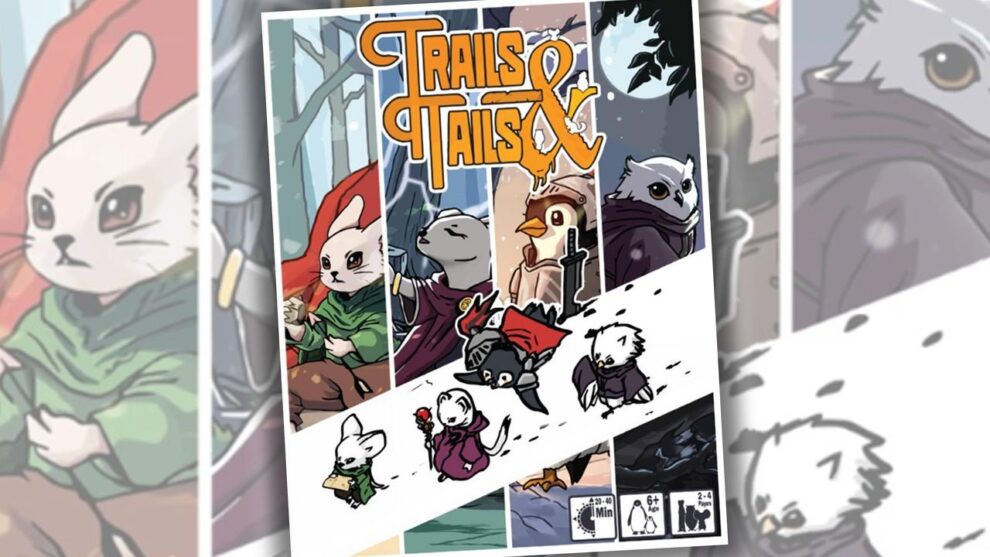
Sadly, the answer is not much, although the illustrations (again, BGG does not list a credited artist) are pretty cool. They are so cool that my kids wanted to play Trails & Tails as soon as they saw the box cover…an interest that chilled almost as soon as we started playing our first game.

Among the many problems with the gameplay in Trails & Tails:
- Movement is relatively easy, and it’s also somewhat easy to stay out of harm’s way because of the dice mechanic. Players might be able to move 20+ spaces on a single turn, and end on a space that lands in-between any pre-printed hazards on the board.
- Getting “snaked” or chuted downwards is rare, and when it happens, it is not punishing. I almost wish Trails & Tails had a card or game effect that shot someone 50 spaces down the board. It does not.
- The box says play time is 30-60 minutes…but none of my three plays (one with three players, the others with two players) took longer than 20 minutes. One of my games took just a hair over 10 minutes, and it was never interesting.
- The player who reaches space 90 gets four gold…in a game where seven gold or more always won the game. So while there are ways to pick up treasure on each level, many of the treasure cards are worth just one gold…and there are not a lot of easy ways to upgrade treasure to be worth more. You are usually better off trying to collect as many treasure cards as possible, but that just serves to slow the game WAY down.
- The strategy outlined in the previous bullet might be worth it if the treasure was more meaningful. But my findings suggest that racing to the top is the better play, with a sweet bonus: if you land exactly on space 90, that gives you a two-gold bonus. Every player that reached space 90 won the game.
- Many of the treasure cards only apply if you are one of the four named characters in the game…so, if you pick up a treasure card that gives Luna an extra turn, it’s pretty sweet if you are playing as Luna. If you are not playing as Luna…it’s not actually a treasure, is it? (At the end of the game, every treasure card is still worth a point. But taking another turn is certainly more valuable.)
- Exploding Kittens fans—or any players who love games where you can steal treasure, items, or turns from another player because you are holding a certain card—might enjoy Trails & Tails more. Every player begins the game with three item cards, and all of them are ways to stab a neighbor. I didn’t think the world was looking for Backstabbing, Take That Snakes & Ladders, but if you were, do I have a game for you! (Like Exploding Kittens, there ARE “nope” cards, so you can ward off evil if you are lucky enough to be holding a “nope” card.)

Trails & Tails is basically a roll-and-move game with no cool items or powers. That would be fine if the game featured any real strategic depth beyond how one moves up or down to collect items and treasure.
But I was surprised at how boring everything was here. If you roll high, you are going to move up the board. Even early in the game, you might reach the 45- or 50-value space by your third turn with average die rolls and a little luck. At its worst, you’ll have turns like I did in my third game, where I rolled a pair of ones with my starting dice in the first couple rounds and had nothing to show for my efforts besides watching the other player run up the board.
Each player does get a power that triggers if they are currently in last place. One character’s power is to replace two rolled dice results with a fresh roll from a D20. On one turn when I was in last place, I was able to swap out my two ones by rolling…a four.
From my D20. This is not exactly the kind of thing dreams are made of.
I don’t blame my D20 for that result. I blame Trails & Tails for not only being boring, but featuring the same lack of control the original versions of Snakes & Ladders / Chutes & Ladders had. It’s a decent-looking game, but Trails & Tails is not a game I can recommend.