
Disclosure: Meeple Mountain received a free copy of this product in exchange for an honest, unbiased review. This review is not intended to be an endorsement.
Calm. Panik.
IV Studio has a consistent reputation for making games that are unique in both style and play, such as Tend, Realm of Reckoning, and Veiled Fate. Just stop by their booth at any gaming convention, and you’ll see a construct that stands out amongst the crowd.
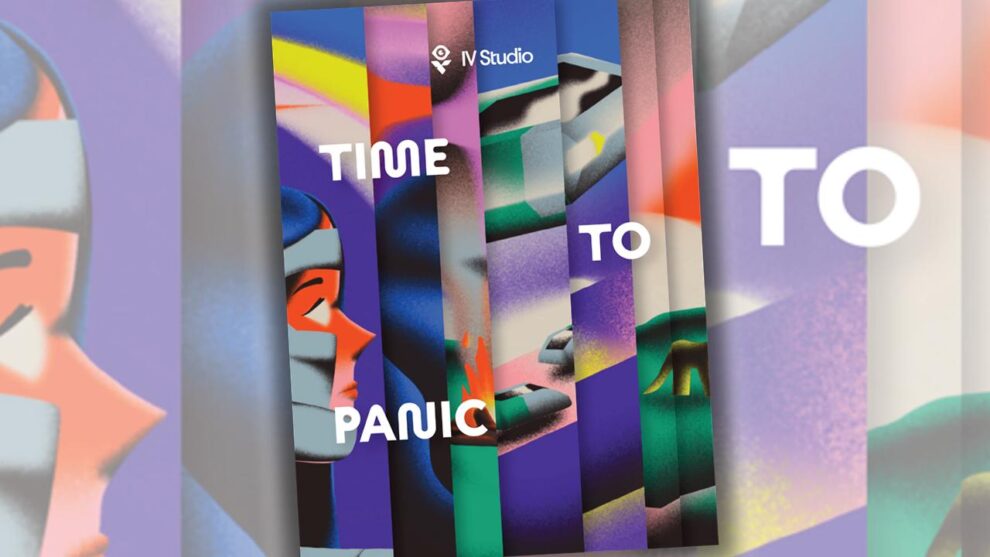
I was excited to be presented with the newest title in their “small box” line, Time to Panic. At first glance, the box doesn’t reveal much—abstract art paired with a title that already manages to evoke a bit of anxiety.
Open it up, though, and you’ll find a neat stack of cards with the beautiful foiling one would expect from a publisher that consistently goes the extra mile in design.
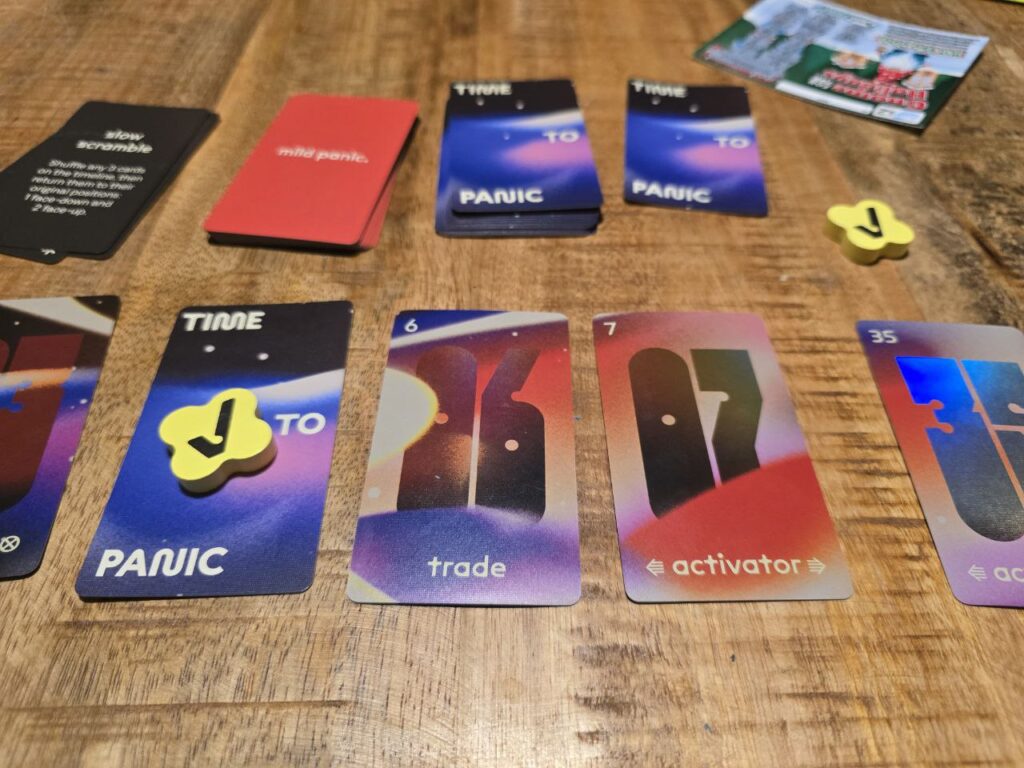
The title itself is a tongue-in-cheek reference to the fact that the time continuum has been messed up, and it’s up to your group to cooperatively (or solo) line the sequences back up.
No Need to Panic, Yet
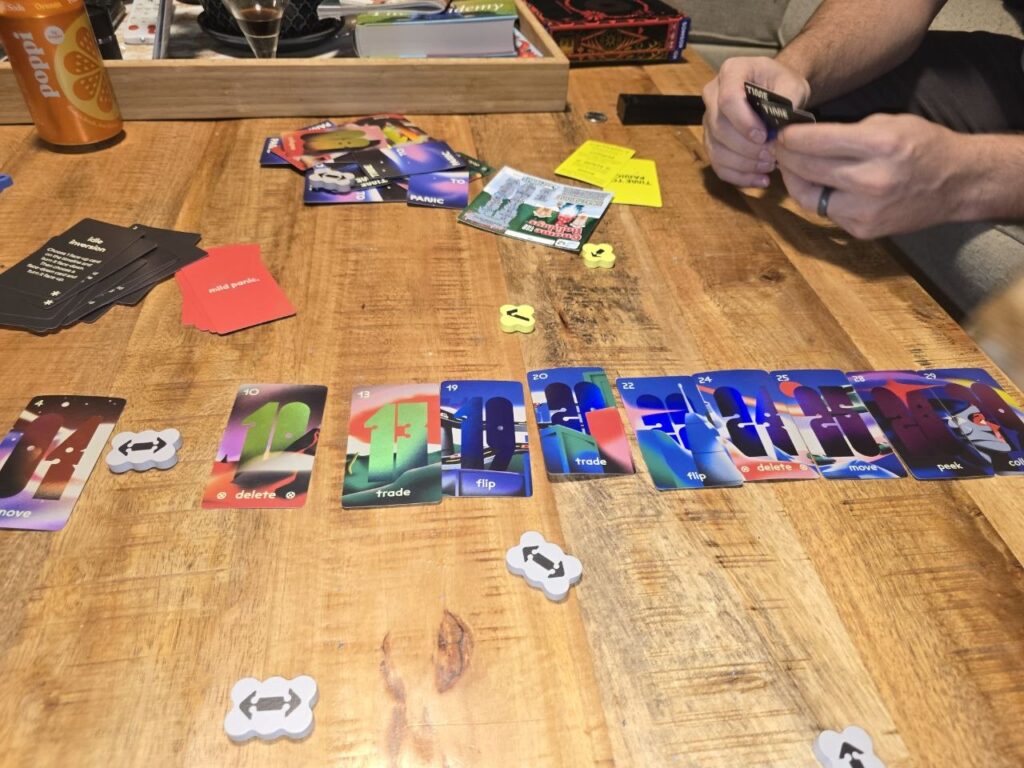
Time to Panic plays over a series of turns until all cards have been played from both the players’ hands and the communal deck. The goal is simple: line up the numbered cards sequentially from lowest to highest. Any numbers that end up out of order count against the group in the final tally.
On a given turn, players may play a card on either end of the timeline or on top of a gap, which acts as a free space. After placing a card, players activate its power along with the power of an adjacent card. These abilities range from swapping card positions and flipping cards face up to removing sequential cards entirely, all in service of nudging numbers closer to their ideal spots.
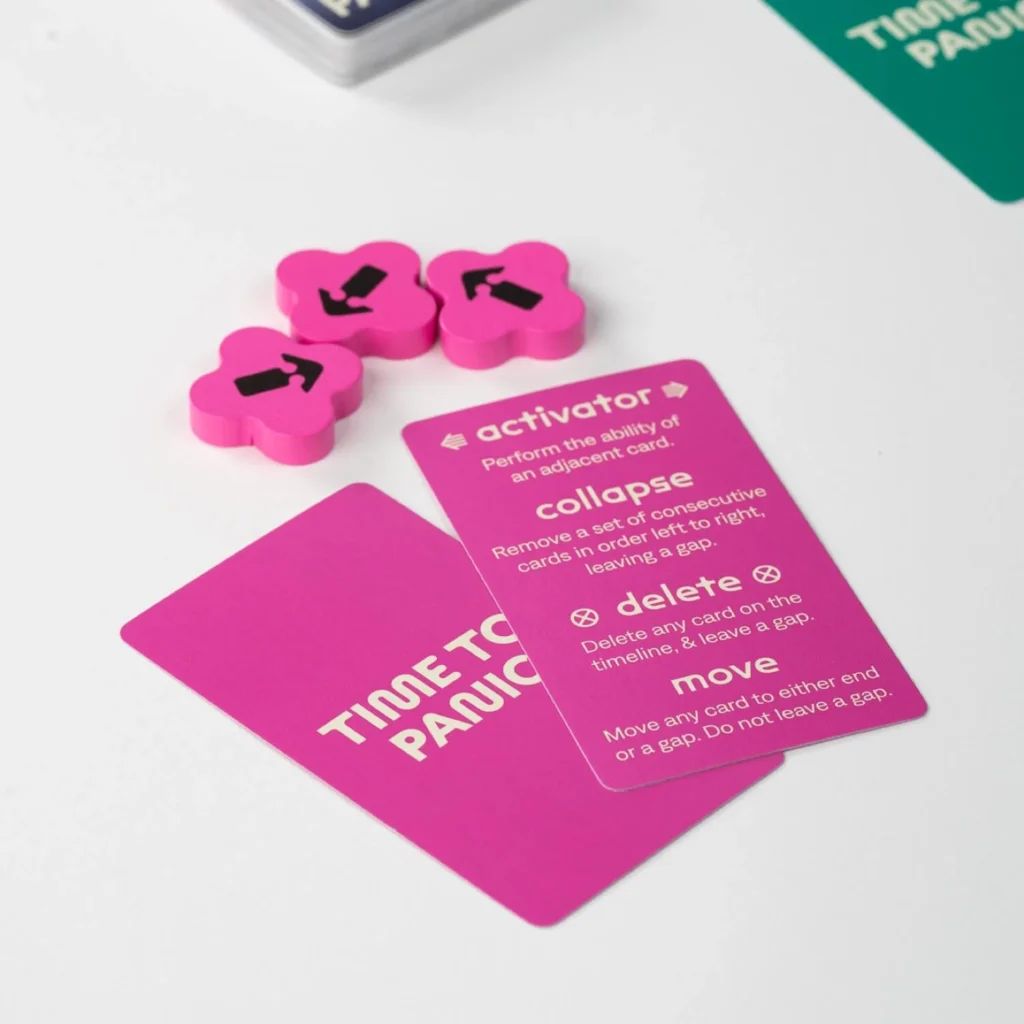
However, at the end of each turn, players draw a panic card—and this is where things get messy. Panic cards disrupt the timeline by swapping cards around or forcing additional cards from the deck into play.
Although Time to Panic is cooperative, communication is extremely limited. Players can only offer vague hints about how they might be able to help, keeping the tension high and information frustratingly incomplete.
Once all cards have been played, any remaining face-down cards are revealed. The group then tallies the sum of all out-of-place numbers and compares the result to the scoring guide, where a score of 0 represents perfect success and 6+ signals a complete timeline catastrophe.
Performance Panicking
Time to Panic is an enjoyable cooperative puzzle. The ruleset is straightforward, but the challenge emerges from the combination of limited communication and the need to strategically leverage card abilities—even when placing numbers that are technically out of order.
There are countless moments where you desperately want to say, “That facedown card is an X,” or “I can place this number right now.” But repairing the time-space continuum isn’t that simple. Instead, players use tokens with arrows and checkmarks to subtly hint at how cards might interact, and the game is forgiving in allowing those hints to be adjusted as the timeline inevitably shifts.
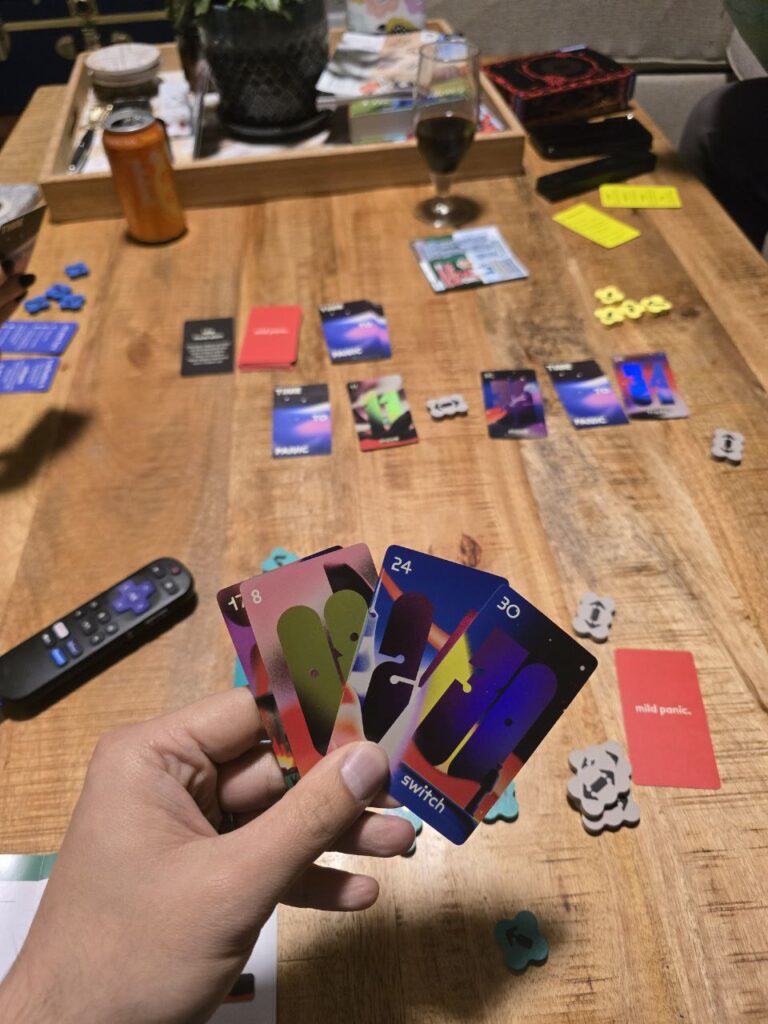
Just when you think you’ve finally stabilized things, another panic card appears and throws everything into chaos once again. It becomes a constant balancing act between control and disruption. Thankfully, the game offers three levels of panic cards—mild panic, panic, and total panic—allowing groups to tailor the experience to their desired stress level.
While the puzzle itself is easy to grasp, every placement feels consequential. Sometimes playing a specific number actively impedes progress, but the associated action (and adjacent bonus action) ends up being the more important move. I found that collapsing cards whenever possible is a major advantage, as it removes cards from the timeline and creates gaps. Those gaps become surprisingly valuable, offering flexibility to place cards in the middle of the timeline rather than being restricted to the ends.
One minor consideration: the timeline grows quickly. Despite its small-box footprint, the game demands a fair amount of table space, so be prepared to spread out.
While Time to Panic does exactly what its name promises—inducing panic—it also delivers plenty of fun as players collectively wrestle control back from the chaos. There’s also a light memory element as cards flip face down, so having someone with an ironclad recall at the table certainly helps.
One of the most satisfying aspects of Time to Panic is the moment when everything clicks—when a perfectly timed card lines up the timeline, triggers a chain of abilities, and suddenly brings order to what previously felt like inevitable chaos. Those moments feel genuinely earned, and they reinforce how every player has the potential to contribute something meaningful. Even turns that initially seem like mistakes often end up setting the stage for the next player to pull off a clever combo, turning perceived missteps into intentional setups. When the group syncs up, the game delivers a shared sense of accomplishment that makes the panic worth enduring.
If you’re looking for a solid cooperative puzzle with a clever theme and meaningful tension, I’d recommend taking the Time to Panic. It’s an experience worth revisiting again and again.