
Disclosure: Meeple Mountain received a free copy of this product in exchange for an honest, unbiased review. This review is not intended to be an endorsement.

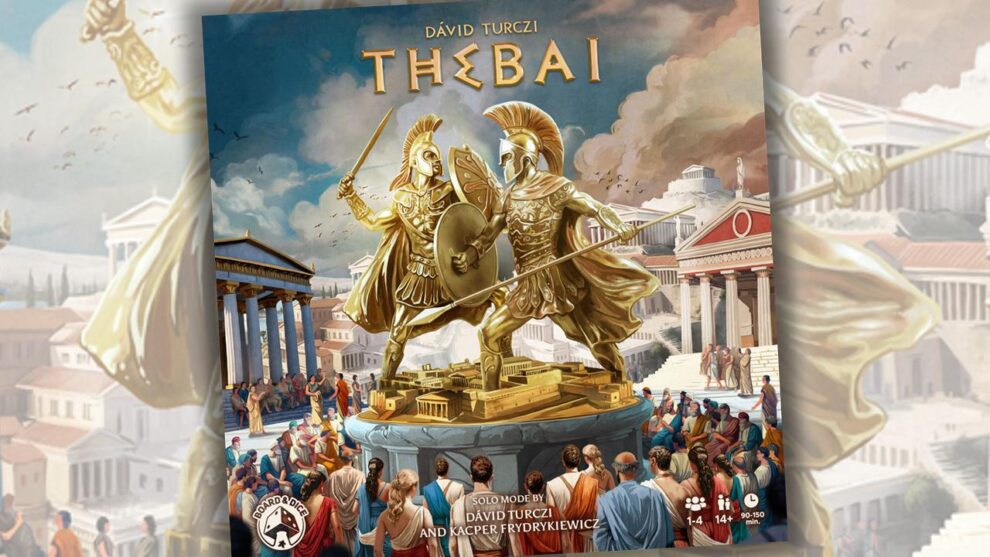
I did a demo of Board&Dice’s latest collaboration with prolific Eurogame designer David Turczi, Thebai, at SPIEL Essen 2025. After just a few minutes, I liked what I saw: 10 rounds, a simple turn structure, an interesting puzzle, and public events that are visible a full five rounds in advance for planning purposes. (Usually, I hate event cards.)
I did this demo with three lovely Italian gentlemen who were attending the fair, and after just two turns, they had seen enough to understand if the game was for them, ending our demo a little early. When I returned to the States, I did a light perusal of other media peers to see if others had begun to form opinions on the game; I hadn’t heard much about Thebai during the show, and the game was still available for sale on the fair’s final day, meaning that the buzz was lighter than other major titles.
Thebai has created an interesting vacuum. I thought it was good, and much lighter than some of Turczi’s best work, such as Voidfall and Nucleum. But there is no one talking about it; I’m more mystified about that than anything that takes place in the game.
Jump Their Dice, Not Yours
Thebai is an economic, tile-laying, dice worker, and order fulfillment game for 1-4 players. Even with four players, you can knock out a game of Thebai in about 90 minutes. (For this review, I did a solo, a three-player, and a four-player game.) Taking on the roles of noble families during the Bronze Age in Thebes, players manage a pool of citizen workers and “hoplites” (soldiers) to fulfill contracts, advance up two different tracks to gain bonuses, manipulate turn order, and establish dominance in tiebreakers during military conflicts that take place at the end of the third, fifth, seventh, and ninth rounds of the game.
Thebai certainly does a lot of “Euro-y” things, and it does those adequately, with dice workers that can be promoted to take stronger actions and later score end-game milestones, with hints of things that worked well with upgradable workers in games ranging from Teotihuacan: City of Gods up through this year’s Devir title Covenant. There are plenty of ways to gather resources to later fulfill contracts, contracts which grant both immediate bonuses as well as tags for end-game set collection scoring. Fighting the unnamed hordes at the end of certain rounds rewards participants with minor spoils but punishes players who decide they would prefer to play the role of non-participants.
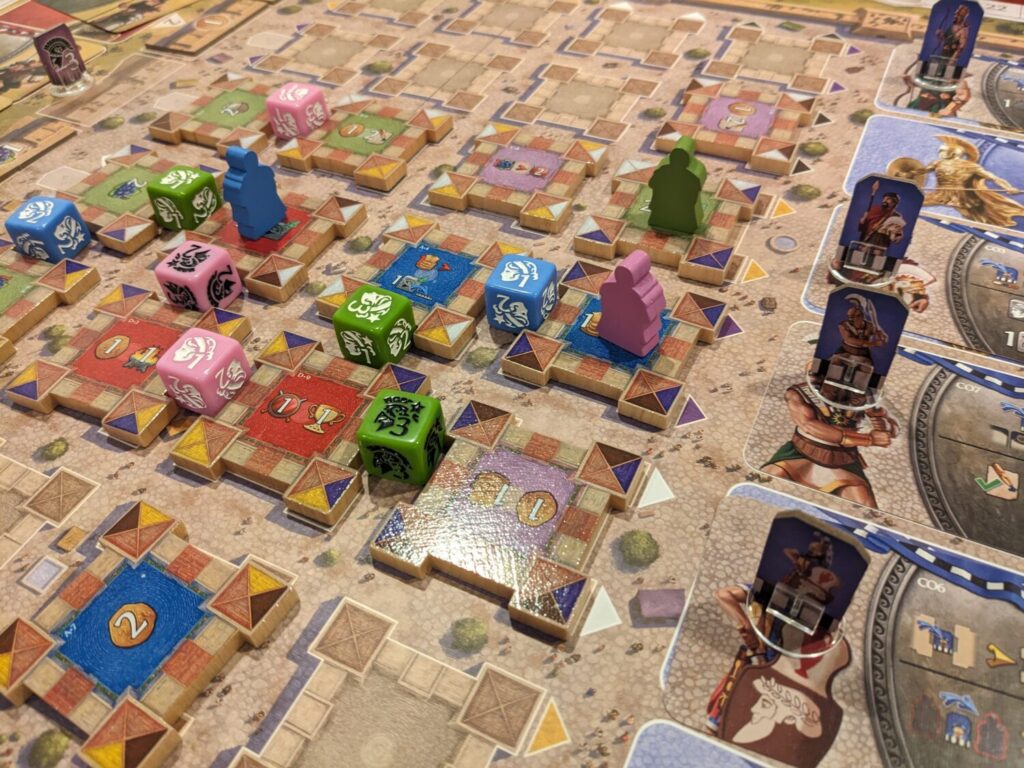
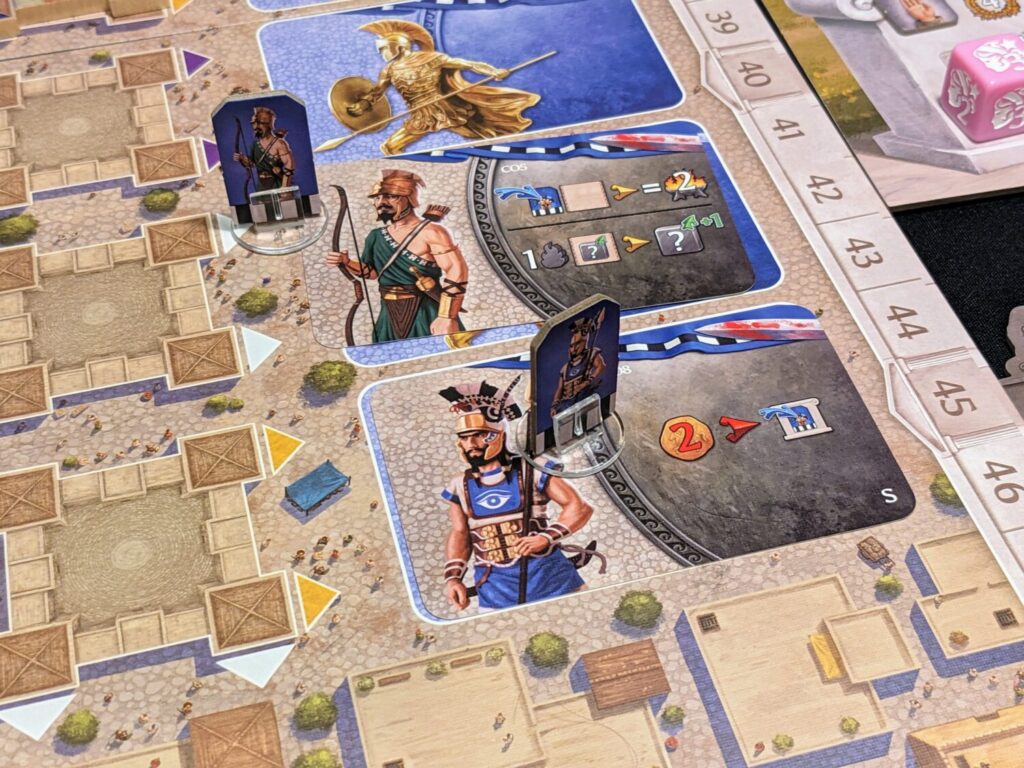
What elevates Thebai is twofold. After a player places a die, either on their personal Estate board or on the main city map, they have to then move a separate token known as the Archon. Each player has one in their color. Players have to move their Archon around the map via Cadmea tiles that were placed during setup and as actions during the game.
These Cadmea tiles, which each show a small bonus, help create a cool-looking small city with tiles in each player’s color. The Archon can move around the board via these tiles, but save for one move per turn, has to navigate the Cadmea tiles by using other dice as a bridge to get from place to place. But, there’s a catch: when an Archon moves over dice of another player’s color, those dice are promoted by a single level. When the Archon moves over dice of the active player’s color, they get demoted by a single level.
So, you will try to find ways to get your Archon to a Cadmea tile that gets you the best bonus for the moment, but you’ll also want to try to not help out opponents too much. Dice that get promoted are later used for end-game scoring (if the promoted die was a citizen) or significant defense bonuses (if the die was a hoplite) when raids take place at the end of the rounds named above.
While players can choose to remove their Archon from the board to reset it for a future round, that only nets the active player a single coin. Finding ways to promote the right opponent dice and still take the action I wanted was a fun puzzle to solve.
The other thing that is cool about Thebai is the placement of Cadmea tiles. First, a player who removes a tile from their personal board gets to place it adjacent to other tiles in the City, slowly growing the board and unlocking better actions as play moves along. Each Cadmea tile has 2-4 different colors at each corner; when placed, players get bonuses for matching sides to other previously placed tiles. Lining up tiles in the right place for bonuses is interesting, but placing tiles in locations that can directly benefit the player through the placement of dice or the movement of their Archon also proved to be a lot of fun.
Solid…and, Generic
Thebai’s biggest problem is that it does feel like “just another Euro.”
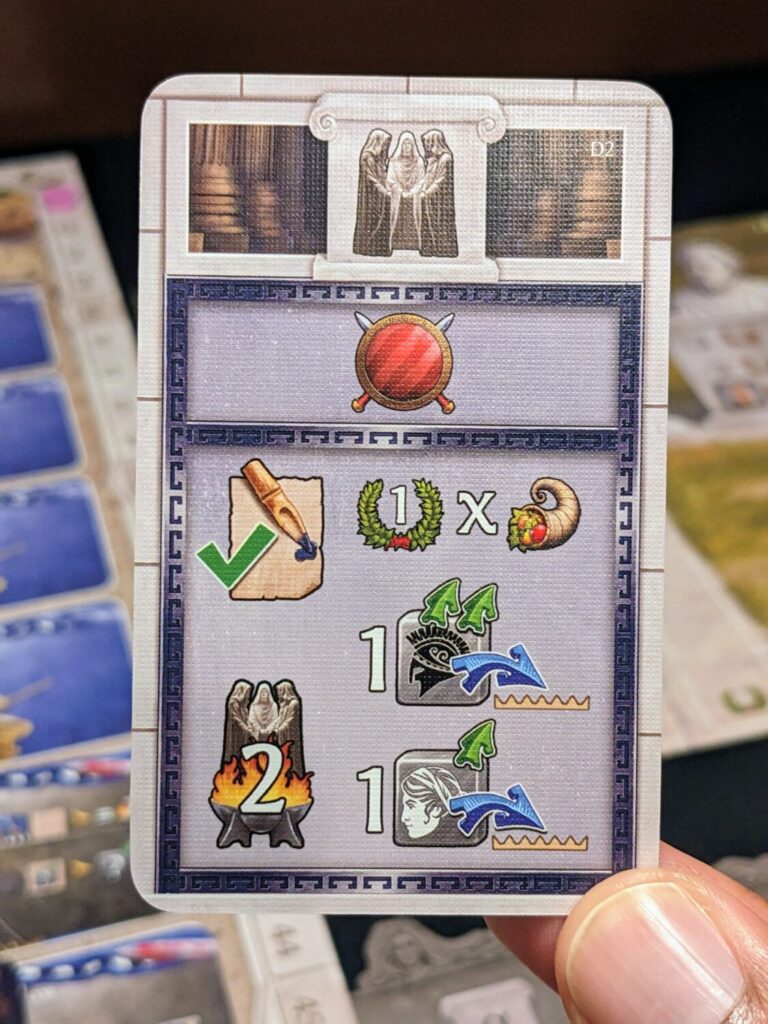
The central puzzle is interesting, some of the combos are great (especially on turns where a player fulfills a contract that has a juicier reward), the production is strong, the player aid is sensational…but at no point will a player yelp with delight. Taking turns here consistently put me in that muffled, under-my-breath happy place, not that fist-bumping high-five you want to hand out during turns of your favorite Euros.
Thebai is very safe. I enjoyed my time with it, and I already know it lands below some of Board&Dice’s best games, such as Tiletum, Teotihuacan, Nucleum, and the sadly underrated Reef Project. That doesn’t make it bad; in fact, I’m still struggling to pick out anything wrong with Thebai. I hate that the dice featured promotion levels uses a hard-to-read star icon format in-between promotions instead of just using something simpler, such as the Teotihuacan system of six-pip dice for six worker levels.
Maybe that’s why Thebai doesn’t have the buzz that other titles had at this fall’s SPIEL event. Even Tianxia, Board&Dice’s other major Eurogame strategy release this year, has more exceptional moments, and strangely mirrors some of the same mechanics as Thebai, with hordes attacking the player collective at the end of certain rounds. Tianxia’s tracks are more interesting, its actions more swingy, and asymmetrical bonuses that got more players excited.
Thebai is worth a look, but I don’t think it will leave an impression as lasting as some of Turczi’s other recent work.
Thebai details
- Designer: Dávid Turczi
- Artists: Lucas Melo, Piotr Sokołowski, Zuzanna Kołakowska
- Publishers: Board&Dice, Intrafin Games, Maldito Games, Pegasus Spiele
- Release Date: 2025
- Player count : 1 - 4
- Age range : 14+
- Time range : 90 - 150 minutes
- Mechanism(s): Contracts, End Game Bonuses, Events, Grid Movement, Matching, Solo / Solitaire Game, Tile Placement, Variable Set-up, Worker Placement with Dice Workers
- BGG Geek Rating: 7.40006 - converted to Meeple Mountain scale: 3.5.
- More articles about Thebai.