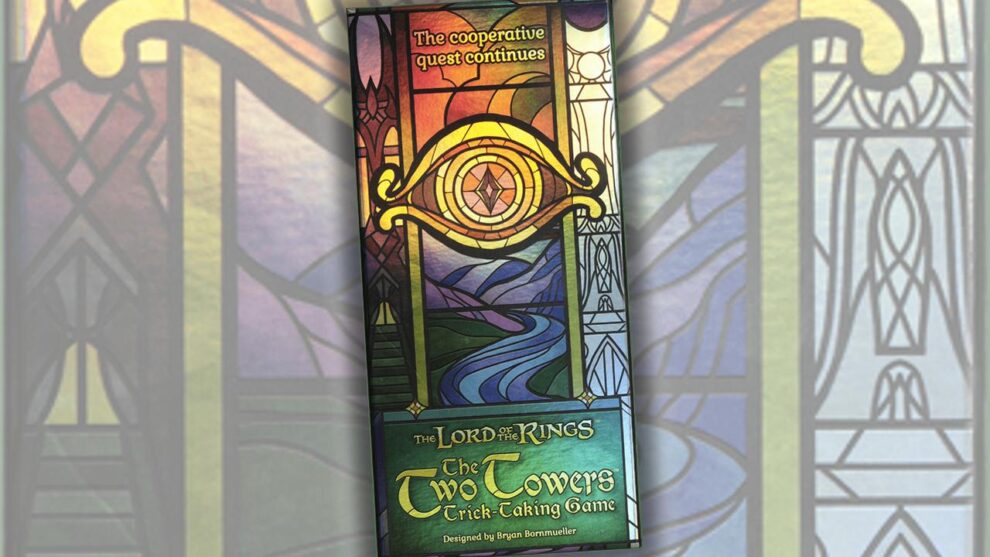

Disclosure: Meeple Mountain received a free copy of this product in exchange for an honest, unbiased review. This review is not intended to be an endorsement.

I struggled with The Lord of the Rings: The Fellowship of the Ring – Trick-Taking Game. For all the inventiveness on display, as passionate a love letter to trick-taking as it was, Bryan Bornmueller’s commercial triumph left me cold. Too often, I said, that cooperative card game would leave players in the lurch, handing them combinations of characters and cards that were not winnable. Unlike its close cousin The Crew, something like half the hands in TLotR:TFotR-TTG proved unwinnable from the jump, save for an act of providence. I don’t want cooperative games to be easy, but I do want continuous losing to feel like a skill issue rather than RNG.
That’s the long and the short of it, anyway. And for what it’s worth, my criticisms of The Lord of the Rings: The Two Towers – Trick-Taking Game are almost exactly the same as my criticisms of the first game. Critical decisions are made without crucial information. A lot of hands are dead from the jump and there’s nothing you can do about it. A few of the chapters here even sharpen my criticisms. It would be easy to get bogged down in an even more negative review, to dig into all the ways in which I continue to think Bornmueller’s game doesn’t work.
But.
For one thing, I’ve already written that review. Writing the same review twice isn’t interesting, to say nothing of reading the same review twice. For another, and more to the point, I think I may have learnt how to love this game?
The Perils of Experience
Most of my plays across the first two volumes of this series have been with my normal gaming group, a set of individuals who either came to me already steeped in trick-takers or have become so as a direct result of spending time with me. Regardless of how they got there, they now exist at the far end of a bell curve. One night, in lieu of the usual suspects, I sat down to play Two Towers with a coworker, an old friend, and my partner. All three are people who enjoy games, but do not by any means identify with gaming as a hobby. We went over the core rules, then started from the first chapter. It would prove to be, by a long shot, the most enjoyable session I’ve had of either The Lord of the Rings trick-taking game.
It helped, I’m sure, that they weren’t looking for cracks. They haven’t trained themselves to push against the outer edges of a game to see what it allows and what it forgives. They don’t see failing a mission as the arbitrary outcome of the shuffle, even if it is; they see it as a hard-fought loss that we should immediately try again. That improved the overall mood. The fact that they cared less about the result meant that I cared less about the result. We marinated in the experience.
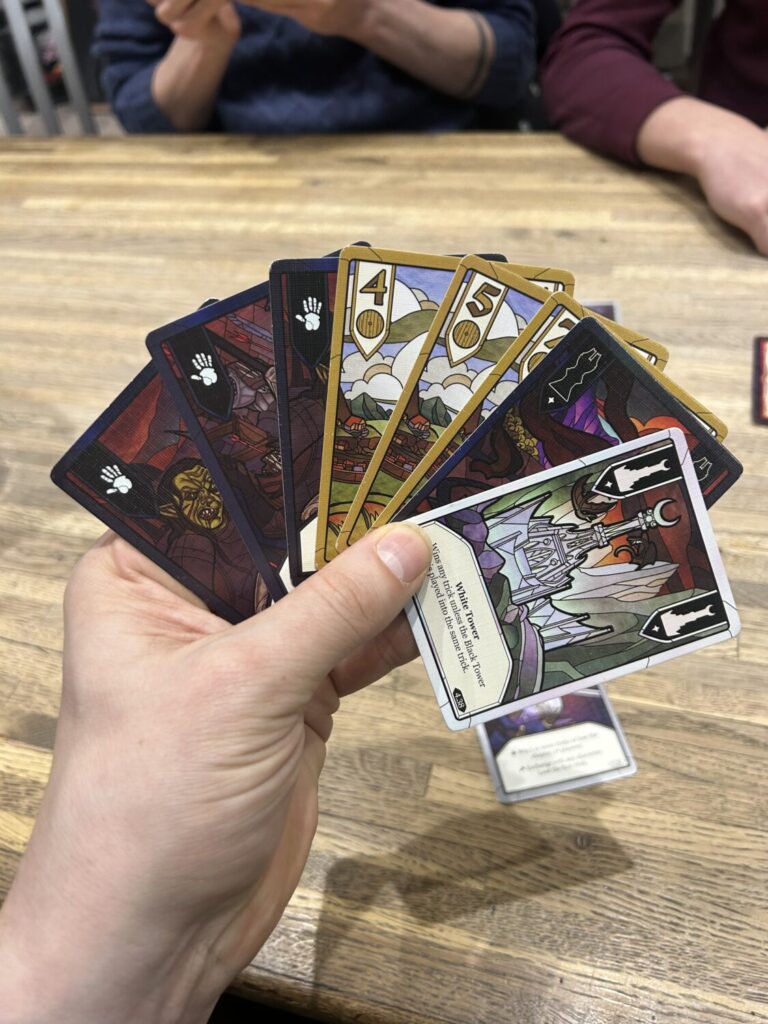
And boy did they love the plate of jewels approach Bornmueller has taken. As well they should. The one thing about these games that I have consistently raved about is his seemingly inexhaustible supply of trick-taking variations and the rigor with which he marries those variations to Tolkien’s story. The hits in Two Towers start early, and Bornmueller feels emboldened by the first volume’s success.
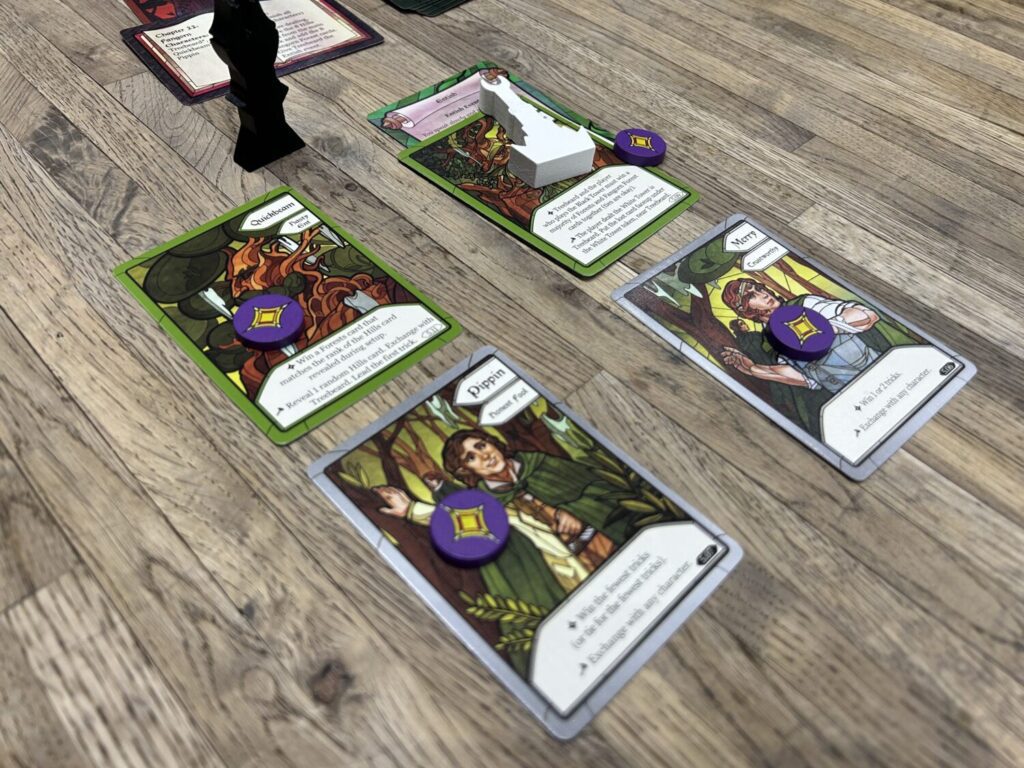
There are many examples to choose from, but the discovery is part of the joy, so I’ll limit myself to early chapters. The eponymous two towers are the only trump cards, but they cancel one another out, which can lead to some fun plays. One of the early chapters gives us the tour de force that is Treebeard. Apt for an Ent, he plays cards a trick behind everyone else. Whatever card would go into the current trick is instead placed on-deck, and the card from the previous trick is thrown into the fray. This idea is brilliant conceptually, and it is all the more impressive for how effortless Bornmueller makes its execution.
Chapter after chapter, we had a great time. Even people who don’t spend time digging around in the tricky trenches appreciate this as the virtuosic display that it is. Bornmueller has now made himself an ambassador for the darker, weirder corners of this particular sub-hobby within The Hobby™. The Lord of the Rings: The Two Towers – Trick-Taking Game shows why people like me and my friends spend so much time seeking out and thinking about these games. It invites them in and delights them with its pyrotechnics. In that context, you couldn’t ask for anything better.
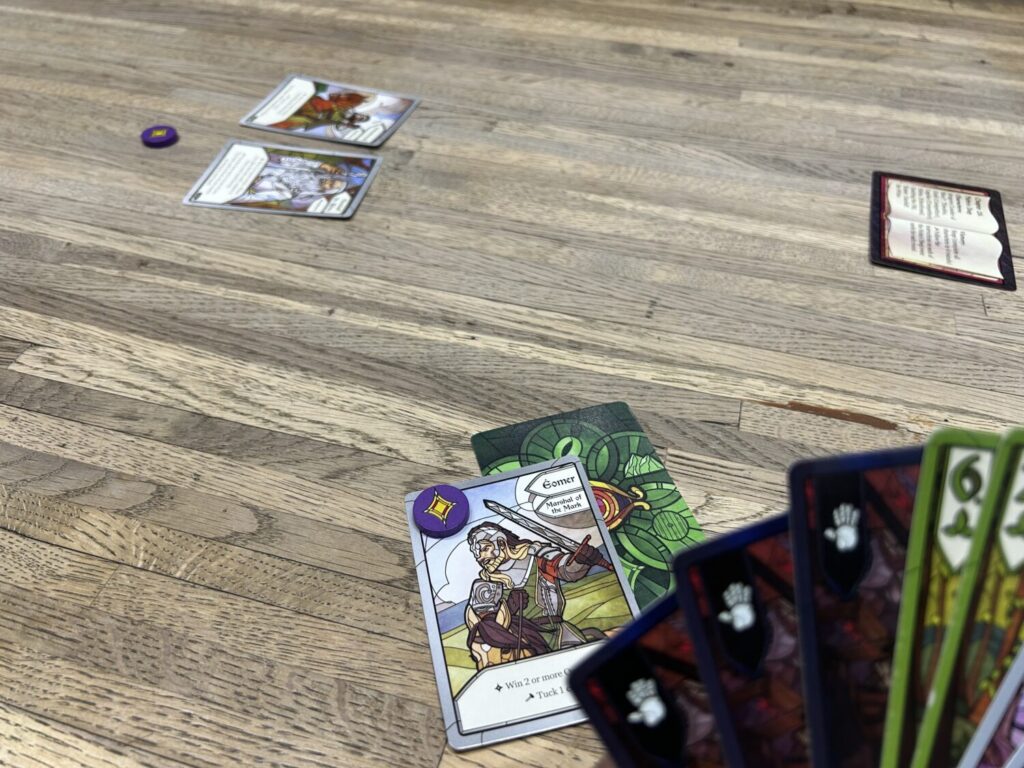
Will I independently seek out opportunities to play this? No, I don’t think so. I would still rather play The Crew, something that feels more rewarding of skill and cleverness. That’s a consequence of spending too much time with games like this. But The Lord of the Rings: The Two Towers – Trick-Taking Game makes up for what it lacks in opportunities for skill and cleverness with a remarkably accessible brand of weirdness. That’s where the brilliance lies. I would play it any time with non-gaming friends who asked.
I don’t know. Maybe it’s time to give up game criticism. Pack it in. Live life like real people do. Seems like they may have the right idea.
The Lord of the Rings: The Two Towers – Trick-Taking Game details
- Designer: Bryan Bornmueller
- Artists: Elaine Ryan, Samuel R. Shimota
- Publishers: ADC Blackfire Entertainment, Asmodee, Gameology (Gameology Romania), Geekach LLC, Gém Klub Kft., Office Dog, Rebel Sp. z o.o.
- Release Date: 2025, 2026
- Player count : 1 - 4
- Age range : 10+
- Time range : 20 minutes
- Mechanism(s): Communication Limits, Cooperative Game, Scenario / Mission / Campaign Game, Trick-taking
- BGG Geek Rating: 8.37678 - converted to Meeple Mountain scale: 4.0.
- More articles about The Lord of the Rings: The Two Towers – Trick-Taking Game.