Disclosure: Meeple Mountain received a free copy of this product in exchange for an honest, unbiased review. This review is not intended to be an endorsement.
The history of 20th century music is full of rivalries, be they real, manufactured, or imaginary. As much as they can get in the way, they also serve an important function within the culture of popular music for both artists and audiences. The Beatles and The Rolling Stones, to say nothing of The Beatles and The Beach Boys, were pushed to ever-greater artistic heights as a result of trying to outdo one another. Blur and Oasis sold way more singles as a result of their mutual distaste than they would have otherwise.
As for the audience, rivalries can produce better music, but they also serve a social function. A rivalry makes room for partisans. “N*SYNC rules, Backstreet Boys drool”—an insane position given that the Backstreet Boys are obviously better singers and could do both party songs and ballads with equal aplomb, while N*SYNC couldn’t sing a ballad if their lives depended on it—gave identity-hungry teenagers something to cling to.
This is hardly restrained to the world of pop. Before the boy bands, before Britpop, and even before The Beatles and The Stones, there was the rivalry between Maria Callas and Renata Tebaldi, two of the great operatic divas of the 20th century. From our contemporary perspective, it’s easy to see how that played out. Ask anyone over the age of 35 to tell you what they know about opera, and, if they know at least three things, there’s a good chance that Callas’s name will be one of them. Practically nobody knows who Renata Tebaldi is anymore.
But that wasn’t always the case! These two were once equally as renowned. They both regularly appeared on television the world over. They performed in opera houses on six of the seven continents. Tebaldi was on the cover of Time! They don’t put just anyone on the cover of Time!
Fussy Divas
The Battle of the Divas is the second game in publisher Salt & Pepper’s Battles without Bullets line, a collection of two-player games that tie traditional card-driven game (CDG) mechanics to atypical settings. The first game in this series was the masterful The Battle of Versailles, which took place during a fashion show that changed modern fashion. The Battle of the Divas, from designer Albert Reyes, details the decades of rivalry between Callas and Tebaldi, as they vie to outperform one another in productions of beloved repertoire.
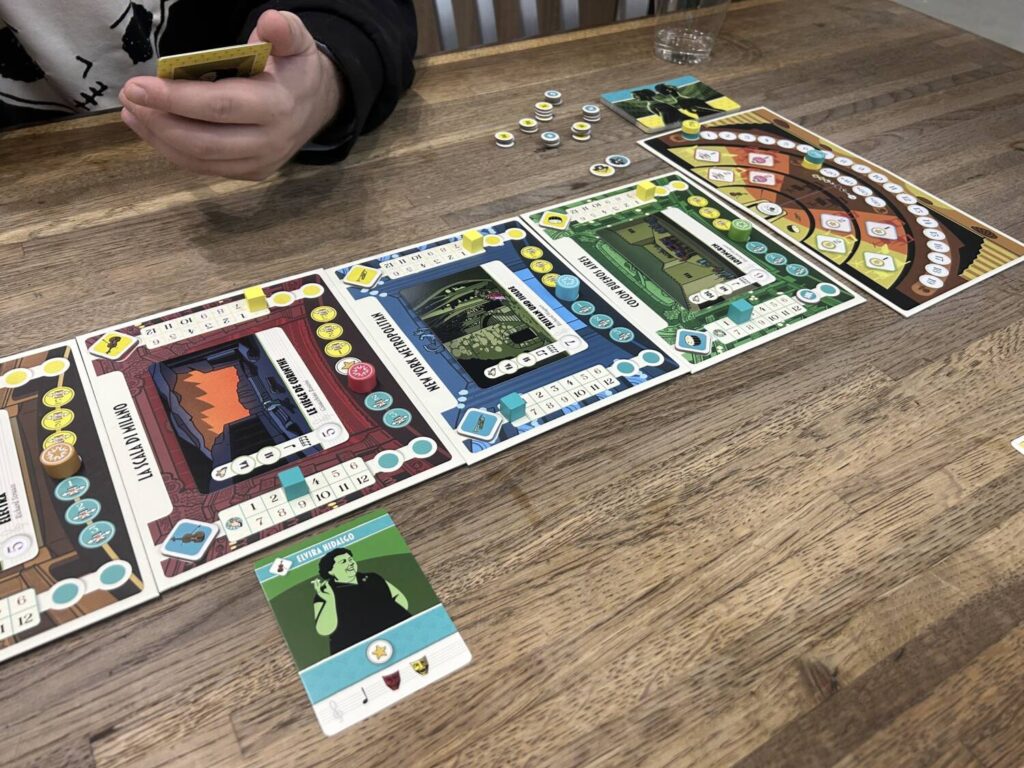
Each player has a personal deck, a combination of Character and Event cards, that are shuffled up. At the beginning of each turn, you play a card to one of the four opera houses on the table, attempting to match some combination of Instrument icons, Rhythm icons, and Masks. When these resources are played at matching locations, you gain Applause, which represents the audience’s reception of your performance. It is always better to outpace your opponent in Applause.
Then you shift your attention to the Piano, a sideboard with figures for each player. Every card has a Rhythm with something between four sixteenth notes and a single quarter note. It feels safe to assume that anyone reading this review will be familiar enough with music that we don’t need to fill in the gaps in between. Whichever note value you played, you can move up to that many spaces on the Piano.
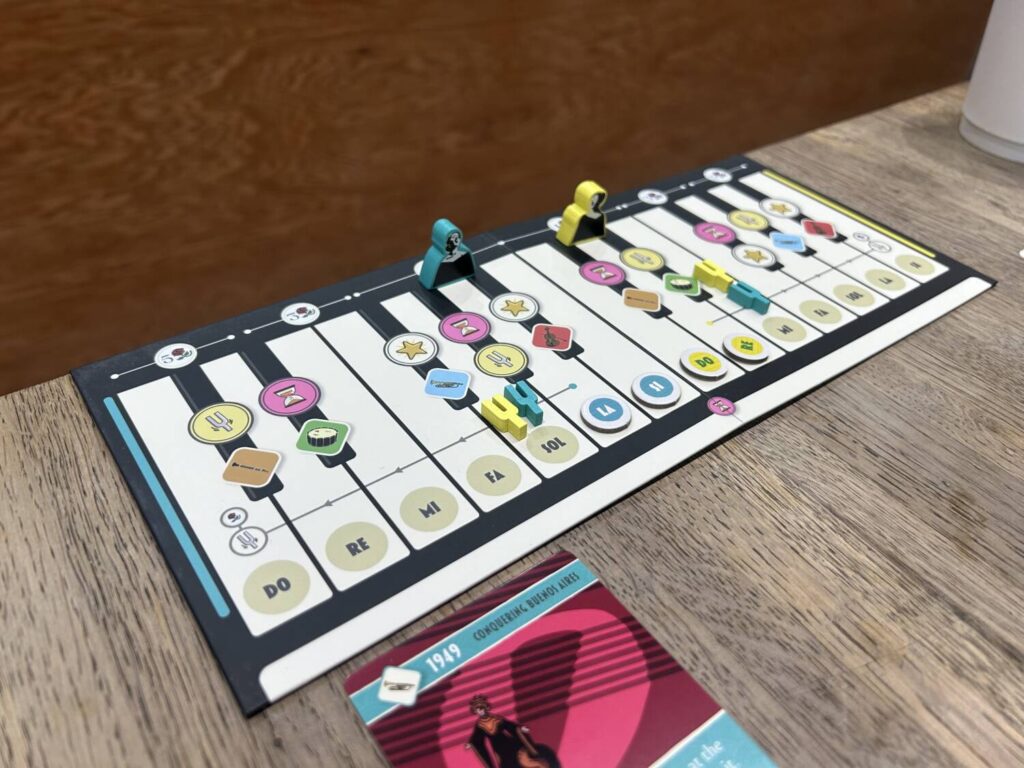
This next part is somewhat involved for all the overlapping mechanisms it brings together. First, provided the key you land on is within your vocal range—demarcated by two adorable tuning fork tokens—you get to place a Musical Note token in your color. Then check the black keys to the left and right of your current position, and pick one set of actions to perform. These can increase your vocal range, your Fame, allow you to add cards to the Timeline, or give you access to an opera house action of your choosing.
It was while reading through this portion of the (very good) rulebook that I began to worry. It is my general experience that the presence of an action that cannot be explained fully without explaining several other actions is not a good sign. It doesn’t mean the bridge won’t hold, but it will absolutely be rickety. What’s worse, no one of those actions can be explained without explaining at least a few of the others. Thank goodness this review isn’t a rulebook. As the writer, I would be driven to tears, as would you as the reader.
At the bottom of all those interlocking bits and pieces is what many CDGs end up being, what I described in my review of Votes for Women as “multivalent tug-of-war.” There are tracks upon tracks, each referring to another. I consistently found my attention pulled between too many poles. The Battle of the Divas is assuredly clever, but it ends up too clever by half.
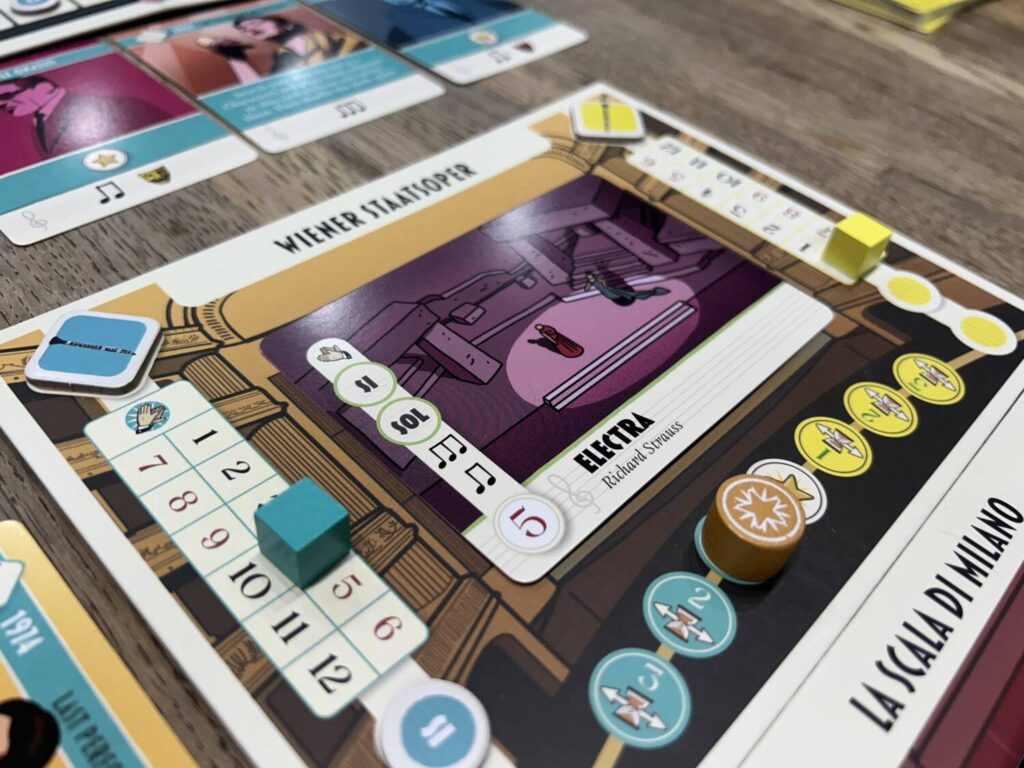
The game would improve with simplification. The difference between Fame and Applause and actual Points takes a while to settle in your mind. Tracking whether you’re playing the first matching Rhythm or the second one, whether it matters if your opponent has already played a Note or not, and whether or not all the cards in the Timeline are in order, is not enjoyable. It’s fussy.
I guess “fussy” is appropriate that a board game about mid-century opera divas. It’s thematic. I’ve written two professionally produced operas, and I have had wonderful working relationships with several divas, so I’m allowed to make that joke. The Events are probably the high point of the game. It is genuinely hilarious that I, playing as Marie Callas, get to kill my opponent’s mother. There are these little bursts of light.
For the most part, though, The Battle of the Divas exists in darkness. For all the wonderful art, the wonderful colors, and the attempt at doing something new, The Battle of the Divas feels a bit too much like accounting. You’re not telling a story or engaging in a cut-throat battle of wills. It’s too abstract. I kept waiting for the aria, and instead I got a box full of recitative.