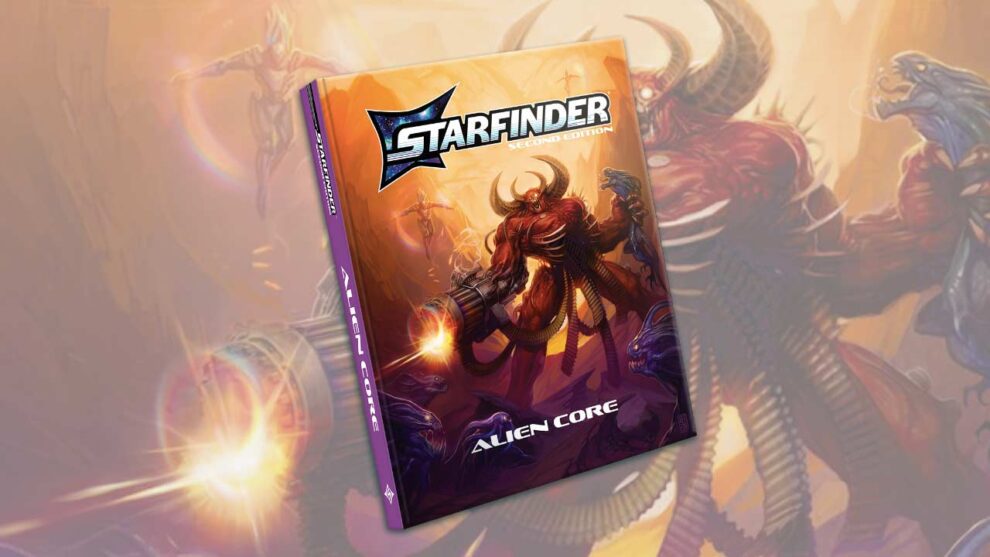

Disclosure: Meeple Mountain received a free copy of this product in exchange for an honest, unbiased review. This review is not intended to be an endorsement.
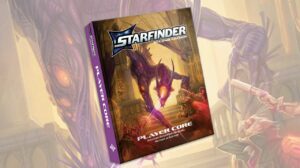
If you’re a Gamemaster running Starfinder Second Edition, the Starfinder Alien Core is your de facto manual of monsters. It promises pages upon pages of strange creatures that would feel at home in any sci-fi world. Some are geared more towards horror, others are more techy, and some are there as classics to hit you with a nostalgia bomb. Let’s take some time to run through the highlights of the book.
Starfinder Alien Core
Right off the jump you are greeted with the full alphabetized table of contents for every creature featured in Starfinder Alien Core, including visual breaks for each set of letters to prevent the usual wall-of-text layout. Directly afterward is a brief section that describes the different aspects of a creature’s statblock, how to play creatures, and making adjustments. I was quite surprised looking back at the Starfinder GM Core that this information was never included. There is more in-depth guidance into custom creature creation, but nothing that lays out the aspects of the statblock as succinctly as this.
Then it’s time to dive right into the 200 pages of creatures, typically featuring one on each page. The general flow of information starts with a brief snippet of lore about the creature to set the scene, followed by the creature’s statblock. The sidebar also always features an extra bit of lore, location information, related creature references, treasure/rewards details, additional rules, or related hazards.
Don’t skip the sidebar!
I’ve found that my favorite facts come from the sidebar, which oftentimes allude to something that you could build an entire campaign or one-shot adventure around. For example, the entry on omnipaths—parasitic lamprey-like creatures who inhabit war machines powered by nanotechnology—suggests that there is a great war involving the omnipaths and godlike eldritch beings dwelling in the far reaches of space. Those sidebars may be small, but they pack a big narrative punch.
Starfinder Alien Core is a breeze to navigate thanks to the guide on the outer margins. You can see which creatures are coming up next at a quick glance, since there isn’t a perfect distribution of creatures starting with each letter in the alphabet.
As far as actual creatures, there is a healthy assortment of demons, fungal creatures, humanoids, robots, technology-based creatures, pirates, undead, eldritch horrors, and of course, dragons. There are a couple that stood out to me as prime fodder for an entire adventure, I would classify most of the creatures under a singular designation of being cool. The nice thing about Starfinder is that Paizo can really take their creativity out for a walk in a way that Pathfinder Bestiaries did in the later editions. Once you get to Bestiary 4 and 5, you already have published the low-hanging fruit for a system between the earlier Bestiaries and the published Adventure Paths. Starfinder Alien Core takes that same energy and necessity for creative thinking to give us a treasure trove of fun creatures.
I’m not going to do a comparison between the creatures in Starfinder 1E vs Starfinder 2E to see how many of them are just rebuilt from previous models. The point is that these are all compatible with Pathfinder 2E (Remastered) as well, meaning that you can slot them into either game to create the table experience that you’re looking for.
Reviewing a book that is essentially just entry after entry of creatures can be a challenge, as there are only so many different ways that I can emphasize the volume of content. It is also worth noting that the entirety of the creatures featured in Starfinder Alien Core can be found on the well-known Archives of Nethys site with most—if not all—of the associated flavor text that you would find in the book. It’s a nice way to filter content for a particular Paizo book and see if enough content catches your eye to pick up a physical copy or PDF.
Starfinder Alien Core: Notable Observations
Of all the creatures present in Starfinder Alien Core, three have been on my mind constantly since reading their entries because of the story possibilities they offer.
Paradox 17
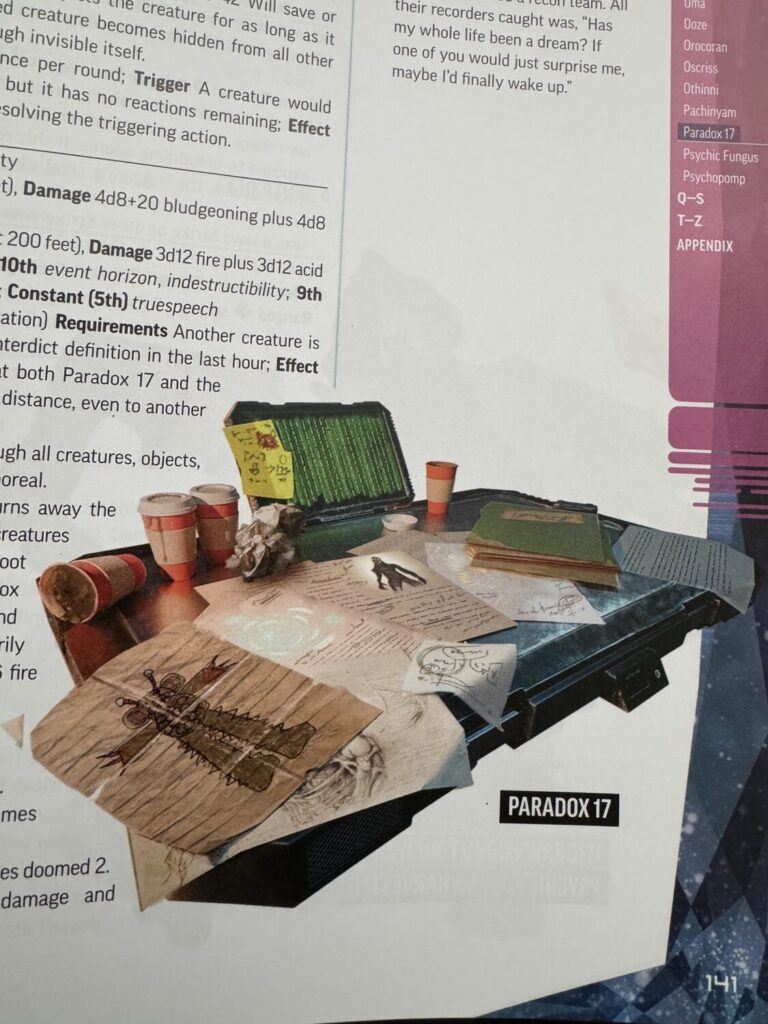
Designed to be a big bad and not your everyday run-of-the-mill monster, Paradox 17 is a manifestation of existentialism. It is as much a living being as it is the overlying question that everything you experience is just a dream. Like if The Matrix was a creature.
Even the art for this creature is just a desk littered with notes, spent coffee cups, and that telltale vibrant green digital rain on a touchpad. The creature is naturally invisible and can travel instantly to anybody who has had a revelation about its existence in the past hour. It takes an absurd Will save to even witness Paradox 17 if it’s floating right in front of you. It is not something to be trifled with.
There are few things quite like an invisible adversary to throw the party on edge. When people in a crew get picked off one by one and you’re shouting at the screen for everybody to stay together and not wander off on their own. Paradox 17 is the perfect focal point for a sci-fi horror campaign, even lending itself towards some illusory ‘real-world’ dream sequences and misdirection.
Tax-Class Civil Robot
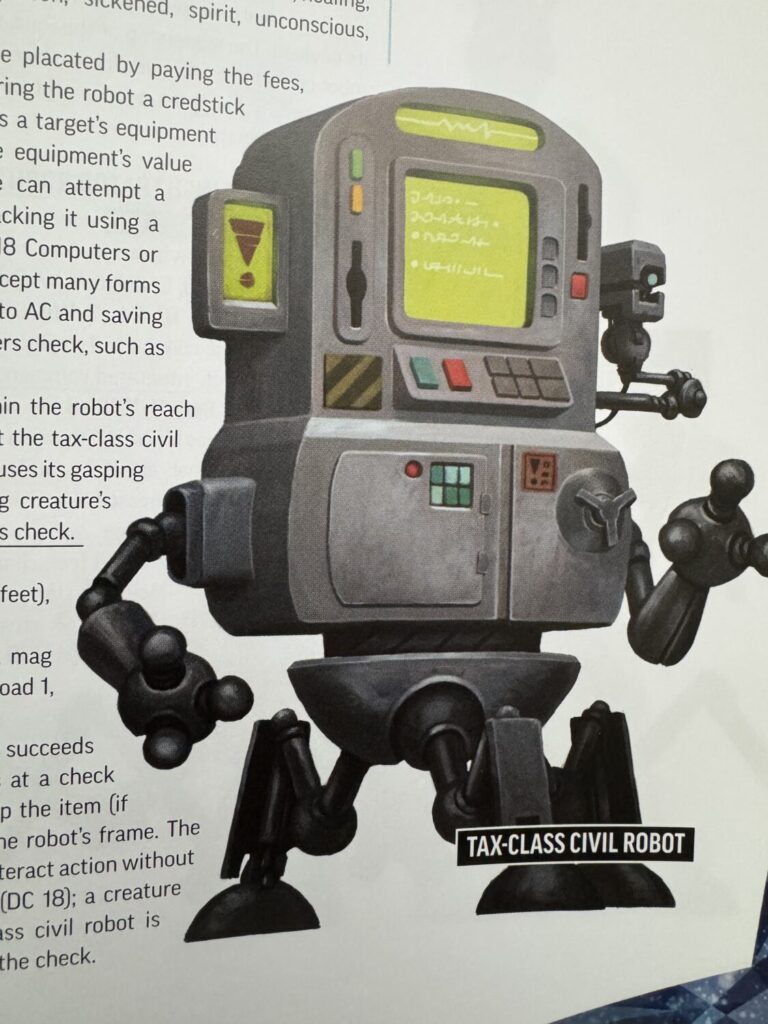
Flipping the script completely, we have the Tax-Class Civil Robot. Made by your friendly neighborhood middle management clerics at AbadarCorp, these annoying robots harass debtors to repay what is owed, skimming off a portion for AbadarCorp in the process. Debtors don’t even necessarily have to pay the entire debt; usually paying a portion that covers late fees is enough to delay the robot from its continual harassment.
While a campaign riddled with bureaucracy and paper-pushing seems moderately enticing, this entry led me to a character concept of a debtor who purposefully keeps the civil robot around, mostly to soak up the energy blasts from plasma rifles. Perhaps they’ve developed a certain form of friendship because of constant interaction or due to some reprogramming or glitch in the system. I could see them also coercing or persuading the robot that their enemies have high outstanding debts, for a nominal fee.
Hardlight Weaver
The main draw for me on the Hardlight Weaver is the art because I’m always appreciative of the synthwave style. Hardlight life-forms appear to be holograms but are actually tangible, living entities. Think Cortana or Obi-Wan in the original Trilogy, but like if you could actually interact with them through touch.
Hardlight Weavers are variations of these beings that have actually melded or malfunctioned partially with their environment, including other holograms. This turns them into an amalgamation of perhaps several different creatures and partially incomprehensible blobs of light. Not only are they effective at close or long-range thanks to their VR spikes and bolts, but they can also construct Virtual Roadblocks that impede non-hardlight life-forms.
As a concept, I love hardlight for its inspiration of a Leaking VR campaign. Some huge, blockbuster VR game has the universe in its clutches before the code breaks or merges with a sentient AI and hardlight forms begin spilling out into the real world. It would be a spin on a Ready Player One mixed with some Dungeon Crawler Carl and could be exceptionally fun.
Starfinder Alien Core: Every Page a Story
Starfinder Alien Core works so well because every entry holds promise and possibility. With such a wide variety of creatures, there is something that fits with every campaign. The majority of the creatures are under Level 10, which makes sense considering a vast majority of campaigns don’t even come close to reaching the Level 20 cap. None of the creatures feel like statblocks; they all have backstory and lore allowing them to be integratable into the story.
You could fill numerous adventures with the contents of Starfinder Alien Core, but knowing Paizo, we’ll be getting at least two more Alien Core books down the road. You’ll never run out of monsters!