
Disclosure: Meeple Mountain received a free copy of this product in exchange for an honest, unbiased review. This review is not intended to be an endorsement.
My first play of Somnia, Kazuma Suzuki’s confounding li’l trick-taker, ranks among the worst trick-taking experiences of my life. It was horrendous, a trudge through the marshes to get to the end. The scoring was so oblique as to render meaningful gameplay impossible:
If any player meets or exceeds 86 points, they lose a life, unless they are the only player who scored any points, in which case the other three players each lose a life. If there’s a four-way tie, everyone loses a life. If everybody scores some points and the top two players tied, they each lose a life. On the other hand, if the bottom two players tied, then the player in second place loses a life. If the top two players are tied and the bottom two players are tied, then they all lose a life. If none of the above listed outcomes are the case, then the players in second and third each lose a life.
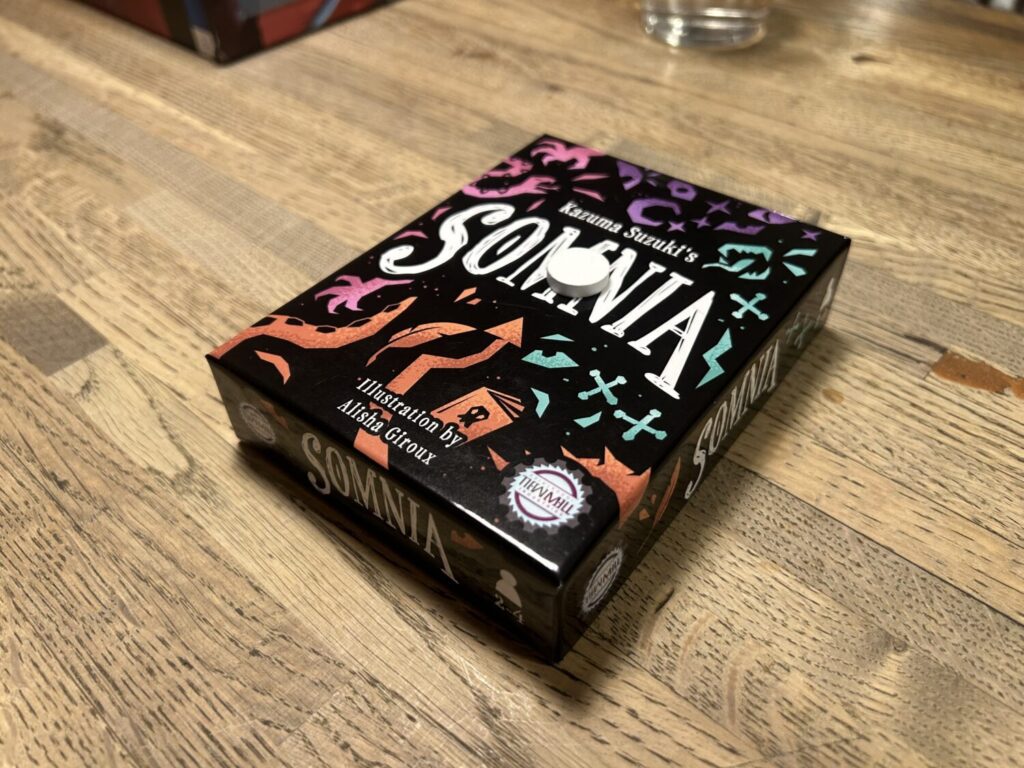 I can’t speak for you, but I personally cannot track all of those hypotheticals, follow all those contingencies, during a fast-moving trick-taking game. Especially not one where the point values of cards vary, and even within that vary depending on whether or not that card is in the trump suit. Part of what makes trick-taking such a compelling form is that your purpose is always clear, at least to you. Somnia at four players had no sense of clarity, nor did it reveal deeper intentions with repetition. It was confusing.
A few months later, once I thought my friend Nathan would have forgotten enough of the details to be willing to play again, we gave Somnia another try. This time, we played with three instead of four, which meant we were subject to a different set of scoring rules:
If any player fails to take at least one trick, they lose a life. If every player has at least one trick, any player with 100 points or more loses a life. If neither of these are the case, any tied players lose a life, or the player who comes in second place loses a life.
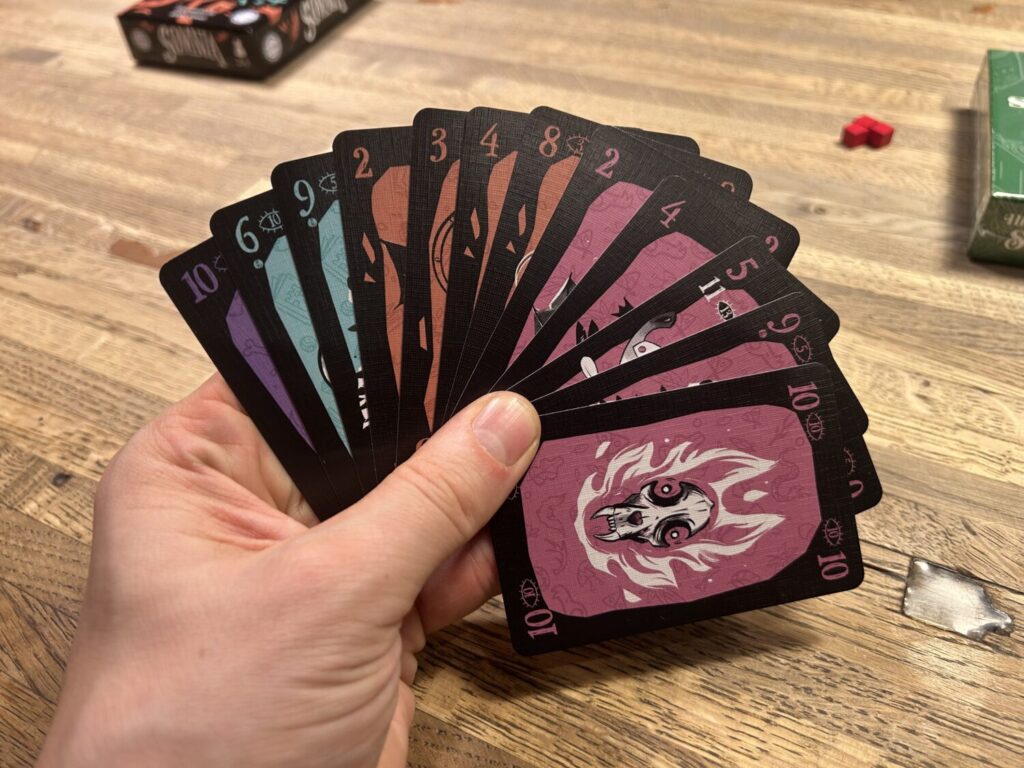 That’s much better. You can boil that down to a few easy heuristics. Even if you aren’t someone who naturally counts cards, these are rules you can feel. They turn each hand into a fascinating, reactive exchange. If two of the three of you are able to successfully fatten up the third player, you can try to push them past 100 points, turning the game into a 2-against-1 with everyone on the back foot. If it starts to feel like that’s not happening, players pivot, and Somnia becomes a dogfight to try and come out on top or on bottom, a furious effort to avoid the middle.
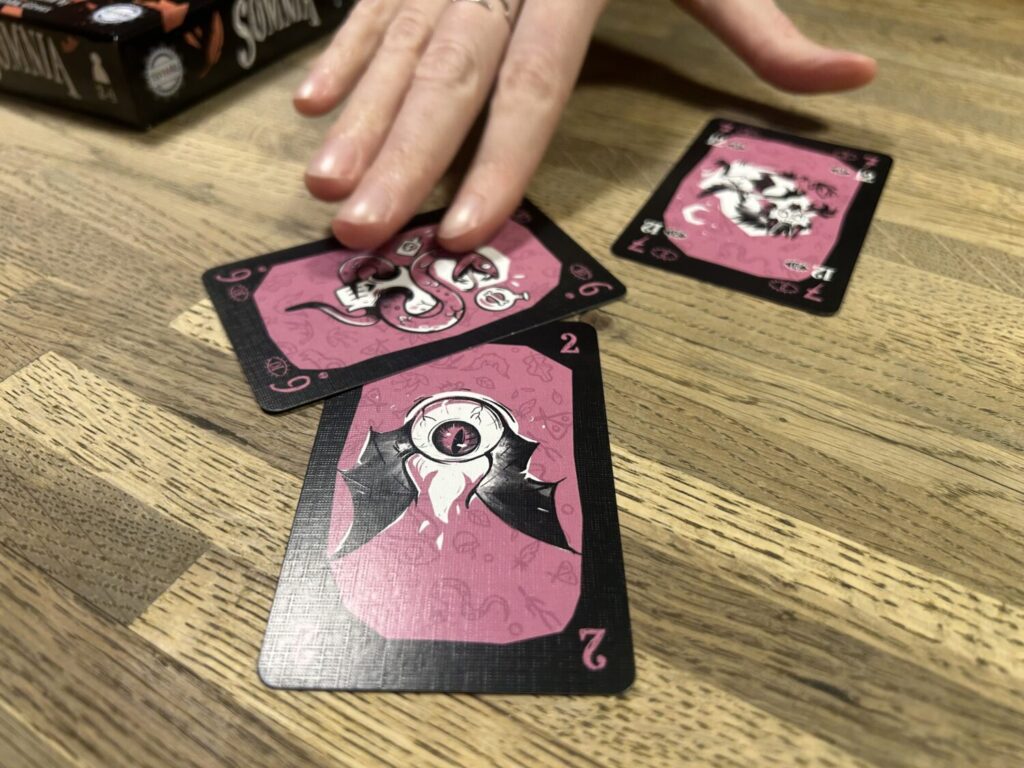
This is rare. There aren’t many trick-taking games that provide such malleable dynamics. It’s a ruleset that allows Somnia to feel like one trick-taking game and then another, to shift in front of the players as a result of their choices. It’s funny, frustrating, challenging, clever, and, on top of all that, the card art is beautiful. After a rough start, Somnia ranks among my favorite trick-taking games, one I will happily play anywhere, anytime. So long as there are only three players at the table.