
Disclosure: Meeple Mountain received a free copy of this product in exchange for an honest, unbiased review. This review is not intended to be an endorsement.

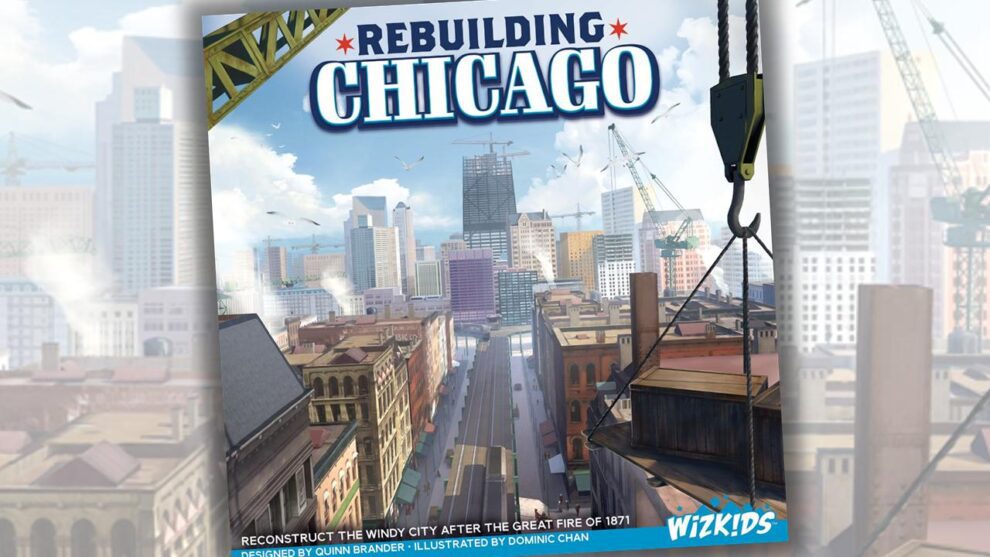
I’m not quite sure what to make of the new game Rebuilding Chicago, the second game in a series from the team at WizKids that began with the 2023 release Rebuilding Seattle. Like the first game (which I have not played), Rebuilding Chicago puts players in the shoes of local officials tasked with rebuilding a major city after a tragic event—here, the Great Chicago Fire of 1871.
Except…well, it’s not really about that at all. Rebuilding Chicago is a three-round tile-laying affair that takes place in three specific years: 1893, 1933, and 2016. I get the first two, since those are tied to the two World Fairs hosted by the city and they are widely celebrated as years when Chicago celebrated itself for rebuilding large parts of the city’s infrastructure. But 2016? That’s when the Chicago Riverwalk opened.
The Riverwalk is a blast. I’m just not sure I would call it a major rebuilding event across the city’s previous 125 years.

I’ve lived in Chicago since 2012, in a suburb just west of the city limits. When I first saw the round structure for Rebuilding Chicago, I kind of laughed. I wasn’t sure what the designer of the game, Quinn Brander, was going for with the Chicago framing. (Brander is also the designer of Rebuilding Seattle.)
Players take turns to buy tiles from a market, tiles in seven different flavors (six building types, and statues) that help a player build out their District boards and the suburbs surrounding their district. These tiles are used to cover empty spaces, or to help a player extend their suburban network. Players can also trigger once-per-round events, using a mechanic similar to games like Puerto Rico where the active player gets a slightly better benefit of an event than other players. They can also enact a law, a one-time or ongoing benefit, once per round.
But none of the tiles capture anything resembling a city planning game. It’s probably more accurate to say that Rebuilding Chicago is a “grid coverage” game. That’s not a knock. In fact, fans of Tetris, mixed with players who like the challenges presented by games like The Princes of Florence (the tile placement part, not the auction part), might feel right at home with Rebuilding Chicago, since buying new tiles from the market is tied to buying the right cards at the right moment to fill up your grid.
Each player’s District Board has tracks which can boost event scoring. There is an unhappy population marker that can negatively affect scoring during events. The District boards call out six different real-world Chicago neighborhoods, but as someone who lives in Chicagoland, I was hoping that the boards might provide more local flavor, such as a starting map structure that looks like the place in question, or a more accurate depiction of what makes each area special.

Locals might quibble with the edges, but broadly, River North is the nightlife area of town, along with the Fulton Market area. But based on the symbols of the River North starting grid, River North is more of a shopping district than a nightlife district. Fulton (which locals know as Fulton Market) has a nightlife focus on its starting grid, but Fulton Market and the West Loop are the hotspots in Chicago for new restaurants.
The best way to lower a player’s Unhappy Population marker during play is the Graduation event, which lowers that marker based on the number of education symbols. Personally, I would prefer a mechanism that addresses crime or taxes or cleanliness or…a lot of other things before I would call out education as the main reason why people might be unhappy about damn near anything. But the game we have is the game we’ve got.
Player turns are fast, and finding ways to score points make sense here. I liked the three different Law options on each District board, and most were useful ways to attack the game’s systems. Each card in the market offers a new shape to add to a player’s District board on one half of the card, while the other half can serve as an end-of-round profit opportunity or end-game scoring boost.
So, sometimes the card choices are juicy. Money is tight early on, but across my plays I found different ways to use the events to increase my cash in hand. Special milestone cards drafted during setup give players fun ways to score a lot of points near the end of the game by building unnamed but familiar Chicago landmarks. (That baseball stadium? Sure LOOKS like Wrigley Field!)

Here’s where I’m going with all this. Rebuilding Chicago isn’t a bad game. Occasionally, it’s fun to build out a city based on the ever-changing market of tile cards. Timing track jumps with the events can also be fulfilling. I’m not sure anyone jumped for joy during my plays of Rebuilding Chicago, but it featured some fun turns and it has a solo mode that is very simple to administer, albeit at the cost of flipping a lot of cards from a solo deck to take the actions of an AI counterpart.
My main issue with Rebuilding Chicago? At no point does it even remotely feel like you are rebuilding Chicago. It never felt like it was 1893 or 1933. It never drives players toward working with other Chicago alderpeople to build out a cool-looking map or Chicagoesque grid. (In fact, everyone’s board layout is the same at the start of play, in terms of the pre-printed building shapes…the only differences come in the color of those shapes.)
The game features a lot of the keywords I wanted to see: the first player is chosen based on who last had a deep dish pizza. OK, funny! Almost no one in Chicago actually eats deep dish pizza, but that’s the kind of stereotype that gets me excited. But that never extended into the gameplay. Once a game gets rolling, players quickly move through their turns to draft a bunch of tiles and make pretty shapes.
A couple of minor complaints surfaced during my plays. The first is that the rulebook is strangely short; I can’t think of the last time I openly wondered why a rulebook came with not nearly enough information. In a couple of cases, I went online to see if BGG had answers to some of my questions. Also, Rebuilding Chicago plays up to five players. My advice? Don’t play this game at five players. Stick to solo or two-player games, because the highest player counts only add downtime, since there is almost zero interaction between players outside of the event cards.
Rebuilding Chicago comes with a very handsome and useful insert, but unless you take the suburb tiles out of their included storage bag and splay them around the box, the game’s lid won’t completely close. I can’t figure out why this decision was made; there’s a perfect place for all the game’s tiles as well as all the cards, player boards, and main board. But the suburb tiles felt like an afterthought, from a storage point of view.
Rebuilding Chicago. It’s not bad. Unfortunately, the tile placement category in tabletop is a ridiculously crowded (some might argue that it is overcrowded) space. When considering some of the peers in this space, I’m not sure Rebuilding Chicago ever attempts to innovate or out-quality any of the best games that exist here, from Azul to Ark Nova to Cascadia, or even polyomino shape games like A Feast for Odin, Planet Unknown, or Patchwork.
So, if you are looking for something that speaks specifically to your love of Chicago, maybe Rebuilding Chicago is worth a look. As a local, I was hoping for something really special.
Rebuilding Chicago details
- Designer: Quinn Brander
- Artists: N/A
- Publishers: WizKids (I)
- Release Date: 2026
- Player count : 1 - 5
- Age range : 12+
- Time range : 60 - 120 minutes
- Mechanism(s): Grid Coverage, Income, Square Grid, Tile Placement
- BGG Geek Rating: 7.77778 - converted to Meeple Mountain scale: 4.0.
- More articles about Rebuilding Chicago.