
Disclosure: Meeple Mountain received a free copy of this product in exchange for an honest, unbiased review. This review is not intended to be an endorsement.

If you’re reading a review of Reiner Knizia deep cut Ratzia, I figure there’s a good chance you are already at least passingly familiar with the game Ra, the Egyptian-themed auction game with strong push-your-luck elements first published in 1999. Ra is regularly considered one of the greatest board games ever published. It has a hardy rating of 7.7/10 on Board Game Geek, and sits at #117 in their overall rankings. Not too shabby for a game that came out nearly 30 years ago, and that success is certainly deserved. Ra is a terrific game.
Neither Ratzia, nor its previous iteration Razzia!, are so fortunate. Both are held in comparatively slight esteem. Ratzia, a mafia–themed auction game with strong push-your-luck elements, is rated a 6.8 on BGG as of writing, and sits low enough in the rankings that the actual spot doesn’t warrant mentioning.
I find this curious, because Ratzia and Ra are effectively the same game. I do not mean to say that they are similar. No. They are, rule-for-rule, the exact same game. There are a few extra tile types in Ra, but that’s it. These two games are more closely related to one another than Hitchcock’s Psycho is to Gus Van Sandt’s shot-for-shot remake of Psycho, which at least had different actors. So why this discrepancy of an entire point in ratings, which may not seem like much on paper but is roughly the space between an A and a C+ within the BGG ecosystem?
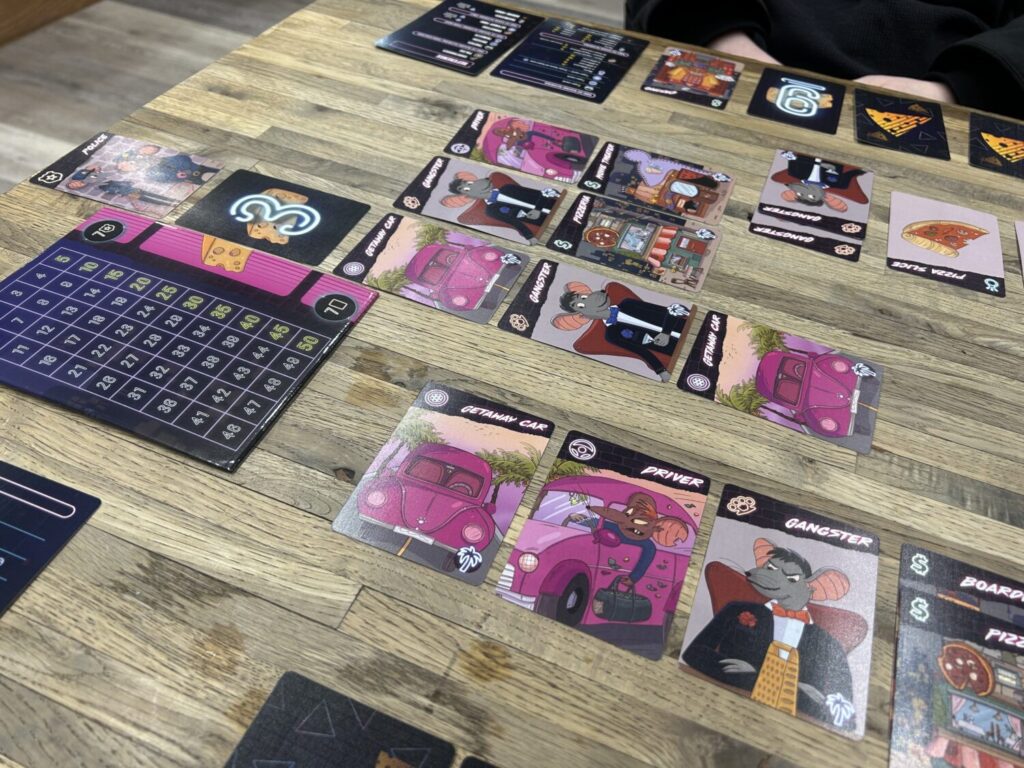
Aw, Ratz
In the event that you aren’t familiar with Ra, Razzia!, or Ratzia, let’s rectify that. This is an auction game in which you have two options on your turn: you can add a card to the pot, or you can start an auction for the pot as it stands. Adding a card is as easy as it sounds: draw the top card off the deck and place it in the auction row. Starting an auction is also easy: starting with the player to the left of the player who initiated the auction and moving clockwise, each player gets one chance to bid.
The values you can bid are fixed, determined by the bidding cards you have in front of you. They run anywhere from 1-16, depending on the number of players, and every bid has to be higher than the previous one. If you sit before me in the bid order and you bid with your 10, having seen that my highest bidding card is an 8, there’s nothing I can do about it. I have to pass.
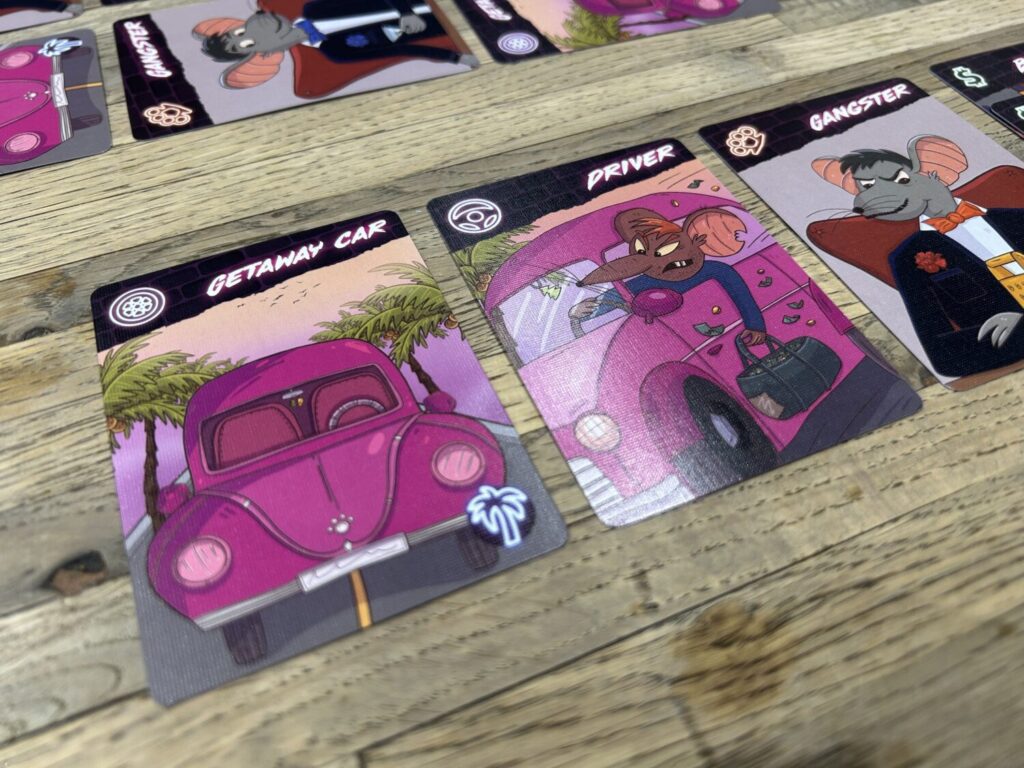
The winner of the auction takes everything from the pot and places it in front of them. You score points at the end of each round and at the end of the game for the sets you have in front of you, though different things score in different ways and at different times. Getaway Cars, for example, are worth one point each at the end of each round, though they’re worthless unless you also have at least one Getaway Driver, who is also worth one point. Getaway Cars stick around, but the drivers are less steadfast; after scoring at the end of the round, they leave the rat family. You’ll have to try and hire more next time.
Other sets score for variety, or as area majority, with players losing points for having the least in that category. The brew of these different set collection mechanisms working together makes the decision of when to start an auction a rich one. There aren’t many auction games where an auction can be started as an act of aggression, but Ra is just such an auction game. If you see a tile in the pot that someone wants, you can start an auction just to make them overpay. There are times when a player will start an auction who has no intention of bidding, and that I think is a beautiful thing.
There’s something else to consider when bidding in an auction: the bidding card you’ll win. During setup, one bidding card is placed next to the pot, to be taken by the winner of the first auction. You swap it out for whatever card you won the auction with, turning your newly-acquired bidding card facedown until the end of the round. This adds an extra bit of pressure to the proceedings. The cards in the pot may be good ones, but if my only option is bidding with 15, are those cards worth turning my 15 into a 2 for next round? That’s tough stuff.
Oh, I forgot to mention that there are external pressures applied even to the decision of adding a card to the pot: the deck is lousy with Police Officers. Every time one is revealed, an auction immediately starts, and if a seventh Police Officer is revealed before the last player has used up all of their bidding cards, the round ends immediately. It’s the fuzz, cheese it.
A Ra by Any Other Name
Thinking back to the difference in reputation between Ratzia and Ra, presentation is the only thing that separates them. Ra uses tiles, while Ratzia uses cards. Ra is about Ancient Egypt, while Ratzia is about rodents who work in waste management. I think I prefer the setting of Ratzia. It makes the whole game feel less abstract. I spend significantly less time reminding myself how each card type scores, because they are intuitive to the setting. I want to have more Gangsters than you. I need a Getaway Driver for my Getaway Car to be worth anything. I want lots of different Loot, which gets sold at the end of each round, and I want lots of different Businesses, which stick around until the end of the game. I can send my Thieves away to snag something from the pot for me. This all makes much more sense than Civilizations and Pharaohs and Gods and all that.
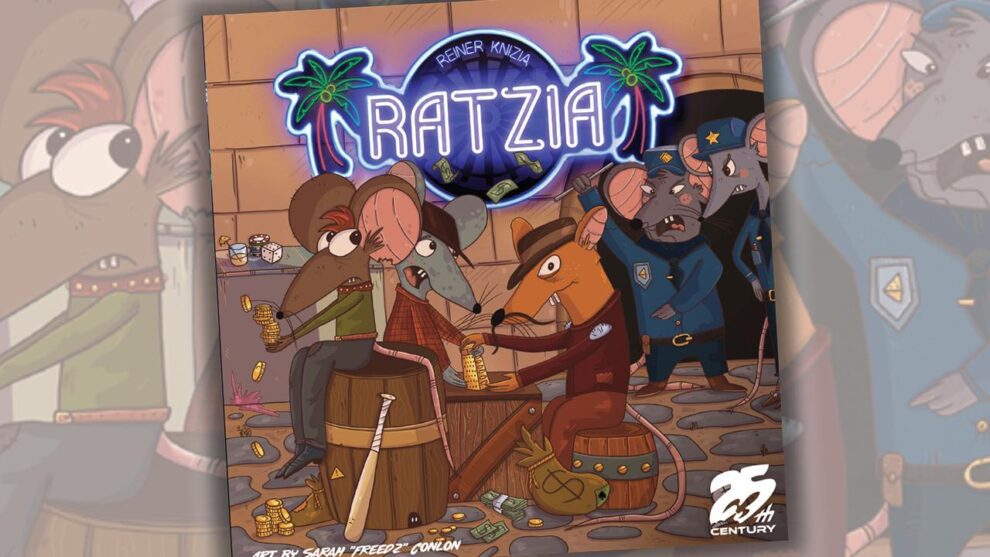
It probably doesn’t help that Ratzia looks a little cheap. The art on the cards leaves something to be desired, and I myself certainly didn’t assume this box contained one of the consensus All Time Greats of board gaming. But that brings us to what I think the real issue is: groupthink. You can’t have a consensus without people buying in, and I think everyone has, over the last 30 years, bought in on Ra, on the idea of Ra.
My question to everyone, then, is this: Are we underestimating Ratzia, or are we overestimating Ra? I imagine it’s a bit of both. Look, I adore Ra, because I love designs that marry pushing your luck to imperfect decision-making, but it probably isn’t nearly as For Everybody as its status would suggest. Like a movie you’ve always heard good things about, people go into Ra looking to be charitable, so they largely come out positive. Meanwhile, Ratzia, with its cheap-looking art, has about it the air of a knock-off. And, in some ways, it is one, so that’s fair. This is a copy of a copy of the original. What can you do?
I’m not suggesting there’s a problem with any of this, by the way. It’s just an observation. We’re social creatures, and that comes with its own ticks and peculiarities. Two games, both alike in dignity, yet different in their station and esteem. Funny thing, that. Anyway, Ratzia’s great.
Ratzia details
- Designer: Reiner Knizia
- Artists: Ivan Iserte, Michael Menzel, Sarah "Freedz" Conlon
- Publishers: 25th Century Games, AMIGO Games, Dragonfly Publishing, Primigenio
- Release Date: 2004
- Player count : 2 - 5
- Age range : 12+
- Time range : 45 minutes
- Mechanism(s): Auction/Bidding, Push Your Luck, Set Collection
- BGG Geek Rating: 6.844 - converted to Meeple Mountain scale: 3.5.
- More articles about Ratzia.