Disclosure: Meeple Mountain received a free copy of this product in exchange for an honest, unbiased review. This review is not intended to be an endorsement.

When I reviewed Nine Men’s Morris a few years ago, I noted it is one of the oldest recorded games, with boards having been found “etched into ancient roof tiles and still exists in a temple from the 9th-10th Century AD in Karnataka, India.” Since then, I’ve also learned that a blogger had discovered the board “scratched onto the side of Charlemagne’s throne in Aachen [and] at Canterbury Cathedral, Salisbury Cathedral, and Westminster Abbey in England.”
Given the historical popularity of this three-in-a-row game, it’s not surprising that there have been many variations over the years—or that variations have continued into modern times. One such variation is Gigamic’s Qomet.
The board is based on the Twelve Men’s Morris board, where the corners of the three squares are connected by a diagonal line. Designer Fabrice Puleo added a central space to give Qomet its unique design.
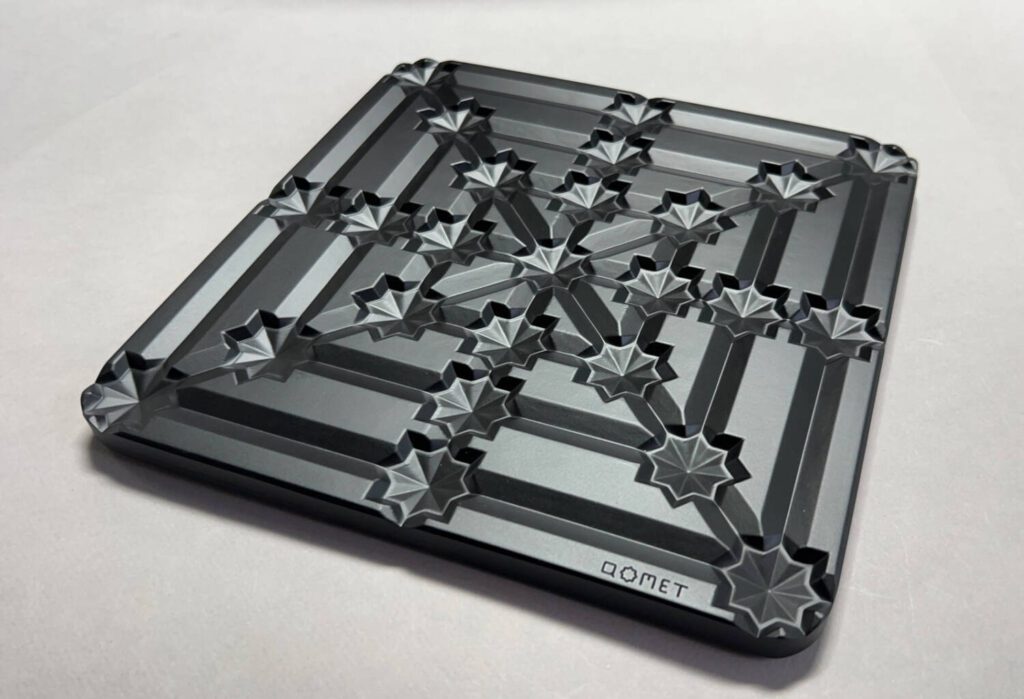
Next, he changed the number of pieces per player from 12 (or 9) to 7 and created a unique winning condition: the first player to form a square takes the game.
On your turn, you can either place one of your 7 wooden stars on any open space on the board or you can move one of your stars along the pathway to the next spot.

If another piece is occupying that space, provided there’s an open space in a straight line just past it, you’ll bump that piece into that further space. (If there’s no open space, you cannot push the piece.) You can bump your opponent’s piece or one of your own.

Qomet is another abstract strategy game in Gigamic’s line of “Q” games. (Quoridor, Quoridor Pac-Man, Qawale) These games come in a wooden, coffee table display format that makes them a pleasure to study while you’re playing. The rules for these games are simple enough to teach and start playing in a minute.
My first games of Qomet were won or lost due to one of us missing an after-the-fact obvious move. This, of course, prompted emphatic requests to play again. Soon enough, games became longer and more considered. Do I play all 7 of my stars to the board early? Or do I hold one (or two) in reserve and build a strategy around them? Should I force my opponent to place one of their stars on the other side of the board to stop my square, effectively leaving them one piece down?
The beauty of a well-designed, modern abstract strategy game is that it is easy to teach, easy to start playing, and reveals the complexity of its strategies the more you play. Qomet fits this description easily.
Whether you’re looking for a new abstract game to add to your collection, to play with your family, or burn some brain cells over, Qomet is worthy of your consideration.
Qomet details
- Designer: Fabrice Puleo
- Artists: (Uncredited)
- Publishers: Gigamic, Hachette Boardgames UK, Hachette Boardgames USA
- Release Date: 2025
- Player count : 2
- Age range : 8+
- Time range : 15 - 0 minutes
- Mechanism(s):
- BGG Geek Rating: 6.81525 - converted to Meeple Mountain scale: 3.5.
- More articles about Qomet.