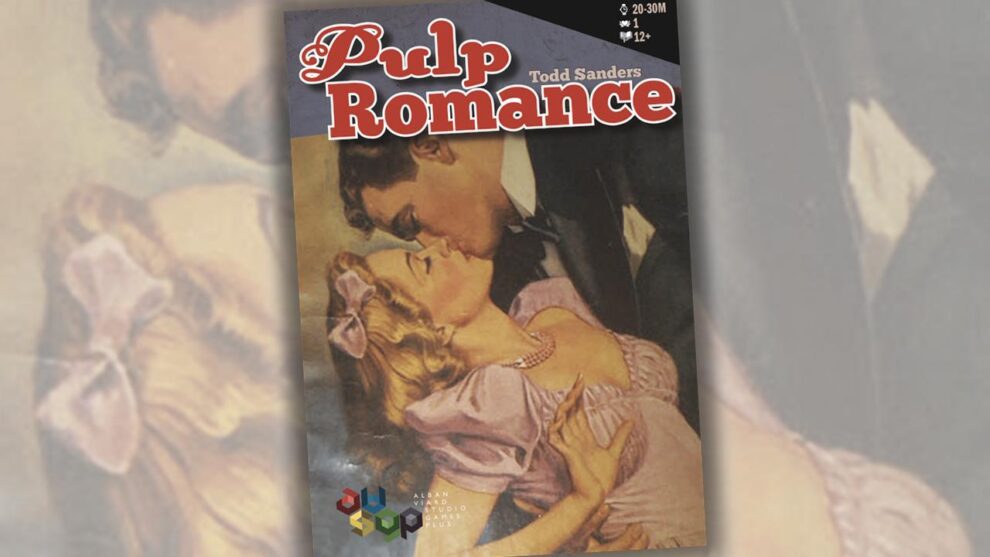

Todd Sanders’ latest work in the Pulp series (Pulp Detective, Pulp Invasion) is Pulp Romance. This is a game that simulates the sort of old-style romance novels and movies that seem (from a literary standpoint) quaint or dated by modern standards. That is in no way an insult! Some of those stories are simply the best examples of storytelling that exists—one need look no further than such classics as Casablanca to understand what I am saying here.
From a base game and core mechanics standpoint, this is the strongest game Mr. Sanders has produced in the series. As with the previous games, you can almost hear the narrator in your head as they describe the conflicts in the mind of the protagonist as they navigate the stormy waters of the heart. It is a beautiful game.
This game uses the same source of original pulp-era artwork used in the previous Pulp games, giving a feeling of authenticity that can come from nowhere else. Yes, this remains the real deal! And they remain a beautiful element in the series!
Romances With Attitude (or A Look at This Theme)
In Pulp Romance, you are seeking true love while visiting beautiful and exotic locations around the world. Your lost love has many rival suitors who would steal their affections, and you must reveal them as the false lovers they are before it is too late! In true pulp fashion, this is handled by hiring detectives to dig into their lives.
The game is about managing your funds so as to ensure you have the other resources needed to keep up with your love, while ensuring that the rivals cannot get too close. As with Pulp Detective, the more important aspect of the gamer is the story that takes place in your head as Percy Davenport seeks the heart of their lost love in Nice or Rome or Monte Carlo while staving off the less-than-honorable intentions of a cadre of ne’er-do-well rivals by checking with detectives, reporters, and friends… all while trying to keep your finances secure (after all, international travel, detectives, reporters, friends, and the rest are not cheap!).
Even though the game is quite entertaining, like with the other games in the series, the story that unfolds in your mind as you play is likely more entertaining. That story remains possible because of the beautiful authentic pulp-era artwork and the fast-pace of the game. The theme and the mechanics meld well, better than the others if one is being honest. This game is truly seamless.
Weird Tales (or How to Play)
Pulp Romance has several types of cards that are put into the draw pile. These are Cities, Friends, Rivals, Detectives, Newspapers, and Bankers. The deck is constructed to have few rivals show up early in the game, then escalate as the game progresses. The manner in which this is done is simple and quick.
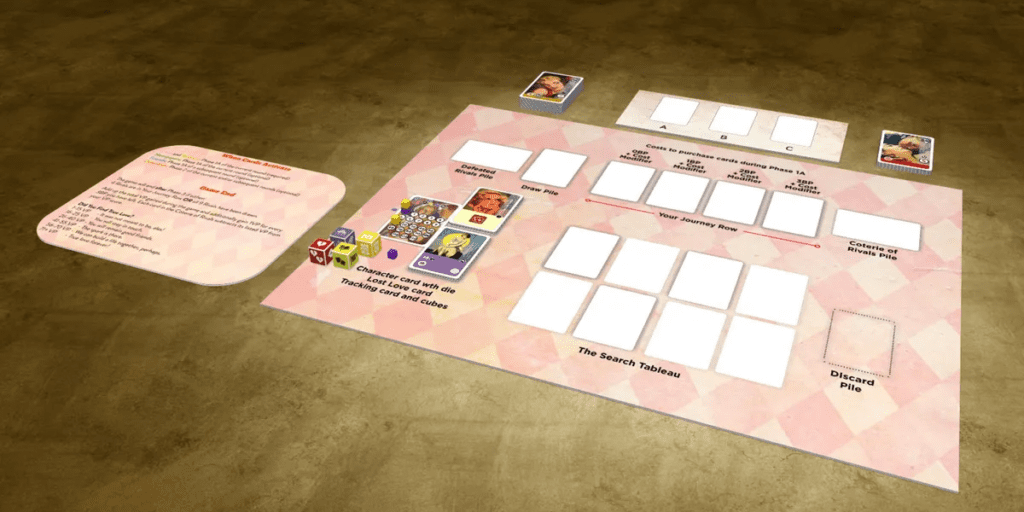
Once the deck is created, four cards are placed into the Journey Row (cards that are available to be acquired by the player), three Search Tableau starting cards (cards you have acquired prior to the beginning of the game). You place markers on the tracking card indicating that you have 0 VP (Victory Points) and 10 BP (British Pounds, currency).
Select a gender from a double-sided character card. Each is associated with one of the four dice in the game. Roll the die once and place it on your character card. The result is a small-to-moderate bonus used for a specific action in the game (e.g., the red die, called the Gossip and Rumors die, adds +1 or +2 to the effectiveness of your detectives throughout the game). With the exception of the yellow die, called the Letters of Introduction die, the face on the die never changes—the rolled face of the yellow die shows how many times it may be used; each use causes the die to be ratchet down one point until it reaches 0 and is removed from the game.
On your turn, the first thing you can do is purchase a card from the Journey Row. The cost is equal to the cost shown on the card, plus a premium for cards the further to the right they are in the Journey Row. Alternatively, you can choose not to purchase a card and instead gather some funds. This will cause the loss of a card in the Journey Row. Any card that is purchased is placed in your Search Tableau and is then activated for its action (if any).
- Cities—activated immediately (required). You gain Victory Points based on the city and icons on cards in your Search Tableau.
- Friends—activated on any future turn (optional). You keep these in your Search Tableau until, on a future turn, you want to activate them. They can be discarded to obtain another card in the Journey Row without paying for it, or to look at the top cards of the deck and put them back either on top or bottom of the deck.
- Detectives—activated on all future turns (optional). The total strength of your detectives determines your ability to eliminate rivals. If your strength is not high enough to deal with a rival, you can spend BP to lower their strength to a point where you can deal with them.
- Newspapers—activated immediately (optional). If activated, newspapers allow the player to discard another card from the Journey Row and either gain VP per that card’s value, or to convert the VP they would have gained into BP. Depending upon the newspaper and the card being eliminated, bonus VP or BP can be gained due to their relationship with one another.
- Bankers—activated immediately (required). When activated, you gain BP for each newspaper in your Search Tableau.
- Rivals—rivals are special. They cannot be purchased, but must instead be eliminated from play via detectives. When eliminated, you gain VP as shown on the rival card.
Your Search Tableau is limited to 8 cards (the game instructs you to place them into a 2×4 grid). If you want, a newly acquired card can be placed over an older card, replacing it. If a card is ever eliminated from the Search Tableau (using a Friend card, for example), then the underlying card is now back. Cards that are revealed like this (or put into the tableau at the start of the game) do not activate for their actions.
The second thing you do is check the total strength of your detectives. Compare that to the strength of any one rival in the Journey Row and see if you can defeat them; remember, BP may be spent to make this easier. If you can and wish to do so, eliminate a rival, placing them to the left of the draw pile and gain the VP indicated.
The last thing you do is to check to see if any rivals are in the Journey Row. If there are any at all, the right-most non-rival card in the Journey Row is discarded to a special pile called the Coterie of Rivals.
Anytime a card is removed from the Journey Row (purchased, discarded, gained by the use of a Friend card, defeated via detectives, etc.), all cards are shifted to the right top fill in any gaps and a new card is drawn to replace it at the far left of the Journey Row.
The game end is triggered when the Journey Row is nothing but four rivals, or all nine of the rivals have been revealed (not necessarily defeated, if the number of defeated rivals plus the number of rivals in the Journey Row equals nine). At that time, total up the number of points in the Coterie of Rivals pile and subtract this from your total score. Compare your score to the following chart:
01–15 — It was not meant to be, alas!
16–25 — You will stay in touch.
26–40 — You will remain good friends.
41–55 — The spark is there.
56–70 — We can build a life together, perhaps.
71+ — True love forever!
Love Story (or My Thoughts)
As indicated above, this is the strongest entry in the Pulp series from a game-play point of view. Nearly all of my reservations dealing with player agency in the previous Pulp games are absent in this latest venture. You have enough information sitting in front of you at all times to make rational and meaningful decisions. There is randomness in the order the cards come out, but you can look at the cards available to you in the Journey Row, look at the cards you have in your Search Tableau, work out what the cost of any given card happens to be, know what the effect of that card will be, and make an informed decision as to how to proceed.
Despite this, the puzzle remains. You need to figure out how to gain Victory Points and how to manage your funds and how to balance your Search Tableau so as to provide you with those things and the resources needed to deal with the rivals before they cause the game to end.
This is a darn good game!
So far, I have played a dozen games or so, and the best I have managed to pull off has been the creation of a good friend. No true love for me.
Yet.
I will keep playing this, and looking forward to the expansions. I have Expansion 1 (Companions), but I have not yet included it in any of my plays. I really want to find true love with the core game first.
Ranch Romances (or LGBTQIA+ Friendly Content)
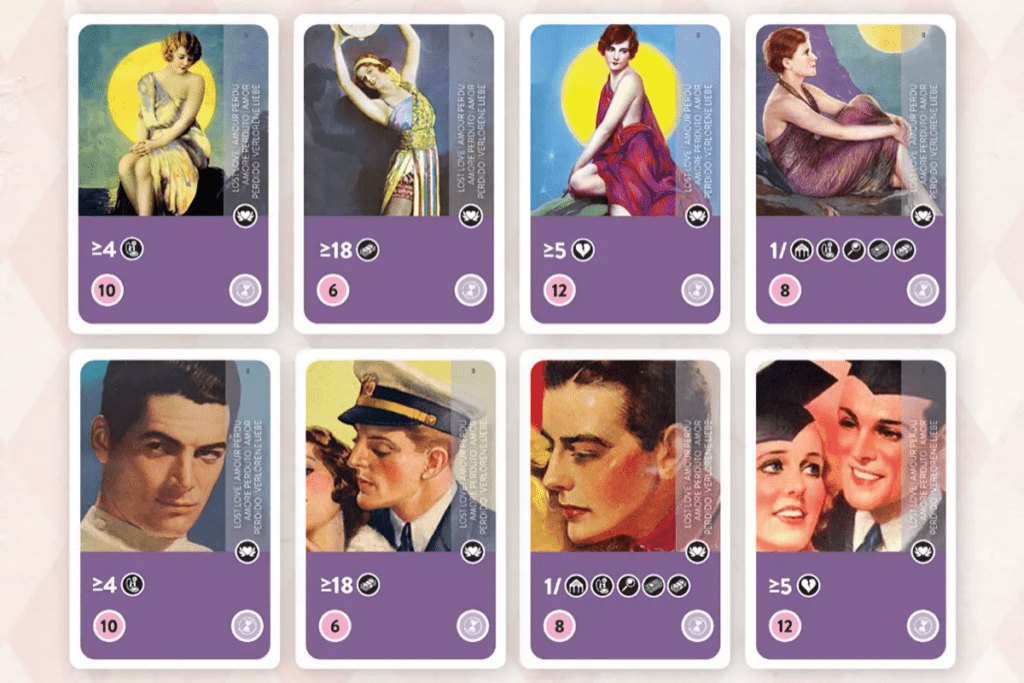
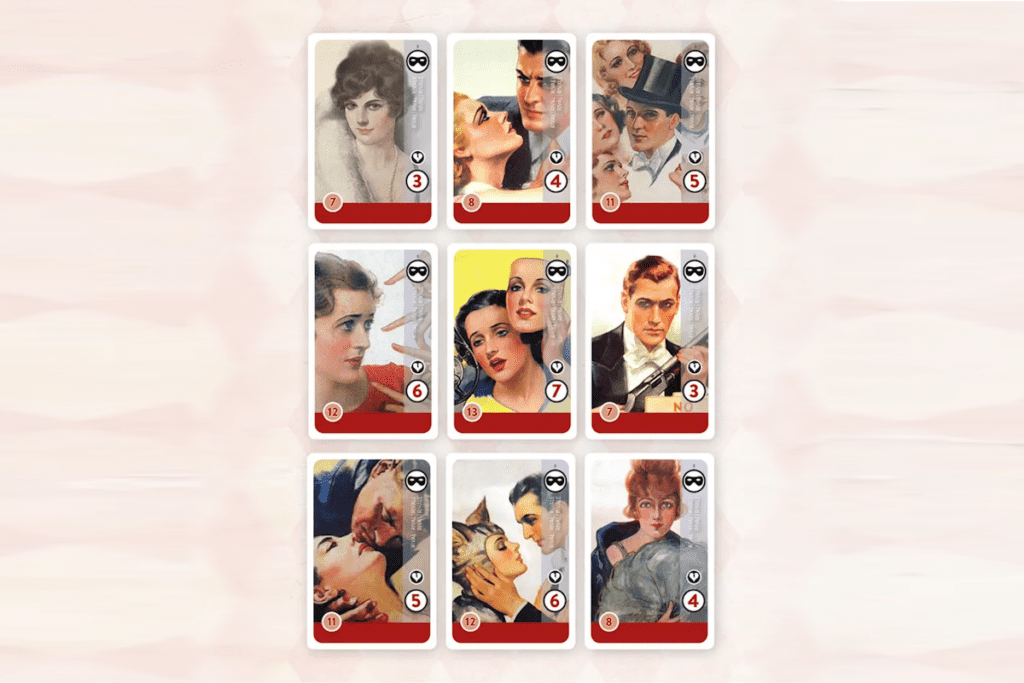
It was early while reading the rules that I realized that Todd Sanders had created something special. It was when I looked at the character cards, the lost love cards, and the rival cards. If you want to play a female character with a male lost love, you can. Just know that you will have a mix of male and female rivals for that lost love’s attention. The same is true if you play a male character with a female lost love… or a female character with a female lost love… or a male character with a male lost love…
As the expansions come out, I am hoping that someone who is Trans or otherwise non-binary, or perhaps androgynous, or what have you will be introduced. I suppose it will depend entirely upon the art he has available.
Which leads me into my one complaint when it comes to this game…
The Argosy (or What is Missing Here?)
Above, I state that the game is truly seamless. For some, this might suggest that the game is a 5/5 and flawless. Not quite. One of the elements of Pulp Detective and Pulp Invasion that made the immersion complete was the combination of the artwork and the pithy text on those cards. That pithy text is missing here.
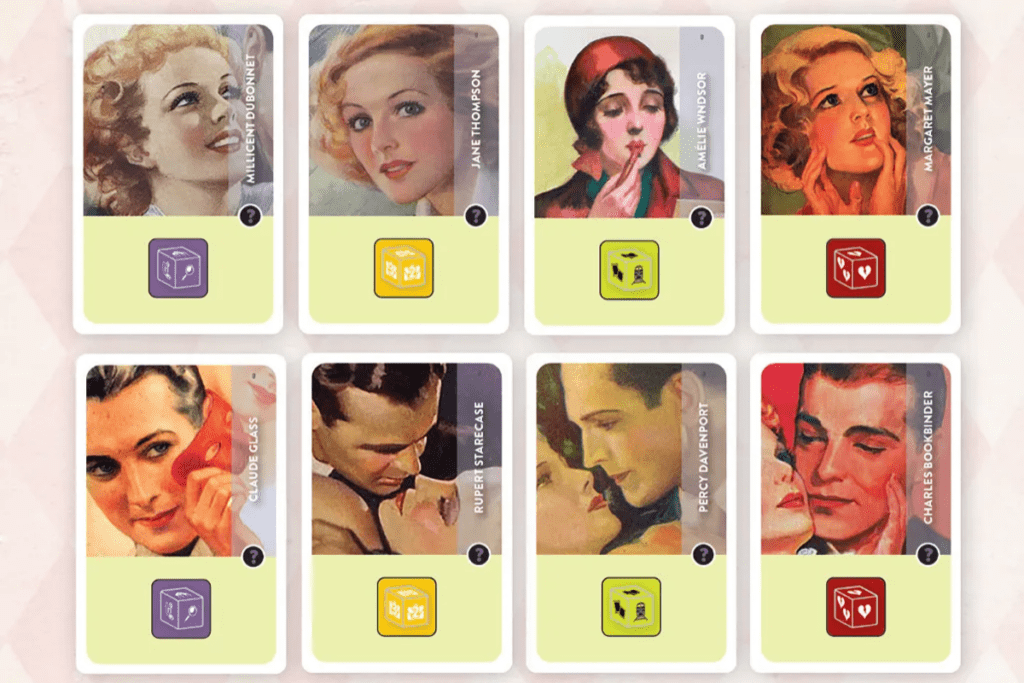
The character cards have names, but nothing to suggest who they might be beyond the image. The city cards let you know what city is being depicted, but have no hint as to what that city might mean to you. The newspaper and banker cards sometimes have enough to let you know the names of the institutions, but not always.
But that is it. Nothing else beyond the images. Granted, the images are beautiful and evocative. But they were in the previous games in the series as well. And Mr. Sanders, in those games, blessed us with some wonderful text, sometimes just a snippet of suggestive words, that added so much to the experience.
Lost loves? Friends? Detectives? Rivals? Not even a name for any of these..
Some of the detective cards have artwork that was used in Pulp Detective. Even if the names (and titles) from those cards had been re-used, that would have been more than enough to allow those images to leap off the cards and have far more meaning than the image or the text alone could provide. Heck, that would have even created a beautiful linkage between the games!
Looking at the gorgeous artwork of the various loves, friends, detectives, and rivals without even knowing their names, let alone their titles or a snippet of who they are, is a tragically sad loss of opportunity. Including this one small detail would have expanded the possibilities for the truly great elements of the game (see Ranch Romances, above).
That said: this is truly my only complaint. Todd Sanders has really outdone himself on this one.