

Disclosure: Meeple Mountain received a free copy of this product in exchange for an honest, unbiased review. This review is not intended to be an endorsement.
I approached Telephone in a dark, isolated room, far from where prying eyes might see us and ears might hear us.
“Telephone, I’m going to make you deal.”
He didn’t say anything. I knew he wouldn’t. Telephone had survived in proximity to the Supreme Socket by being a good listener. I took a drag from my cigarette, its red light dimly reflecting off the gold accents on the walls.
“Neither of us are replacing the Supreme Appliance. You know it and I know it. We don’t have to like it, but we have to face the facts. You’ve turned too many people off, and I…”
“You’ve burned too many people.”
“In a manner of speaking.”
A long pause. Not even a dial tone. He really knew how to draw you out.
“We both like Toaster,” I ventured.
“In a manner of speaking.”
“We both know how to handle Toaster.”
“Sure. I know how to keep my bread from getting burnt.”
“Blender and Radio are disorganized and at one another’s throats. Let them waste their energy. If we work together to back Toaster…”
“It works out better for both of us.”
“Exactly.”
“I see your point. You have a deal.”
For now, at least. So it goes. A temporary truce is better than a permanent war. I turned to leave.
“Oh, Telephone, one more thing.” He raised his eyebrow. “About your vendetta against Radio. Would you be willing to turn down the heat a bit? He’s an idiot, but he’s a useful idiot to me. I don’t want him frozen out.”
“You have your vendettas, and I have mine. On that I cannot make any promises.”
At least I knew he was telling me the truth.
Apply Suction
Kaleb Wentzel-Fisher’s Power Vacuum is the rare trick-taker with ideas larger than the game itself. This is a cutting satire on authoritarianism and the petty power squabbles that come with the territory. The Supreme Appliance has been unplugged, and now five of his subordinates vie to take his place. On the surface, this is a straightforward must-follow trick-taking game, but there’s a lot more going on than that.
There are four main suits: Media, Bureaucracy, Money, and Violence. All four are indicated on both the front and the back of the card, so you know what kinds of resources your opponents have at their disposal. You may not know how much of the Money that Blender controls, but you know she controls a good amount of it. Violence, appropriately enough, is the trump suit, with all other forms of influence subordinate to its desires. If you read a textbook (or the news), it checks out.
But not all of the cards are what they appear to be. Each suit has been infiltrated by one Spy, a super-trump that only wins the trick if someone else plays a Violence card. These add a healthy sense of paranoia to the table, keeping players from knowing even the things they’re pretty sure they can say they know. You cannot be forced to follow with a Spy, which is itself an interesting detail: to maintain control of my asset, it may have to behave in ways that give it away. The winner of any given trick either takes a point or claims any card from that trick to add to their starting hand in the next round. The loser shakes up the power rankings within the politburo.
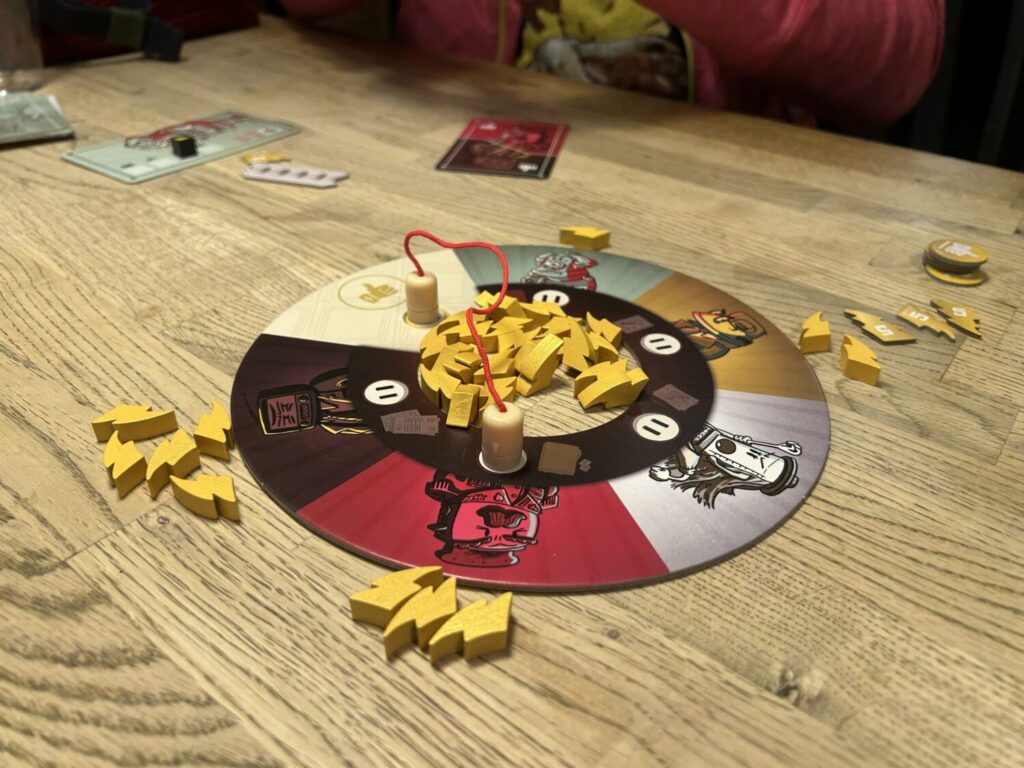
I didn’t mention, silly me, that there’s a board in the center of the table, a ring divided into six sections and with a massive pile of Power tokens in the middle. This board represents the distribution of power and influence amongst the different appliances. Each character’s current standing is reflected by tokens outside the edges of the board. The more Power you have, the better you’re doing. Connecting any two of those board segments is the Power Cable, the only conduit for redistribution of power. If I play the lowest card in the trick, I first have to move power from one to the other end of the Power Cable, then I have to move one of its two ends to another segment of the board.
It would be easy for Power Vacuum to be a somewhat banal back and forth of players attempting to snag the most points for themselves, but that brings us to Wentzel-Fisher’s great innovation, the Agenda card. Each player gets one at the start of each hand, a card with two different characters on it, one of whom may or may not be your own character. By the end of the hand, in an ideal world, you want one of these characters to have the most Power, and one of them to have the least. Which is both up to you and something that doesn’t have to be decided until your card is revealed.
The fluidity of the Agendas is what makes them so interesting. I can start the round with one plan in mind, only to pivot when I realize that the prevailing political winds aren’t going to work in my favor. I can even capitalize on my own misfortune, so long as I plan for it. You get more points from an accurate Agenda than you are ever likely to get from a round of winning tricks and moving Power to your section of the board, so throw yourself on that sword if you have to.
At any point during a round, Agendas can be revealed. The more cards you have left in your hand when you reveal yours, the more points you’ll get for each correct half. The risk of revealing a card is that you’re painting a target on your back. You’re locked in, and everyone knows what you want. But sometimes that can be useful. If someone else has declared an Agenda that overlaps with yours, why not combine your efforts? Not revealing an Agenda carries its own risks and rewards. An Agenda that isn’t revealed until the end is worthless unless everything about it is right.
It is in embracing the roleplaying and table talk that come with Agenda cards that Power Vacuum shines brightest. The most fun I ever had playing this game was during a hand in which my friend revealed his agenda and I saw the tides turning against me. “Boris,” I said, as I held eye contact and flipped my Agenda card over to reveal his character as my choice for the most Power and myself as my own choice for the least, “I’m going to make you a deal.”
If Power Vacuum could consistently deliver those moments, this would be a rave. As it is, the game is occasionally great, but mostly alright. I can’t shake the feeling that there’s a greater game here, or that this one isn’t quite done baking. Things like the Spies and the ability to take a card in preparation for the next round suggest a game of great depth that I’ve yet to see any evidence of. The more baroque your game becomes, the more necessary each additional flourish should be.
If Power Vacuum never quite coheres as a game, it is at least a thorough and surprisingly thoughtful meditation on the nature of authoritarian power structures. Like The Death of Stalin, Power Vacuum knows that the danger inherent in these systems is very real, and directly connected to their absurdity. As an experience, it’s alright. To quote the real-life Telephone, “I’d play it again, but I’d never ask to play it again.” Still, as a design, as an object of consideration, it’s pretty excellent.