Disclosure: Meeple Mountain received a free copy of this product in exchange for an honest, unbiased review. This review is not intended to be an endorsement.
Piñatas is an unusual trick-taking game. That’s always a good place to start. I like the weird ones. But unlike, say, Ghosts of Christmas, or Cat in the Box, or Inflation!, Piñatas isn’t unusual as a result of some baroque approach to the card play. To the contrary, Piñatas is a must-follow trick-taking game with a trump suit. That’s about as straightforward as the genre gets.
Piñatas is unusual because it concerns itself first and foremost with timing. Most trick-taking games are focused on quantity, whether they are asking you to win as many tricks as possible, or no tricks, or a specific number of tricks. Piñatas asks you to be mindful of when you win your tricks.

Each time a player wins a player count–dependent number of tricks, they drop out of the round. The later you can manage to drop out, the better, since you score points equal to the number of tricks other players have won when you dip. Sounds easy, right? Just win your tricks as late as possible. It isn’t that simple. As is often the case with Reiner Knizia’s best games, there’s a catch. The last player left in the round doesn’t score any points at all.
This gives Piñatas a unique texture within the world of trick-taking. Winning, at least in the immediate sense, isn’t the goal. Losing can be in your interest. Each hand becomes an exercise in self-inflicted precarity, trying to win only as often as necessary. It’s fun to have a powerful hand and find yourself striving to lose whenever you can manage it, or to have a weak hand that requires seizing the few opportunities afforded you. Piñatas found a way to create a trick-taking game that is simultaneously play-to-win, play-to-lose, and perfect bid. It’s good stuff.
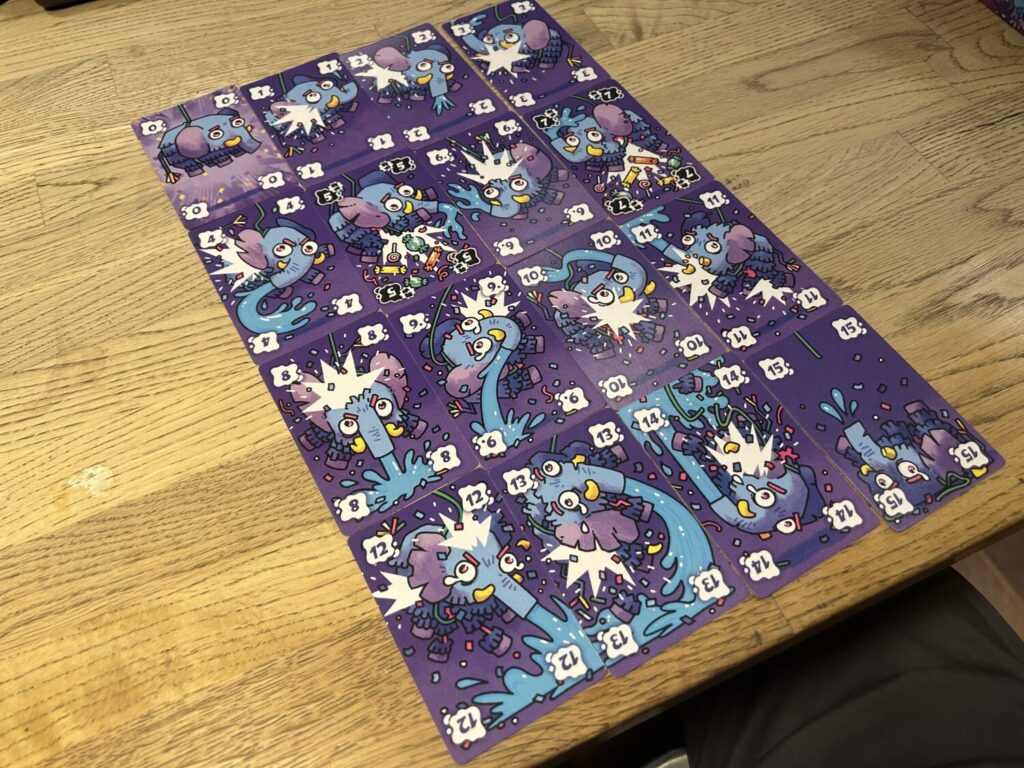
While this design has been published twice before, as the let us say culturally indelicate Voodoo Prince and the delightful Marshmallow Test, Piñatas adds an extra twist: if you win a trick with either a five or a seven, the resulting trick counts as two tricks. If you manage to pull a come-from-behind triumph out of the bag by winning with the 5 or 7 of any suit—especially given that the cards in each suit run from 0-15—that would surely be an all-time gaming moment. Conversely, someone attempting to dump a 5 early in the round and getting undercut by everyone else would be extremely funny.
I’m here for a rule that does little to complicate things and promises hilarity. It’s a mechanic that points towards the larger attitude of the game. You might accidentally win two tricks in one. You can’t count cards because ten random cards from the deck are left out of every hand. You may plan your arc perfectly only to realize that the walls are closing in on you. At the bottom of everything, Piñatas feels like one of the least intentional trick-taking games I’ve ever played. It’s also one of the most fun. Pick up a stick and take a whack. I don’t think you’ll regret it.