Disclosure: Meeple Mountain received a free copy of this product in exchange for an honest, unbiased review. This review is not intended to be an endorsement.
Now Boarding
I’m no stranger to airports and planes. Coming from a family that traveled often, I’ve seen it all—delays, cancellations, crying babies, medical emergencies, and I even remember when planes still had ashtrays in the armrest (there was a time when you could smoke cigarettes on airplanes, people!!). Planes change constantly with technology, but airports? Big gates and bigger aircraft. Same routine, different day.
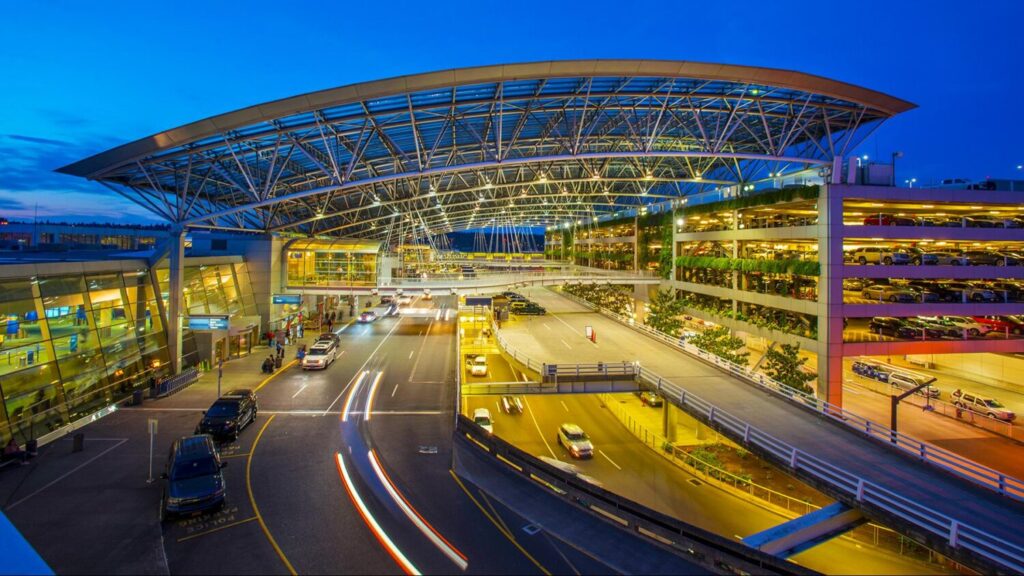
PDX brings the charm and excitement of air travel without the baggage fees and bland in-flight meals. Named after Portland’s airport code, players manage rival airline companies, building the most profitable routes and running their business like a well-oiled jet engine.
Designed by Sean Wittmeyer and featuring gorgeous art from Skinny Ships, PDX is the second game from Waterworks Games, hailing from the game’s namesake of Portland, Oregon.
But does PDX land on time and intact? Grab your boarding pass, and we’ll find out together, friends!
Flying the Friendly Skies
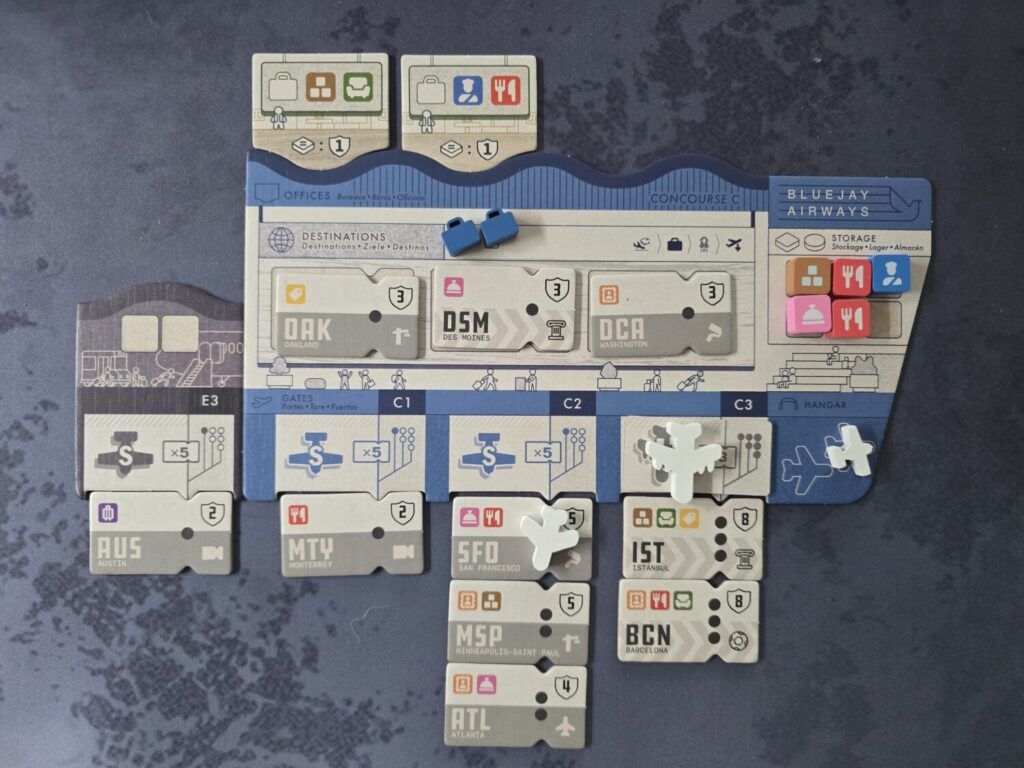
PDX plays over a variable number of turns until three stacks of gate tiles have been depleted. Players compete to score points from destination values, advertising campaigns, and multipliers based on private offices (more on those later).
Turns are fairly straightforward:
- Land planes. Planes move along established routes at your gates, collecting tokens or triggering bonus actions.
- Place a worker in the terminal (worker placement style) to reserve destination tiles, build gates/offices, lease planes from the runway, or launch advertising campaigns.
- If an action has a suitcase symbol, you can place a suitcase token as a free extra action that resolves during your next turn.
- Schedule flights, moving planes from your hangar onto the appropriate-sized gates (small/medium/large) for future landings.
- Cleanup: discard down to your capacity, then pass play.
Nothing to hide. That’s Transfarency.
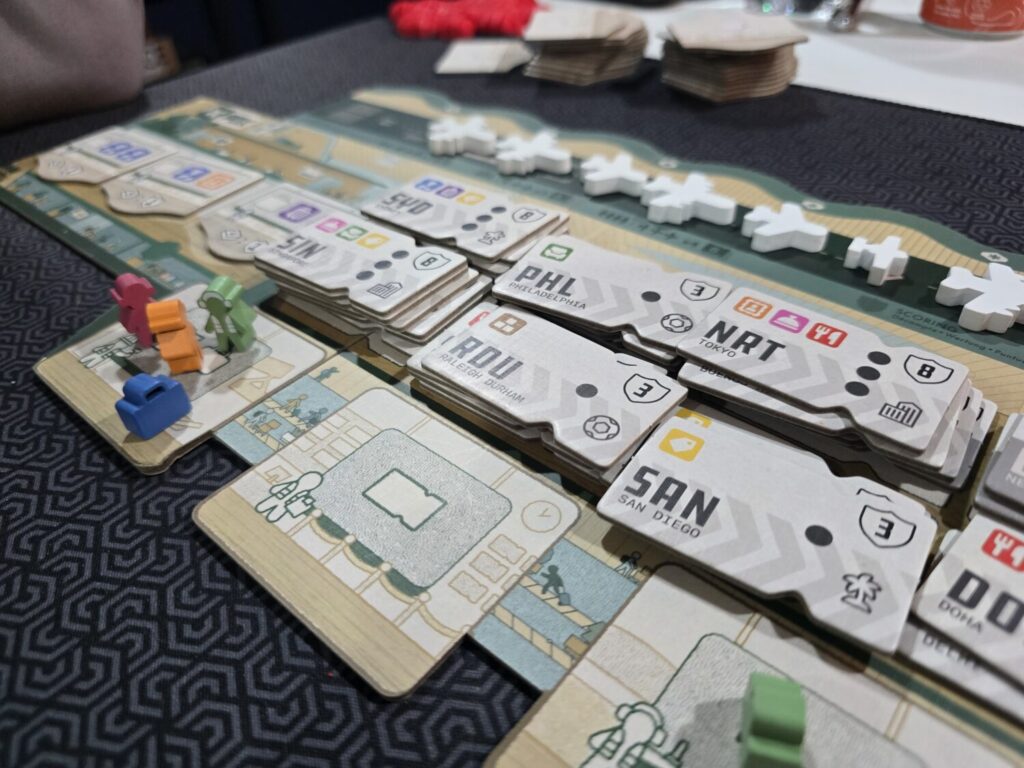
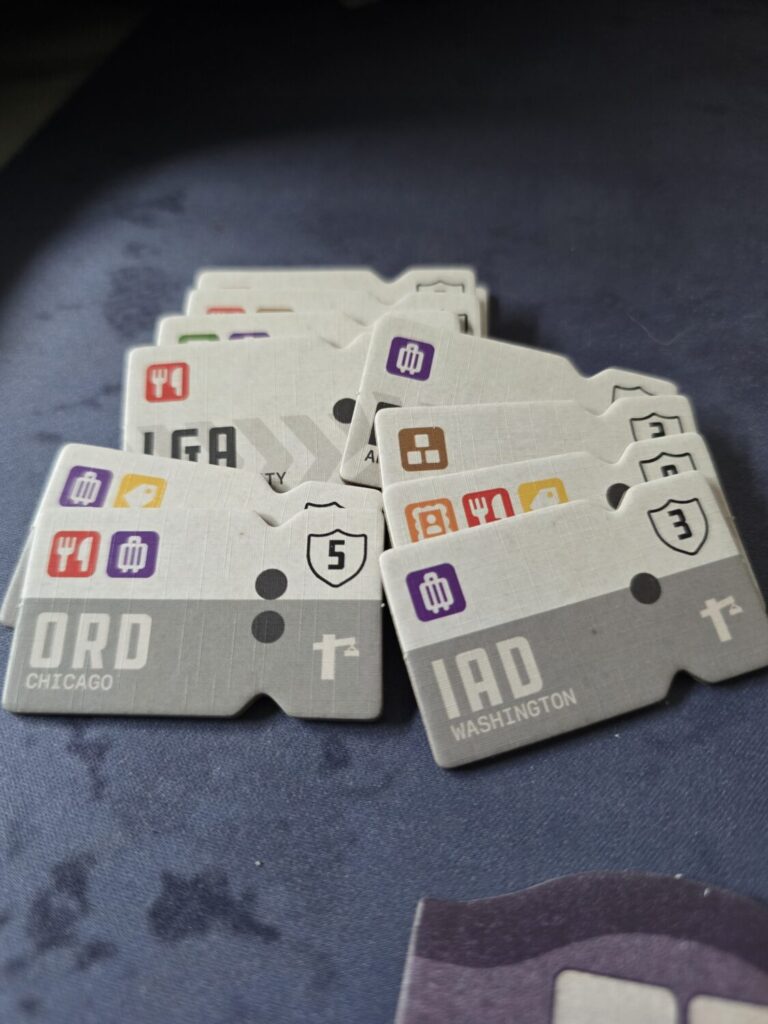
Destination tiles come in a variety of flavors, with each destination’s size matching the aircraft required to fly that route. Short routes represent closer hops like SEA (Sea-Tac) and SFO (San Francisco), while large routes are farther, like SIN (Singapore) and DOH (Doha). Building these destination gates costs a combination of service tokens—earned through landing planes or service offices.
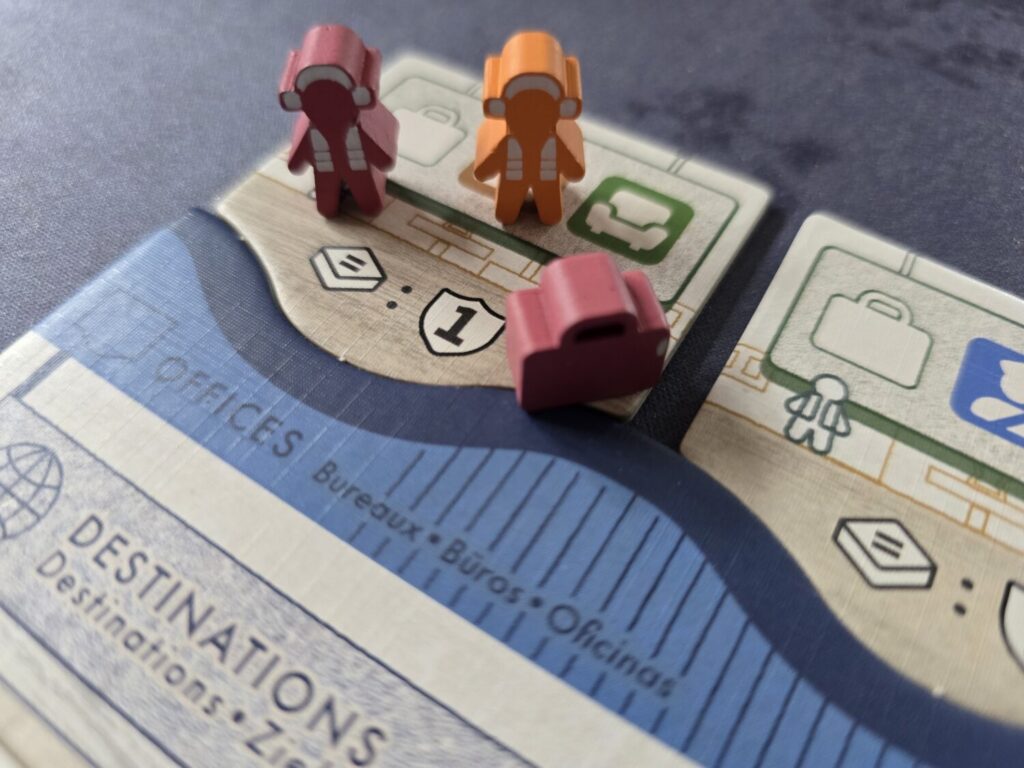
Private offices provide specified service tokens and score endgame points based on how many of your built destinations contain those specified tokens. If another player uses your private office, you can place a suitcase, giving you an extra action later. (Yes, please.)
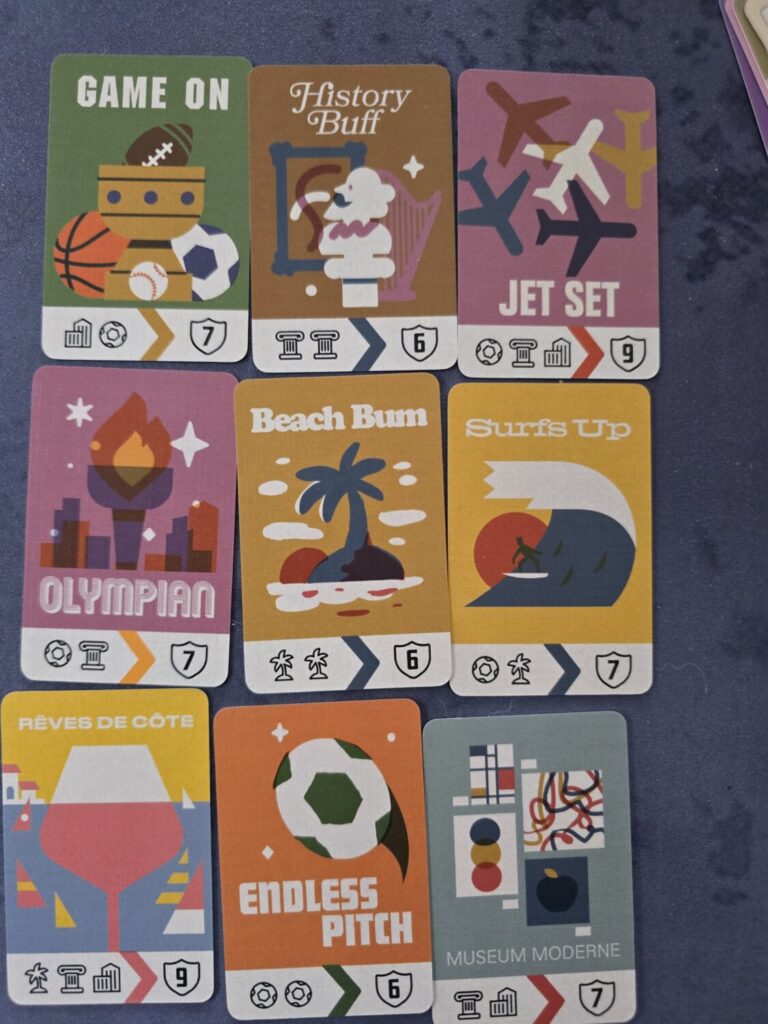
Advertising campaigns work similarly: pay specific tokens to claim them, then score straight points at the end.
Though the game only consists of a handful of main actions, building destination gates and re-arranging destinations (moving tiles between gates, provided the plane size supports them) are anytime actions—even on other players’ turns.
Take-off and Landing
After my first play, I wasn’t sure where I landed. I drove home, chewing on the airport experience I’d just had. I came in last and felt like I was treading water on most of my turns.
I’d focused on building large destinations to generate the activity tokens needed for advertising campaigns. Those artistically rich cards offered handsome points, so I assumed that was the strategy worth pursuing. Instead, I found myself rushing my engine—aiming for endgame builds without starting with a small, sturdy foundation.
In subsequent plays, I saw the beauty of the game and where the puzzle really lies. Much like any small company, it’s important to build the foundation first, with small gates that add extra actions on a given turn before scaling up. I quickly realized that actions are the currency in PDX. And because the game is tight, if you don’t have enough of them early, you’ll fall behind.
Folks, after my first play, I was disappointed with PDX. The more I played, the more I realized I was just misunderstanding it—and let me tell you, this game is impressive.
Premium Economy
PDX’s beauty is that it presents simple-to-learn worker placement mechanics but hides a deep strategic puzzle. To play effectively is to build a strong engine quickly, then refine it again and again to adapt to shifting needs and goals.
Destination tiles often grant extra actions that make a turn more efficient. But when those actions stop being useful, that route needs to move somewhere else to improve your sequencing.
Timing matters because landing triggers happen before your main action. That little window of flexibility is huge—especially as the board state changes between turns. Destinations disappear, that juicy advertising campaign you’ve been saving for gets claimed, and other tomfoolery.
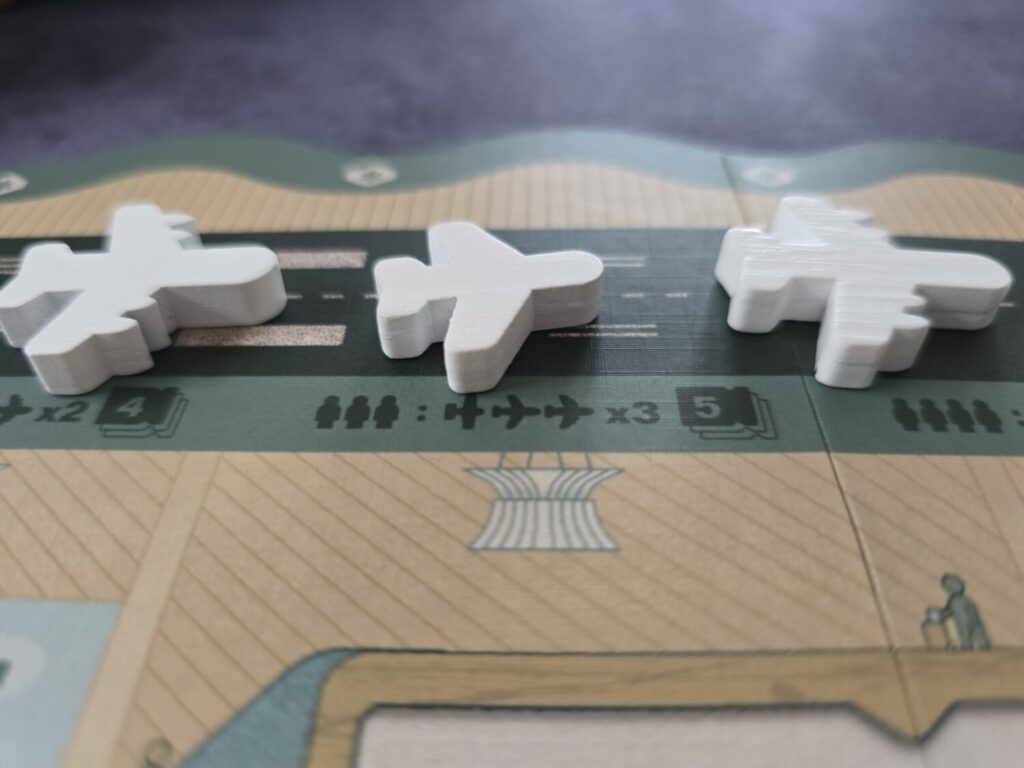
Leasing airplanes is one of the most important actions in the game; you can’t fly your routes without them. The twist is that airplanes sit on the runway in a random queue of sizes. If the aircraft you need is further back, your route might have to wait a turn or two—while you watch other players and hope the right planes cycle back.
Portfolio diversification matters. It hurts when there are no large planes available and all your gates are large.
Having suitcases (extra actions) out is also an important angle, and you should be using them every turn if possible. Retrieving suitcases occurs before your main action, which lets you do more on a turn. If you end up taking only one main action, it leaves you with a bad feeling. The idea is to source actions from your routes, then use your main action to place suitcases for future planning.
The puzzle deepens further because landing on destinations grants service and/or activity tokens, but your capacity fills up quickly. In some games, going for advertising campaigns barely exists because the right activity-token destinations don’t come out (tiles are randomly seeded and not all are used), so strategies shift from play to play.
Route Planning
The more I played PDX, the more enriched I felt when taking my actions. Once you understand the engine-building flow, destinations’ actions become more important than their point values. And because the game has a timer, it becomes a race against other players who are also staring at the same optimization lines and trying to beat you to them.
The game pushes you to adjust your efficiency constantly. Because you can swap destination tiles around, you can tee up your turns differently as conditions change. But that opens another layer of the puzzle: ensuring you have the gate capacity and aircraft sizes to swap freely. Different destinations require different-sized planes—plan accordingly.
You even have the option to cancel a flight, removing the in-flight airplane and returning it to the runway, letting you attempt to re-thread your engine from the beginning.
First Class Feel
PDX is an exciting change of pace for fans of worker placement strategy games. Making actions the economy instead of pure resources gives more agency to how well a player can succeed at engine building. Though it seems light at first, the tight flow rewards early tempo—lacking early on can drag you down, Brass style. Chaining bonus actions and clever timing is everything here.
But the snappy gameplay and smooth 60–90 minute runtime also make you want to restart and rebuild with better knowledge in hand. Much like running a competing business in real life, adapting to market demand is the key to success.
This is definitely one of the best games I’ve played so far this year, and I expect it to hold strong. The base game includes additional variants for added challenges, plus a dice-based solo automa to practice the craft.
A little birdy has also shared that PDX is just the first leg of the flight, with additional modules coming down the pipeline to loosen up gameplay and deepen engagement in an already intuitive system.
PDX feels great at all player counts. With more players, the likelihood of someone using your private office (letting you place another suitcase) drops mid- to endgame—but additional aircraft enter the ecosystem, opening up more route opportunities. I personally found this to be a great date night game with my wife, and our scores were neck and neck every time despite wildly different strategies. We even joked about adding bonus points for airports you’ve actually visited.
PDX captures the best part of travel: the choreography. The planning, the timing, the satisfying little victories when everything lines up—connection made, bags secured, wheels down. When your engine finally purrs, you’re not just taking actions; you’re conducting traffic. And because the board shifts and the runway queue won’t always cooperate, every play feels like a new itinerary instead of the same flight on repeat.
PDX begins boarding on Kickstarter in February 2026.