
Disclosure: Meeple Mountain received a free copy of this product in exchange for an honest, unbiased review. This review is not intended to be an endorsement.

Small Box, Big Critters
You gotta hand it to Allplay: their small-box games work overtime as both space savers and a smart marketing angle. Walk past their booth at a convention and you’ll see a neat, satisfying wall of matching boxes. Even those with a hint of OCD would feel soothed by the uniformity. As a friend once called it, it’s the “Pez Dispenser” of game displays.
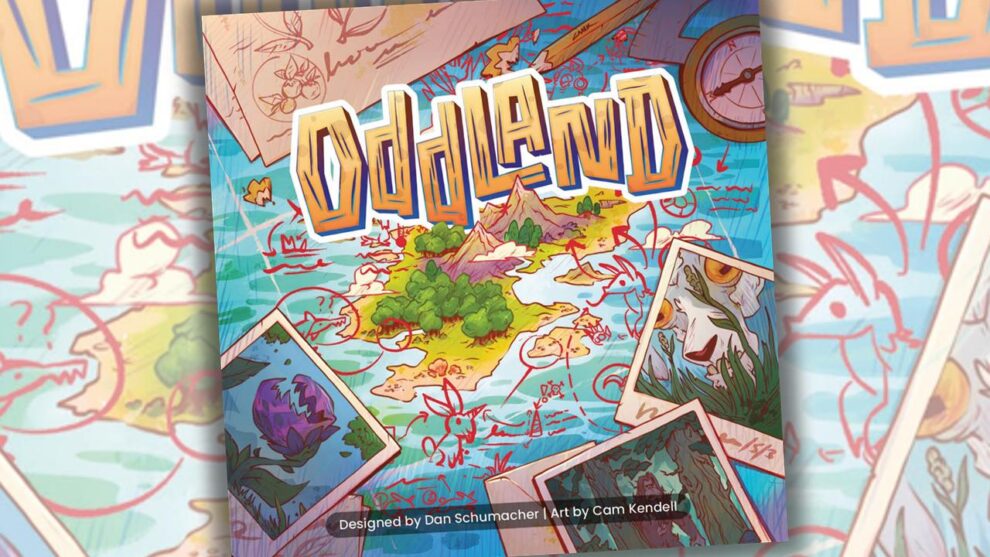
Oddland, the debut title from video game designer Dan Schumacher, fits right into this aesthetic. Inside its tiny box are colorful map cards and a parade of hybrid critters practically engineered to make you grin. Whether it’s the Owloose (moose + owl), Pangaroo (pangolin + kangaroo), or Grizzsleep (sheep + grizzly bear), the game’s tone is baked right into its cast.
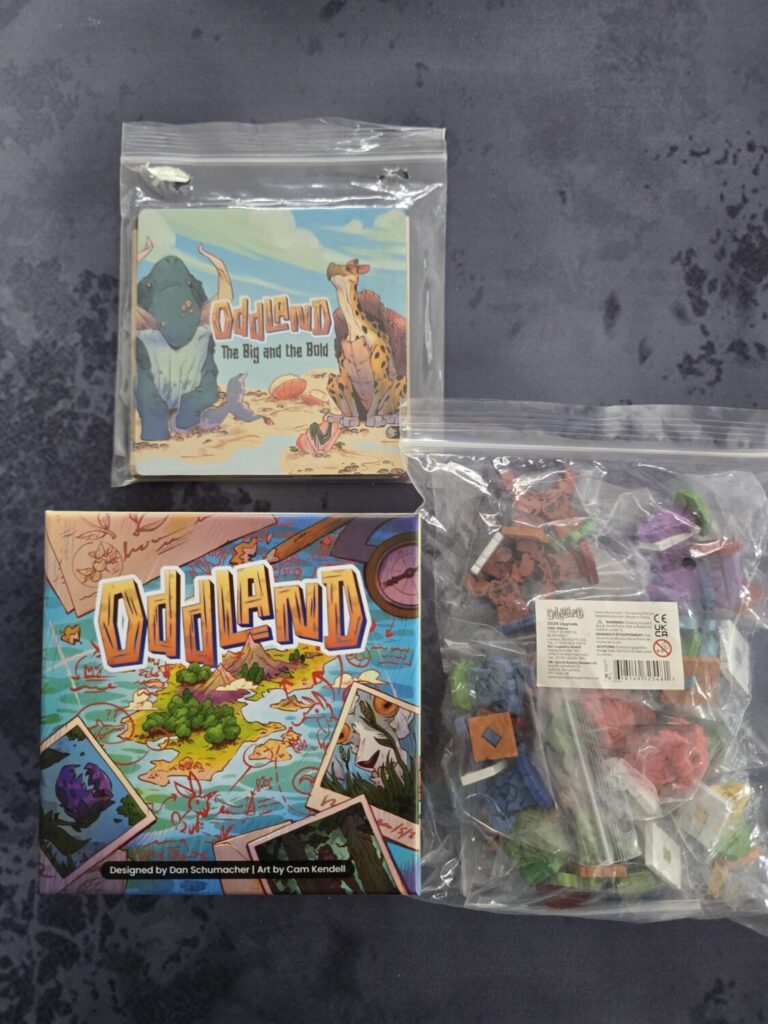
I also had the chance to try the upgraded components—handsome wooden versions of the cardboard markers—and if you’re picking this up, they feel like an essential add. The 3D pieces make scoring cleaner and more readable, and they elevate the tactile appeal. But be forewarned, they won’t fit in the base box!
Quick Cartography
Oddland unfolds over seven rounds, and your goal is to position your creatures in spatial configurations that maximize their unique scoring conditions. Each species has its own scoring pattern, and the backside of the cards offers more advanced, asymmetric challenges.

On your turn, you’ll play one of your two map cards, placing it adjacent to at least one already-played card. Tiles can overlap up to two squares of an existing card, as long as you never cover a token. After placing the card, you must drop one species token onto an empty space on that newly placed tile.
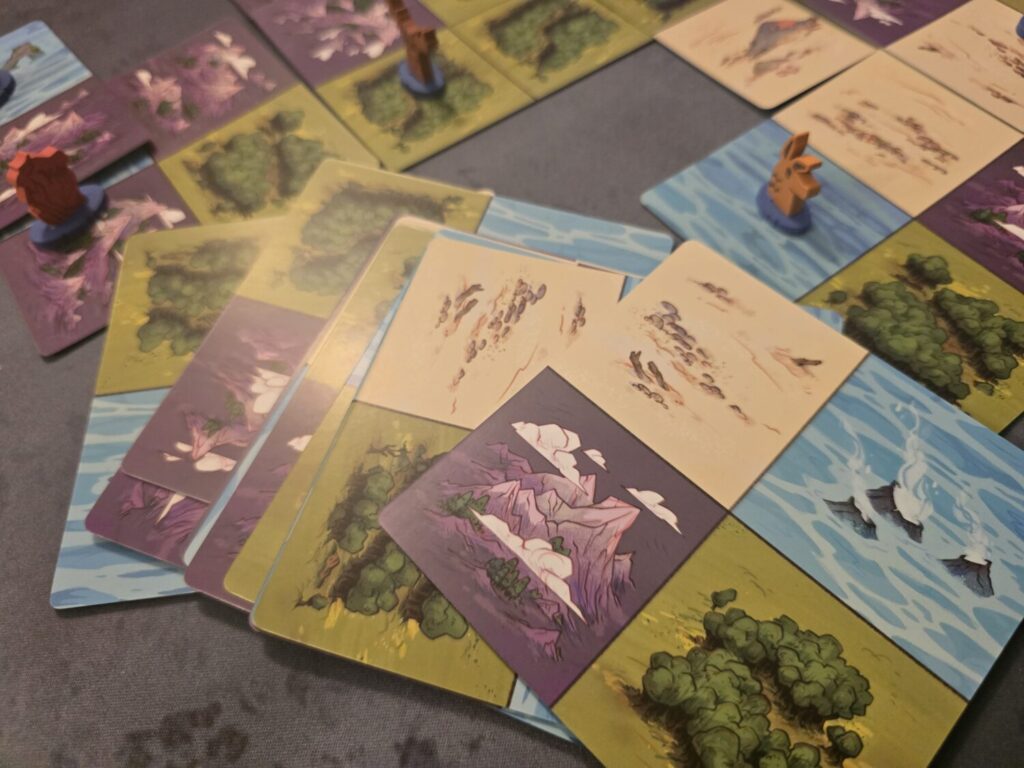
Territories—connected groups of matching terrain—can hold only one species token at first. But as new tiles connect previously separate areas, you can later merge territories to create bigger scoring opportunities. Once all players place all seven of their species tokens, the game ends and the critters score based on their individual conditions: same-row matches, diagonal forest tiles, surrounding territories, and more.
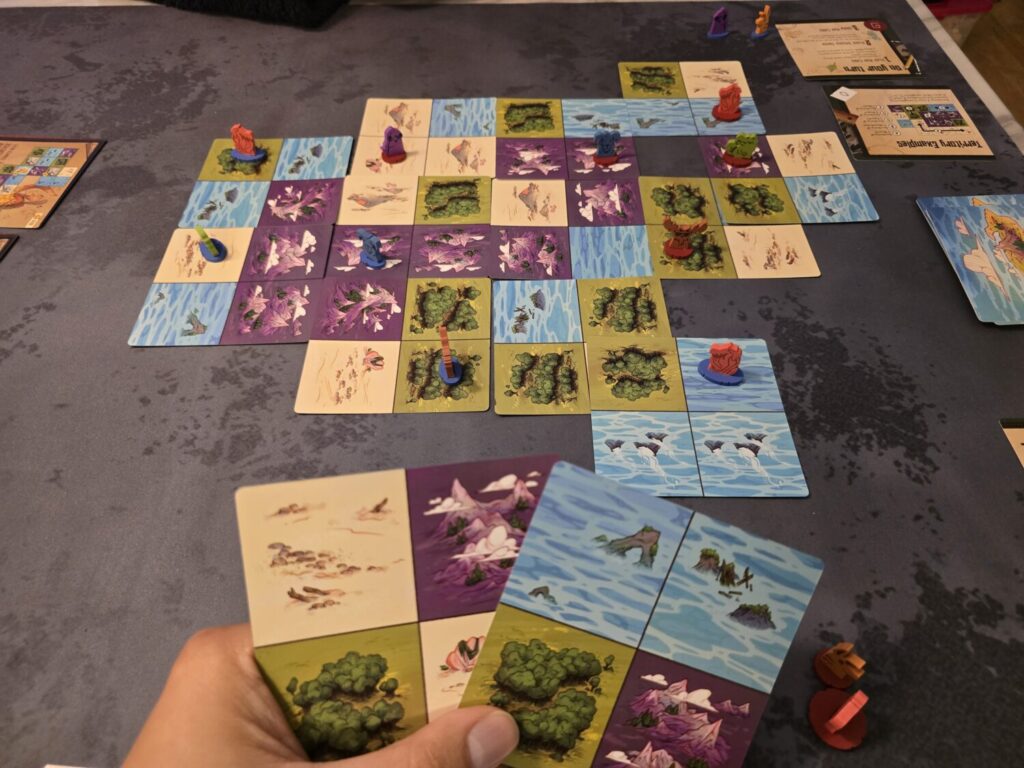
There’s also a solo mode that plays like “beat your own score,” giving you a puzzle-y way to test new strategies.
Short Satiation
Oddland is as smooth as it is thinky. There’s already a crowd of games in the “place animals for asymmetric scoring” genre, with Cascadia being the obvious headliner. But Oddland brings its own flavor without overstaying its welcome, fitting nicely among the ranks of Beach Day, Confusing Lands and Nimalia.
With only seven rounds to place your seven unique scoring pieces, you rarely have time to optimize everything. Because you must place a token each turn, you’ll sometimes sacrifice a creature’s scoring condition entirely just to set up a better move later. That tension becomes the heart of the game: focusing on a handful of high-value plays rather than trying to squeeze points from every species.
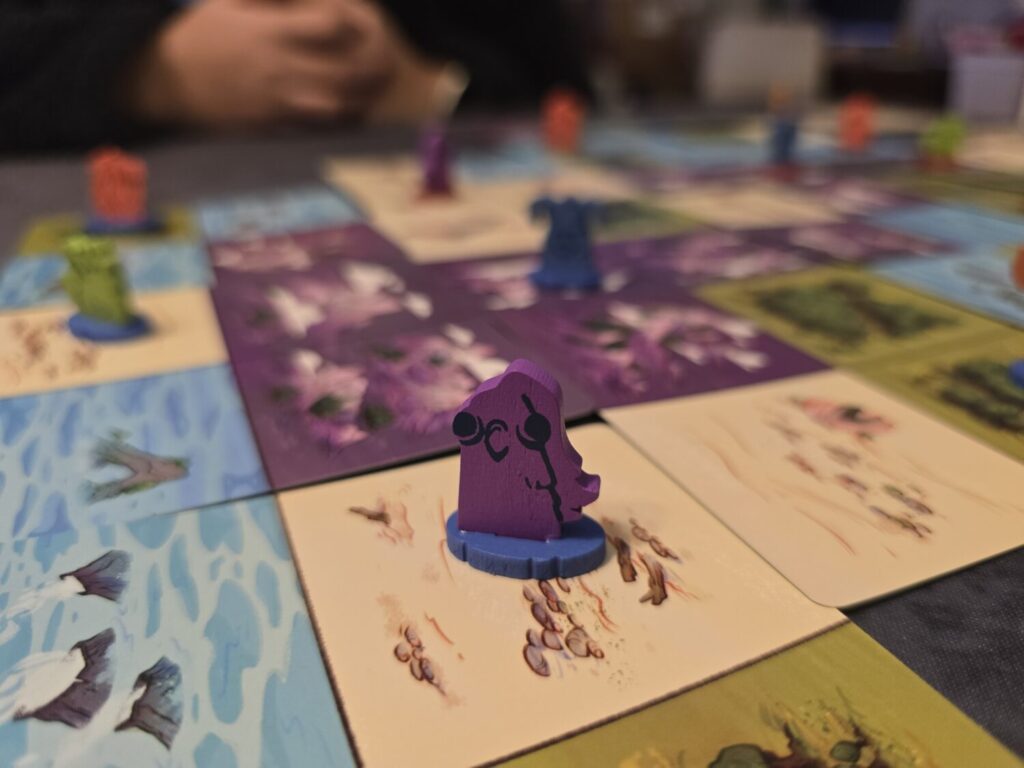
The flora tokens help here. On their A-side, they don’t score at all, but they’re surprisingly useful as tempo tools—blocking opponents, buying time, or setting up a juicier placement a turn or two later.
The puzzle becomes delightfully spatial. You’ll often find yourself hovering tiles over the table, squinting and imagining the perfect alignment. Because terrain distribution is randomized, luck in the draw matters; the forest or shore you need might show up late—or not at all. There’s no mechanism to swap cards, so as they say, you play the hand you’re dealt.
There is also the challenge of keeping track of all those scoring conditions. With a full table, players frequently double-check how their animals score, and mid-game recalculations can slow things down. I found myself playing more tactically, optimizing what I had left rather than planning around all seven species. I found covering tiles to create bigger scoring zones to yield the best payoff, also known as “layering.”
Oddland wraps up quickly, often prompting players to jump right back in to “do better next time.” Compared to Cascadia, the shared map offers more direct interaction—blocking prime spots or squeezing someone out of a high-value placement. The alternate scoring modes lean more into adjacency, area control, and territory wrangling, giving the puzzle some variability.
It shines at two players and scales well, with more players creating both more terrain to build on and more competition for key spaces.
After a few plays, though, the base game starts to feel a bit “samesy.” But for those first sessions, Oddland is a snappy, satisfying optimization puzzle, similar to cracking a mildly tough sudoku, and you may find yourself immediately wanting another.
Luckily, there is a small expansion, The Big and Bold, that adds two new fauna: the jovial Whalephant and Cheetoise. These animals are shuffled into the base game, essentially adding two extra turns per player while opening up additional scoring opportunities. I really enjoy these additions, as they add another strategic layer, with the Whalephant requiring two vacant tiles and the Cheetoise scoring for big territories (animal area majority!).

Oddland details
- Designer: Dan Schumacher
- Artists: Cam Kendell
- Publishers: Allplay
- Release Date: 2025
- Player count : 1 - 5
- Age range : 11+
- Time range : 40 minutes
- Mechanism(s): Connections, Layering, Pattern Building, Solo / Solitaire Game, Tile Placement
- BGG Geek Rating: 6.98296 - converted to Meeple Mountain scale: 3.5.
- More articles about Oddland.