
Disclosure: Meeple Mountain received a free copy of this product in exchange for an honest, unbiased review. This review is not intended to be an endorsement.
The approach was classy, but the commentary was not.
“What kind of s*** is that?”
“S***, baby…let’s get PAID!!”
“Who knew…I guess s*** really does roll uphill.”
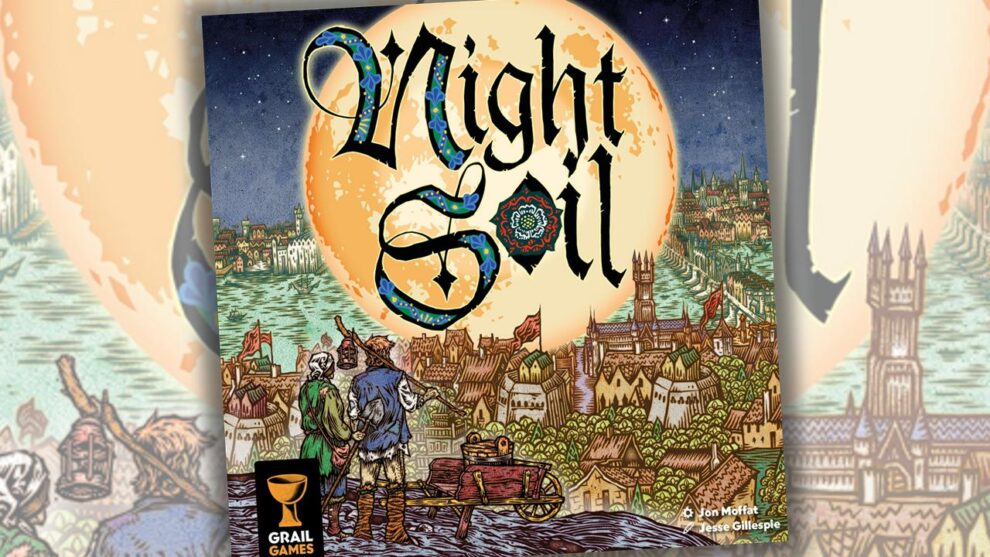
During my time at SPIEL Essen 2025, I had the chance to pick up the game Night Soil, a new design from Jon Moffat and Grail Games. The box cover looks classy, with a pair of individuals looking out over London in the early 1500s. The artwork, by Jesse Gillespie, is exceptionally vivid and really draws a viewer in.
Then I flipped the box over, and the game’s true designs took shape—Night Soil is “a very mature game about sanitation.” And, I would agree with that; from the rulebook’s formatting to the nature of the business of moving brown cubes around a map of Tudor-era London, Night Soil approaches its subject matter with a level of class that elevates the entire experience.
At the end of the day, this is a game about moving stuff around. Well, it’s a game about moving s*** around, which is both the best thing about it and the near requirement that you play this game with other immature, adult-sized 11-year-olds like myself.
“What a Load of S***!”
Night Soil is an area majority, pick-up-and-deliver game for 2-5 players. (A friend who also picked up Night Soil did a play with five players…and after she reported that the game took “hours” to finish, I cancelled any plans of trying this at the maximum player count.)
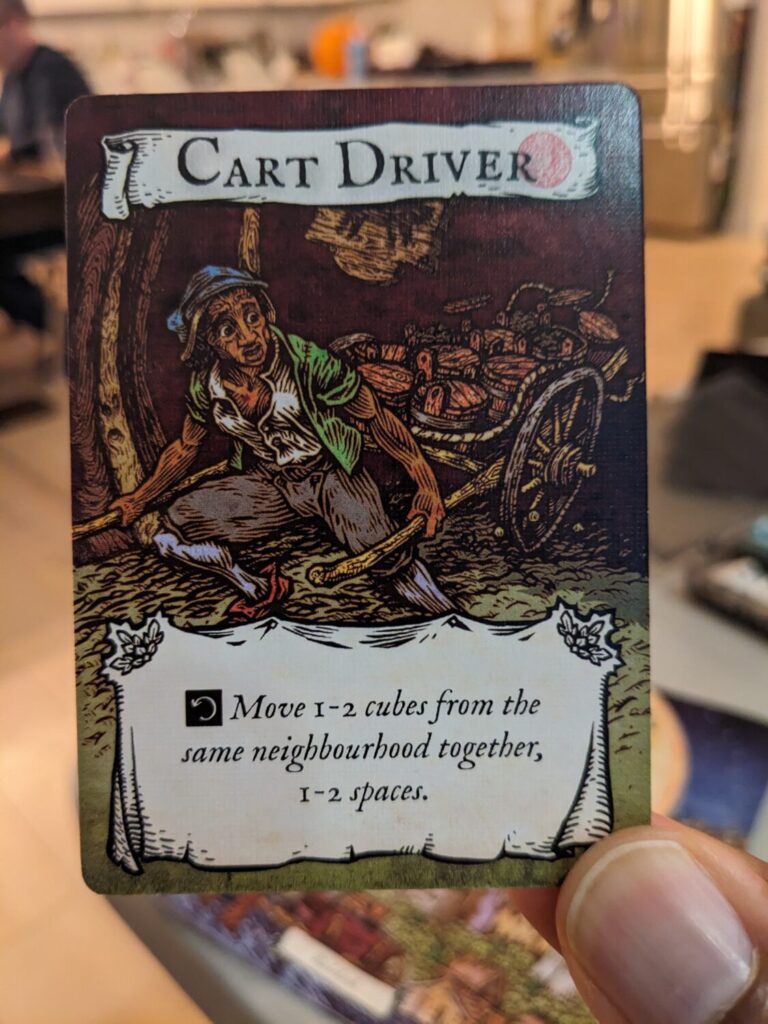
In the game, players are in charge of their own “night soil” companies, tasked with removing the city’s waste each evening. Over the course of 3-5 rounds (based on player count), players will populate the map of London’s neighborhoods with small and large workers who create waste in each location while taking actions to boost their influence with local stakeholders in the form of tracks. They will gather coins and collect waste cubes, which are later turned into coin income at the end of each round. Players must also add to their labor pool by buying Labourer cards that will be played during a round’s Night phase. Labourers are used to move cubes around London and ideally out into the Thames River because, a bit like the major waste issues in other cities of the time period, it’s all about moving s*** out to sea.
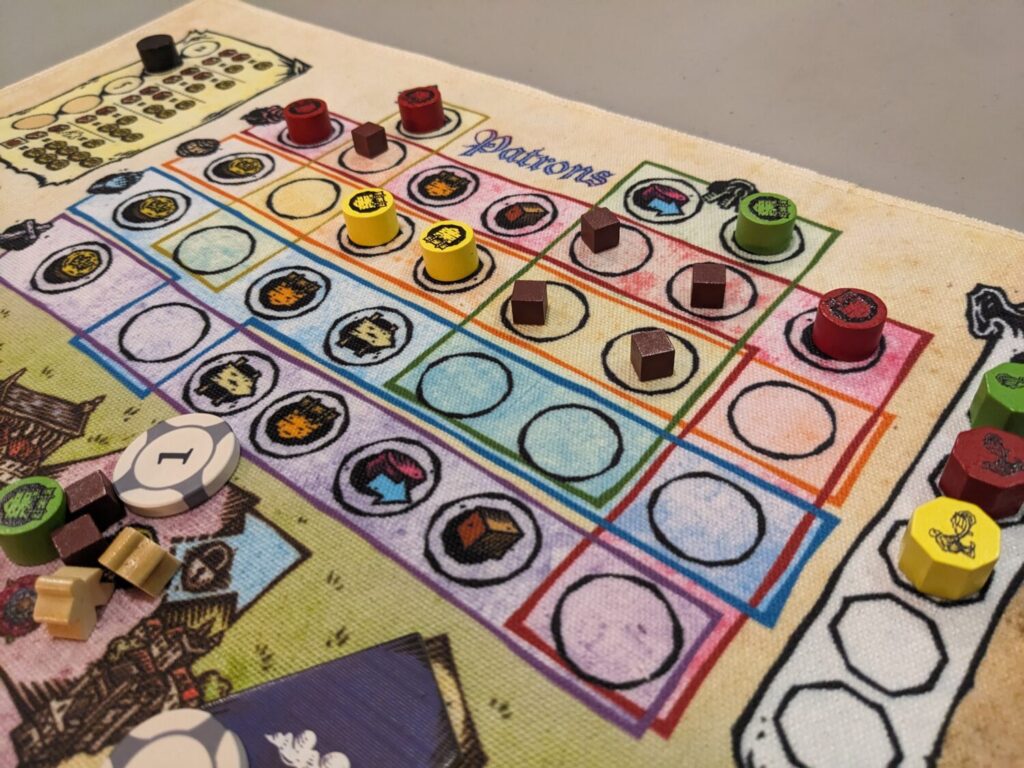
Night Soil elevates itself above the fray in many different ways. The game comes with a cloth board, which somehow made my experiences with the title more elegant. The influence tracks at the top of the board are non-linear, with some tracks crossing over into other tracks. This means that a player who wants to influence the Lamplighters might also be able to influence owners of local breweries. During play, certain actions allow a player to place influence tokens on these tracks, and the current majority leader earns a special power that is theirs as long as they maintain a strict majority.
Getting Labourer cards is crucial, because more actions is better than fewer actions–and in Night Soil, most of the game’s juice comes during the Night phase, when players play their Starting or Special Labourer cards to move cubes through various neighborhoods to reach the Thames. Flushed cubes go to the person who moved them into the river and are worth handsome rewards during end-round cleanup.
And this is where Night Soil really shines, during that Night phase. That’s because players don’t have their own workers to use during the Day phase. They have to earn them by cleaning out neighborhoods where workers were placed during the Day phase. Keeping those neighborhoods clean long enough to take workers (and sometimes, coins) into their possession is critical because if you don’t have any workers, you can’t take any turns during the following Day phase.
Night Soil didn’t look like much when I first did a demo of the game in Essen, but even after just one Night phase, I was hooked. Thankfully, the game held up once I got it in front of the folks in my gaming groups.
“You’ve Got to be S******* Me”
Day phases in Night Soil are, well, a mixed bag.
In each round, players take pretty standard—sometimes boring—actions, to place markers on tracks or remove waste cubes from those tracks to hold for end-of-round income later. You can change turn order or maybe buy a card. That’s all fine, and it is required to drive the game forward. But it’s sometimes not very exciting, especially because of the rules tied to the concept of “clean” and “full” neighborhoods.
If there are three waste cubes in a normal neighborhood space—or just two in the fancy part of town, the Royal neighborhood spaces (that feels right, doesn’t it?)—then players can no longer take actions in those spaces because new workers generate more waste cubes. If players are not efficient at clearing waste in earlier rounds, play can really get stopped up, and we found that in one of our three player games.
That also means some portions of the game can really drag. In one of our games, the card-buying space (there is only one, although there is a space available to copy an action in a four- or five-player game) was blocked for two of the game’s four rounds. That also meant one player had a major advantage during the game because he was taking more actions with Labourer cards than others could. That’s not a cheat or a broken rule, that’s just the way that game can play out—and it left a lot to be desired.
Thankfully, the moving of cubes through the London streets is the reason to play Night Soil. The juiciest parts of the game unfold when players jockey to move waste cubes out of town , but do so by only taking care of themselves to acquire workers and/or coins in spaces that are freshly cleaned by their efforts.
The mechanic of worker acquisition is really cool here, but I also see its downside, particularly in higher player counts where one or more players are unable to get new workers for a future round. Night Soil’s mechanics are slick in this way—no one has their own pool of workers. Each night, players basically have to rebuild their workforce, and that can be a killer if a player gets squeezed out of the action.
“Good S***, Man”
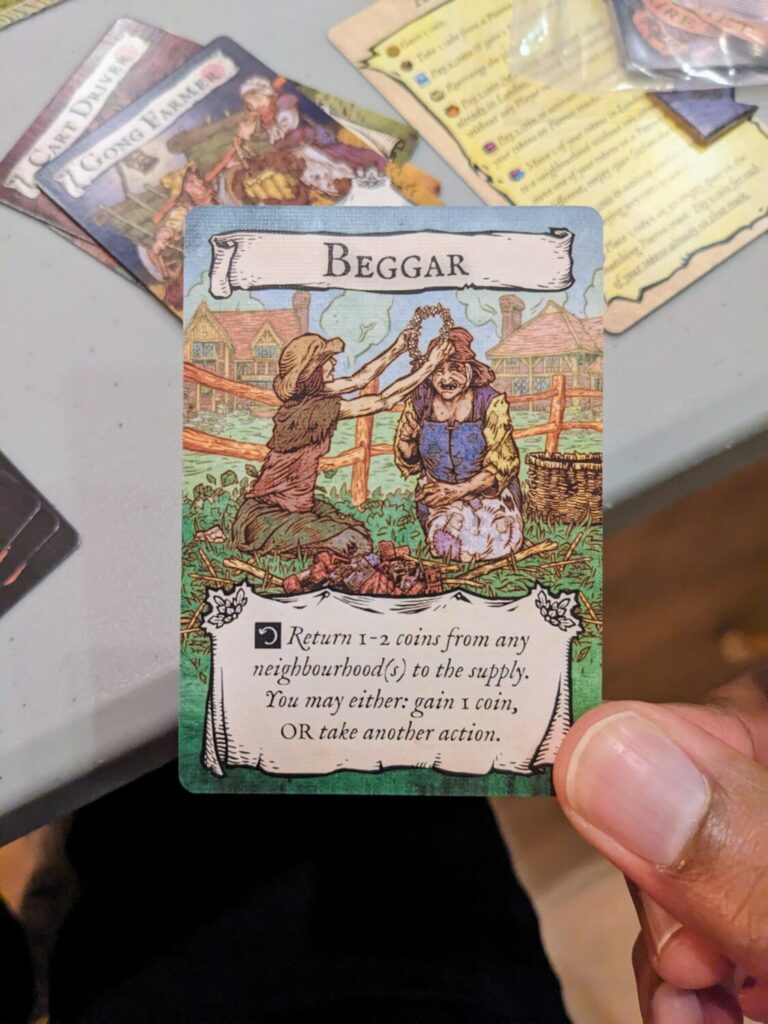
Night Soil was fun. I’m not sure it is a lifer; Night Soil, even after my second full game, showed me all it would ever be. With a limited number of Labourer cards (just 19 Special Labourer cards), it’s hard to imagine games being strikingly different from play to play after your fifth or 10th play.
But what elevated my experience was tied solely to the players. People in my network made plays of Night Soil a blast, because the stabby Night phases mixed with the subject matter made for some very profane moments during each play. (Each of the explicit quotes used in this article were uttered during my plays.) When it gets going, Night Soil’s worker acquisition mechanic is a blast, and scores will always be close. I think most groups, especially after a first play, will have play time down to about an hour with 2-4 players.
Beyond my thoughts regarding replayability, my main issue with Night Soil is tied to the bland nature of the Day phases. Since Night Soil is 75% a Night phase game, that isn’t a major issue, but it’s worth noting. Late in each game, there won’t even be cubes on the tracks any more, rendering those actions worthless by the final round in my experiences.
I’m glad I had the chance to give Night Soil a look. Fans of area majority games should absolutely give the game a shot, and now I’m curious to track down other games by the same designer.