
Hello and welcome to ‘Focused on Feld’. In this series of reviews, I am working my way through Stefan Feld’s entire catalogue. Over the years, I have hunted down and collected every title he has ever put out. Needless to say, I’m a fan of his work. I’m such a fan, in fact, that when I noticed there were no active Stefan Feld fan groups on Facebook, I created one of my own.
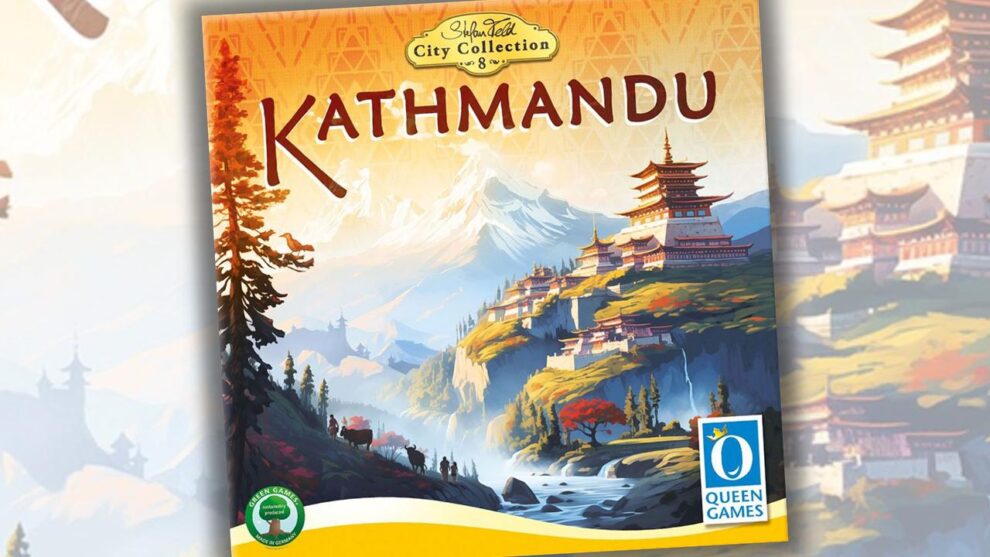
Today we’re going to talk about 2024’s Kathmandu, his 40th game.
Kathmandu drops the players into the Kathmandu Valley of Nepal with a single end goal: reach the capital city of Kathmandu by the end of the sixth day. The faster a player arrives, the better the reward will be. However, there are many stops the players can make along the way to score themselves some extra points. Tarry for too long and you’ll get caught up in the encroaching storm, which can slow you down and cost you a lot of points and resources. So you’ll want to move quickly (but not too quickly).
Kathmandu is a meandering race to the finish. Much like Tokaido, it isn’t about the destination, so much as it is about the journey.
Over the course of six rounds, players will be rolling dice and then using those dice to move their yaks across the map as well as gather resources. The value of a selected die determines how many spaces the yak must move, and the color of the die dictates which resource is received. The type of landscape on which your yak comes to rest plays a determining factor in which actions you may perform. Virtually everything you can do in this game will earn you points, and the player with the most points at the end of the game wins.
Of course, this is an oversimplification. If you’d like to get a better sense of how the game is played, read on. Otherwise, feel free to skip ahead to the Thoughts section to find out what I think of this game.
Setup
The setup for a game of Kathmandu is a bit of a bear, as there are a lot of pieces and a great deal of them are required to be placed into specific locations before you can begin playing. So, you’ll want to make sure you start setting up early or recruit some extra hands to assist you.
First, select four Terrain boards and lay them out, in an orientation of your choosing, sandwiched between the Start board and the Destination board. There are six to choose from, each lettered and double-sided, for a wide range of possible setups. The rule book suggests a layout for your first game and also offers some helpful advice for future setups for increasing or decreasing the difficulty by turning the compass needles (printed on the boards) in various orientations. Next, place a border strip across the line where each of these boards touches the other.
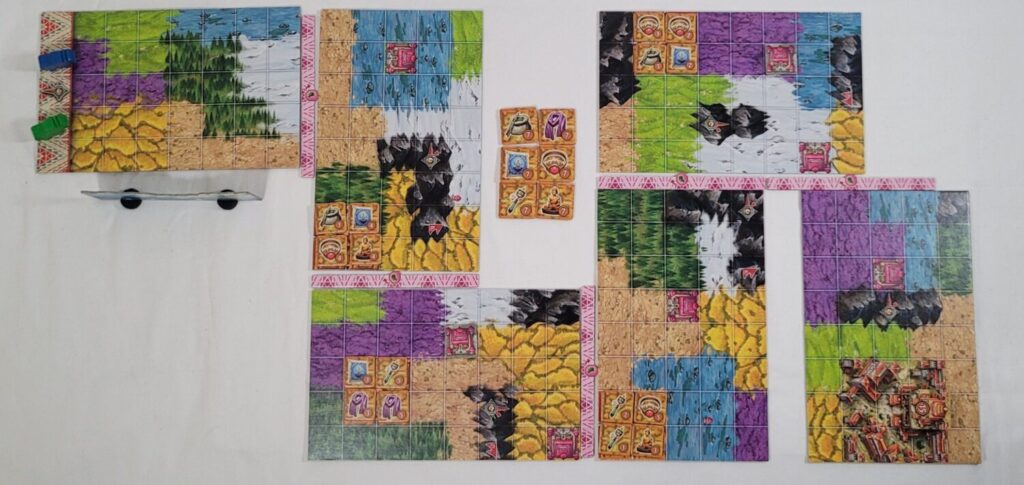
Now, you’re going to populate the Terrain boards with tiles: Temple tiles every other Terrain board, Goods tiles placed face up in the City spaces, and the stack of Kathmandu tiles in descending order on the Destination board. The Storm standee, resource chits, and Exhaustion markers are set aside for now. Next, lay out the game board and populate it with the shuffled decks of Equipment and Animal cards, the shuffled stack of face down Map tiles, as well as six randomly selected, facedown Weather tiles. A number of Equipment cards, Animal cards, and Map tiles are then revealed face up. And, now, we turn our attention to the players.

Each player chooses a color and receives the matching Player board, Scoring marker, Points tiles, Offerings, Yak, and Yak tiles. They also receive exactly one of each resource type—backpack (brown), compass (grey), paint box (purple), coin (yellow), and yak fodder (pink)—and a die in each of the colors. Frustratingly, in the first edition of this game, the dice for the coins are almost red in color, which has been cause for comment in virtually every single playthrough of this game thus far. I hope this is fixed if this game ever sees a reprint.
Finally, each player rolls their six dice, and you’re ready to begin playing Kathmandu.
How It’s Played
Kathmandu is broken up over six rounds (‘days’ in game terminology) divided into three turns per player. Players take turns:
– selecting a die and taking a resource matching the die’s color. If the player chooses their gray die, for example, they would receive a compass. Before selecting their die for the turn, a player may give up a die to reroll all their remaining dice.
– checking their exhaustion levels. If a player has 3 Exhaustion tokens, they discard them and skip the rest of their turn.
– moving their Yak. The player moves their Yak in a straight line a number of spaces equal to the pip value of the selected die, no more and no less. If the Yak runs into a mountain or the edge of the board, its movement comes to an end, and its owner receives an Exhaustion token. If the Yak crosses a board strip, its owner must pay a Yak fodder to the general supply or else receive an Exhaustion token. If the Yak’s movement begins in the same direction the compass needle is pointing, the yak’s owner must return a compass to the supply or else its owner receives (you guessed it) an Exhaustion token. There are only four ways to gain Exhaustion tokens in the game, and three of them are during the Yak movement phase (we’ll talk about the fourth soon), so it pays to plan ahead for these eventualities.
– performing an action based on the location where their movement ends. I’ll get more granular with this in a moment.
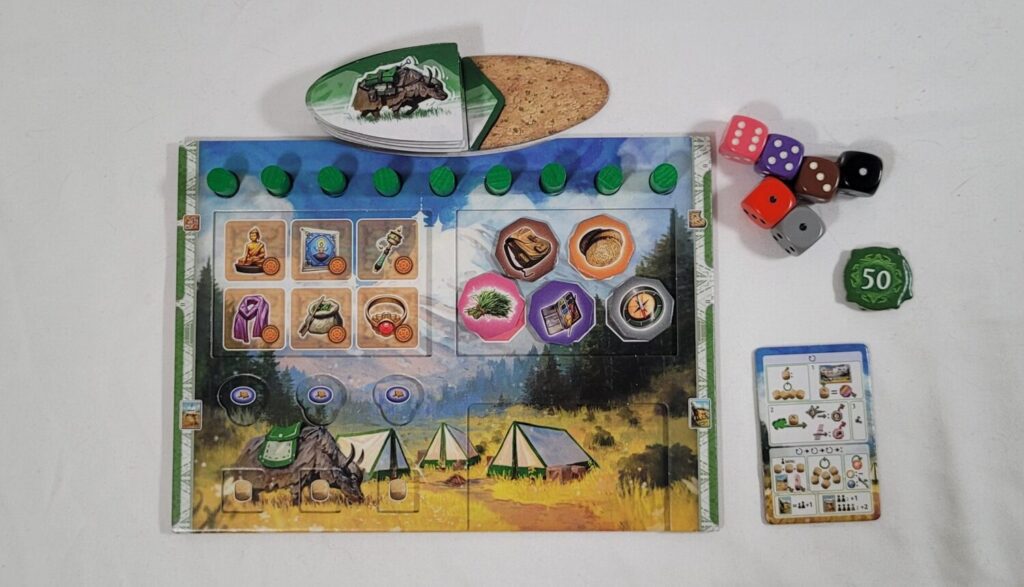
At the end of the day, the first player marker changes ownership, the players re-roll all of their dice, and a Weather tile is revealed. If the tile depicts a storm icon, then the Storm standee moves up to the next border strip. Anyone with a Yak behind the Storm standee receives an Exhaustion token. Even if the Storm standee doesn’t move at all, if your Yak is behind it, you’re going to receive an Exhaustion token.
After the Storm is resolved, the card displays are refilled, and it’s time to move on to the next day, unless this is the end of the sixth day. In that case, the game ends and final scoring is performed.
The Actions
The actions you may perform on your turn are largely informed by the space your Yak comes to rest upon when its movement ends (your ‘target space’), but also which resources you have on hand. If there’s an Equipment card with a background matching your target space, then you can purchase an Equipment by giving up a backpack. The same goes for Animal cards (paint box) and Goods (coin). When you visit a temple, you’ll remove one of the Offerings from your Player board, leave it at the temple, and take one of the Map tiles from the offering as a reward. If your Yak ends its movement in the same terrain type as your currently visible Yak tile, then you get to flip that tile over and reveal a new one.
End Game and Scoring
The game ends at the end of the sixth day. While it is not essential to reach Kathmandu by the game’s end, there is incentive to do so. The first person to reach the city receives 15 extra points. Each successive person reaching the city receives fewer and fewer points. A further incentive to reach the end is that you’ll lose points at the end of the game the further you are away from the city. There are also negative points on the table for unrevealed Yak tiles and leftover Exhaustion tokens. Aside from that, everything else is a positive gain.
There are points to be earned for collecting sets of Goods, for your highest uncovered Offering, Maps (varying based on how complete your maps are), collected Animal cards, and leftover resources. Whoever has the most points at the end of the game wins.
Thoughts
When it comes to Queen Games’s Stefan Feld City Collection, it’s the brand new, never before seen games that I am the most excited about, and it’s a shame that we have to wait three or four games for such a title to appear. Thus far, prior to Kathmandu, the only other new title was 2022’s Marrakesh which is one of Feld’s finest games ever. With Marrakesh, the bar was set very high, so I was really looking forward to Kathmandu when it was announced.
Thus it was that I found myself eagerly tearing into the box that arrived on my doorstep several months ago to unearth the treasures held inside: games #7 and #8 of the Stefan Feld City Collection. Nassau left me feeling underwhelmed, and I was fearful that Kathmandu would follow suit. Those fears, thankfully, were unfounded. While it’s nowhere near as majestic as Marrakesh, it’s still a pretty decent game nonetheless.
Kathmandu’s greatest strength—and my favorite thing about it—is how incredibly chill it is. Maybe it’s the subject matter. Maybe it’s the gameplay, but there’s a sense of openness in Kathmandu that doesn’t exist in many of Feld’s other games, a lack of pressure to be the first to do something or to grab some opportunity before the chance has passed you by. This allows you to be in the moment, to really explore the game space, rather than having to try to min-max your decision making on the fly.
Before the game was released, many people were concerned with the “take that” mechanic presented by the forced map trading wherein players can force a map swap on a player whose Yak occupies the same space as their own. While a valid concern, in my experience, this rarely comes into play because a.) getting your hands on a map piece isn’t easy and b.) oftentimes, the other player won’t have anything worth taking.
Another concern is the role that luck plays in the game. Many turns will be sub-optimal, and the struggle to get your stubborn Yak moved out of troublesome terrain is real. It is not uncommon to watch your opponents zipping around the map seemingly carefree while you’re stuck in a corner jammed up against a mountain, crossing your fingers and hoping that the next re-roll will give you what you need to escape your predicament. Fortunately, Kathmandu gives you enough avenues to explore that you’re always able to cobble something together even if the dice rolls aren’t favorable. There have been several games where I just gave up on trying to keep ahead of the storm, focusing my energies on scoring points elsewhere, and managed to pull out a win even after having to eat negative points during final scoring. This is to say: in Kathmandu bad dice rolls don’t necessarily translate into a death sentence.
I’ve really enjoyed my time with this game, and I am game to play it any time someone wants to get it to the table.