Board gamers are allergic to anime.
At least, that’s the impression I’ve gotten after reviewing board games for the better part of a decade. I’ve covered plenty of games from across the ocean that barely made a stir in the West, including the card-based boss battler Testament, the calculating superhero co-operative game Tokyo Sidekick, and WizKids’ reprint of the time-traveling one-vs-all game Tragedy Looper: New Tragedies. Search for reviews of any of them, and you’ll only encounter a handful that give these games a fair shake.
Jisogi: Anime Studio appears to have broken free from those chains of tradition. Well-known YouTube channels are talking about, praising it, and gushing over its artwork. I won’t lie, I’m about to do the same. I’ve played this ridiculous number of times despite the short timeframe I’ve had with it. I love this game.
Lights, Camera, Debt
Jisogi’s story is a somewhat familiar one in the animation industry. A massive animation studio lays off its employees, and the government decides to intervene. It will fund the next great small studio, provided someone can prove they have what it takes to run one. That someone is you. You take control of one of these struggling studios and have four rounds to establish your worth. Your starting employees are the unfortunate souls laid off by the big studio, and they aren’t exactly in the best spirits right now, hence why they are “dead inside.”
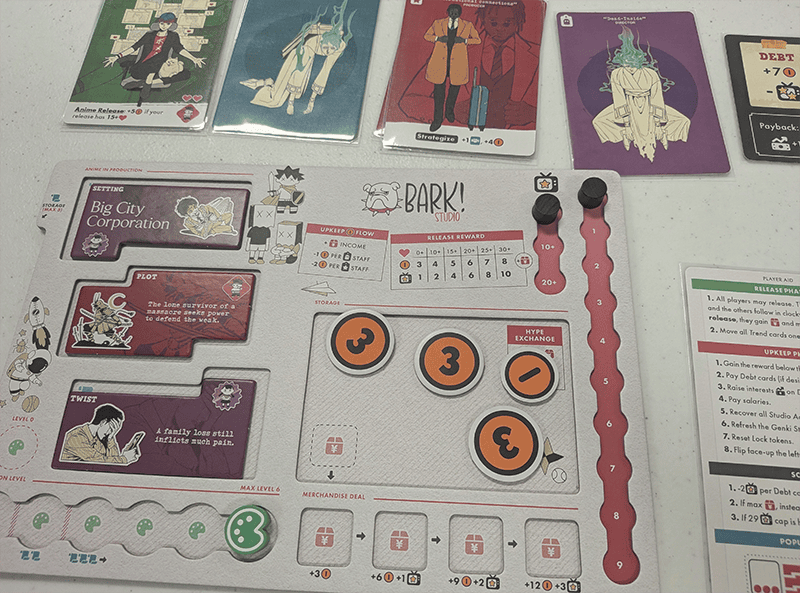
The process goes through a series of definite stages: Production, Release Anime, and Upkeep. During the Production phase, it’s just your ordinary worker placement game; you place one of your tokens on a spot in order to carry out an action. The Release Anime phase is a bit more complicated, but it’s where you will earn most of your popularity points and money. As for Upkeep, it’s your normal bookkeeping exercise: you pay salaries, settle any debts, get your tokens back, and so on. By the way, get used to debt.
Production is the beating heart of Jisogi. It’s worker placement, but your workers have specific jobs, so who you send determines what you can do. Your Writer writes, your Artist animates or outsources, your Producer hires staff or gets Networking cards to break the rules, and your Director can go anywhere.
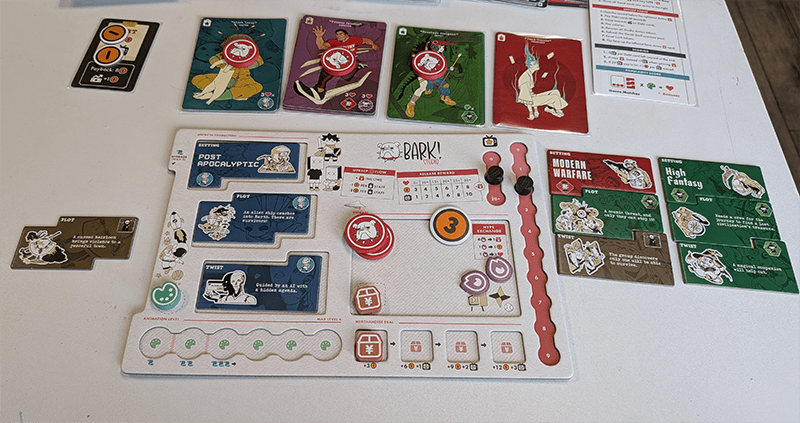
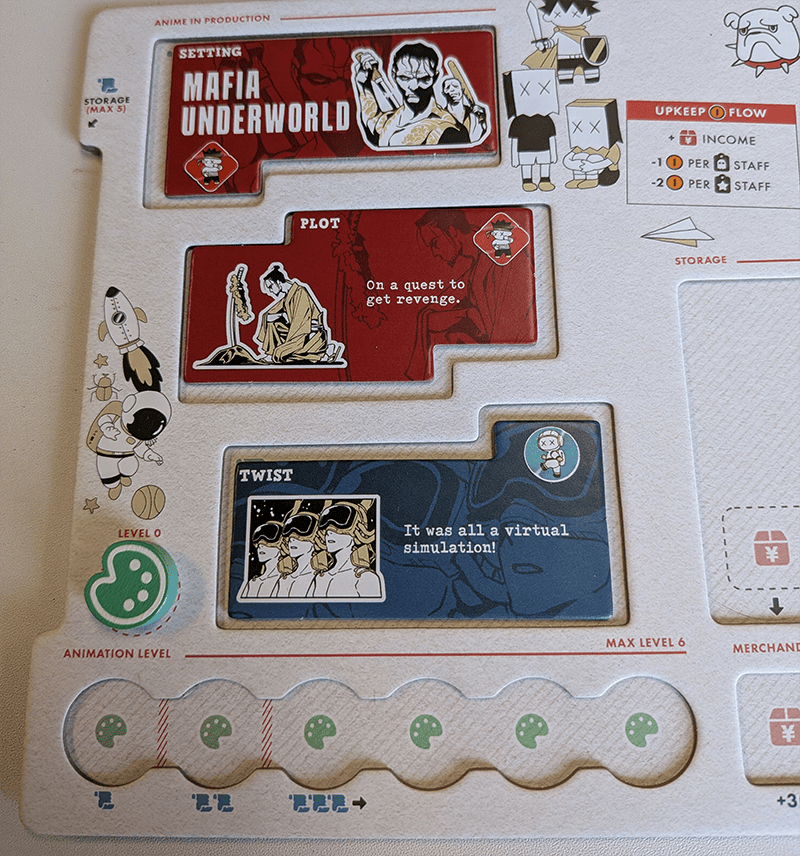
Let’s start with writing first. You collect tiles representing your setting, plot, and twist, then slot three of them into production to create your anime. Their colors represent genres, which becomes important later when you actually release the thing. Your Artist then increases your Animation level, which improves your anime’s eventual performance when you decide to release it. The concept sounds simple, yet your Producer complicates matters by allowing you to hire Genki employees with their own abilities and genre preferences.
Making It Work
Another important feature of Production is that workers don’t actually block spaces as one would expect in a worker placement game. Outside of the employee’s positions, there are no hard restrictions on where you place your pieces. Instead, the more tokens piled onto an action space, the more expensive it becomes for anyone placing there afterward. The game calls this a “high demand fee,” and considering Jisogi’s heavy emphasis on managing loans, you can probably see the problems coming from a hundred miles away.
Once all the players have laid down their pieces, the next stage is Release Anime. Taking turns, a player may release their work into the world if they have all three pieces of a script in production and at least one level of Animation. This is most likely the most “complicated” section of Jisogi, since it requires a bit of calculation, mainly involving simple multiplication. Although I won’t go into the full formula here, I will explain the basics.
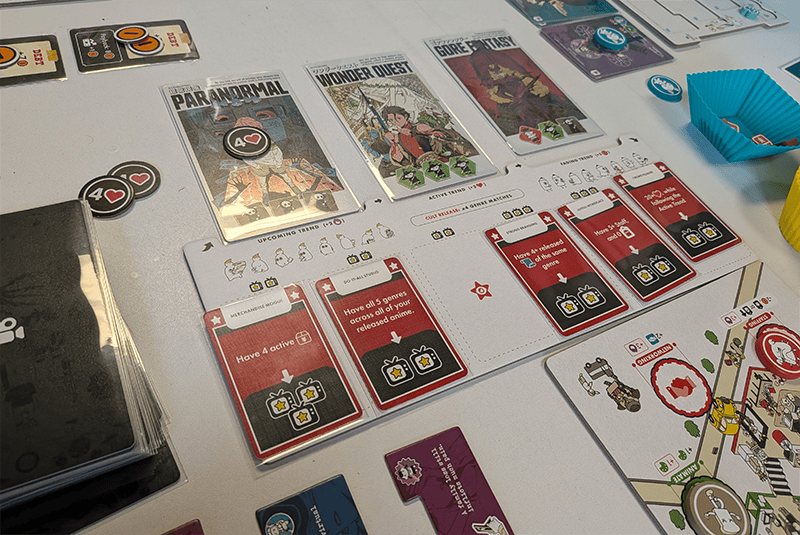
The three currently trending genres are represented by some of the most beautiful tarot-sized foil cards in the game. Each card features three icons representing the genre mix, and your anime’s performance is calculated by multiplying the number of matching genre tiles by your animation level. You can still launch an anime with only one matching genre, but its performance will be weaker.
Once you’ve done the math, you check a chart on your player mat to see how successful your latest masterpiece was, earning money and victory points accordingly. You can also claim one of the public objectives for some extra points.
The Business of Making Pretty Things
It may sound simple, but as with all the other aspects of Jisogi, there are a few things that run counter to the traditional approach. Firstly, if your script matches all three of the current genres, you get a first-come, first-served bonus. Alternatively, you can take the complete opposite route by making a Cult Release. If your script genres don’t match any of the trends, you receive a slightly more favorable reward for achieving something more difficult.
Your employees can additionally influence a release through their preferred genres, increasing your performance or even your Animation level. Under the right staff, you can afford to be more flexible with your script choices because they’re talented enough to make up the difference. It’s a clever system and gives you clear incentives to chase the trends, then hands you several tools to ignore them.
Finally, there’s the matter of Upkeep. About this, I don’t have much to say, since it’s the standard “earn some income and pay your expenses” stage which is typical in any game that includes finances. Carry on this cycle three more times, and the person with the most points will be the winner. If you hold any loan cards, you lose points if you don’t repay them, which is important because you have a maximum limit of 29 popularity points.
At first glance, Jisogi appears to be your simple business game. You’re hiring employees, making your anime, following the trends, and trying to keep going. But it’s here that Jisogi won me over. The more I played, the greater my respect grew for how deeply the history and culture of animation are built into the game’s mechanics. This isn’t simply worker placement dressed up in anime clothes. Rather, it’s a game that illustrates the real-world situations facing the anime industry, such as the various compromises studios must make to survive.
Art Meets Accounts Payable
Even during its early days, animation was also an expensive endeavor with little payoff. Disney’s history is littered with financial hardship, and bankruptcy was always lurking around the corner. Things got so dire that the studio had to do World War 2 propaganda cartoons because the government was giving Disney the fuel to keep the fires burning.
Japan was no exception to the high cost of animation. One of the reasons so much of the anime produced in Japan in the 1980s and early 1990s looked so good was that the country was riding an economic bubble. Since Japanese studios were performing so well, American animated programs began outsourcing their animation abroad; for example, Fox’s Peter Pan and the Pirates and the first season of The Real Ghostbusters.
And we can’t forget The Thief and the Cobbler, co-written and directed by late legendary animator Richard Williams. It is the perfect example of going full art, with no care for the business side. Conceived in the 1970s, the film spent decades running out of money, falling behind schedule, and being held hostage by Williams’ legendary perfectionism.
Jisogi understands this. Animation is a labor-intensive and costly industry, and this game captures that reality through rather simple rules. A lesser design would dropkick you in the throat with pointless complexity to emulate every industry detail. Jisogi is more concerned about making you realize that your small decisions can have major consequences.
Every Studio Has A Story
And those decisions are everywhere in this game. You need to get the right script tiles to pursue the trends or pull off a cult release, and you aren’t the only one who sees that opportunity. Having the right staff is vital to your success, forcing you to hire employees who either amplify your studio’s strengths or patch its weaknesses. Animation is a slow and tedious process, so you need the right animator to do the job, or perhaps hire several.
The various options function because the game’s structure is based on scarcity. Four rounds isn’t a lot of time, and the four employees you start with aren’t very efficient. Decisions have to be made now, not later, and all the players feel this pressure during the game.
Like a proper business, you’re constantly hunting for opportunities to pounce on before someone else does. Jisogi gives players plenty of flexibility, and it’s quite transparent about the consequences. You can do almost anything you want, but you just might not be able to afford it.
It is here that Jisogi starts to tell its story, with each decision becoming its own individual chapter. You might have taken on too much debt to hire that ideal Animator or three, only to find that you now need a major hit to pay them. Or perhaps you had come across the perfect script title, only to see another player take it, leaving you to work out how to turn your leftover scraps into a cheque that won’t bounce. Maybe that Producer you hired on the first turn is finally paying off, giving you a big enough boat to fend off the loan sharks. By the end of the four rounds, your studio has an interesting story worth documenting in a film.
All things considered, the experience isn’t flawless. I’ve played this quite a bit, and after several playthroughs, a few minor problems appeared. None of these issues are serious enough to break the game at all; in fact, I had to squint hard to spot them.
A Few Notes From Management
The staff is the biggest player here, almost to the fault. Hiring the right people feels like the center point around which everything else revolves. I’ve seen games where one player was absolutely coasting because their studio had become the most high-performance machine in history.
The difficulty you experience in the game is very much dependent on who you employ, and Jisogi’s theme of working through scarcity evaporates with the right choices. However, it is realistic to consider that actual animation studios rely entirely on their people.
A further possible issue is the lack of innovation. I use the word ‘possible’ since I have always placed greater emphasis on execution, but I am aware that some players might get upset if they think the game is being too safe. Jisogi certainly belongs in that group.
Creative Differences
Worker placement takes the bulk of the game, and it’s full of passive-aggressive engagement as one would expect, except here the interaction doesn’t involve a court case because nobody can actually block you. Matching script tiles to genre cards is a set-collection and contract-fulfillment with a business degree.
At the same time, your Staff forms a tableau that can eventually run like a proper machine or a very expensive disaster. Jisogi treads on some very familiar ground, but the small detours it takes along the way make for an experience that is both enjoyable to engage with and to master.
Animation has always been a balancing act between creativity and cold, hard business, and Jisogi understands that better than most. Its individual mechanics may not break new ground, but they work together with impressive efficiency, creating a competitive puzzle that gives players little room to breathe. Every decision matters and costly mistakes have a habit of coming back with interest.
It is one of the best games I’ve played this year. Besides the meaningful decisions, Jisogi presents a surprisingly thoughtful look at one of the toughest creative industries on the planet.
Now if you’ll excuse me, I have another studio to mismanage.