
Disclosure: Meeple Mountain received a free copy of this product in exchange for an honest, unbiased review. This review is not intended to be an endorsement.
As activities go, I love the direction Chris Couch Games is taking with its initial batch of releases. The production looks exceptional and the bright, vivid colors of nearly every game I picked up from this publisher at Gen Con has the shelf appeal a game needs to stand out.
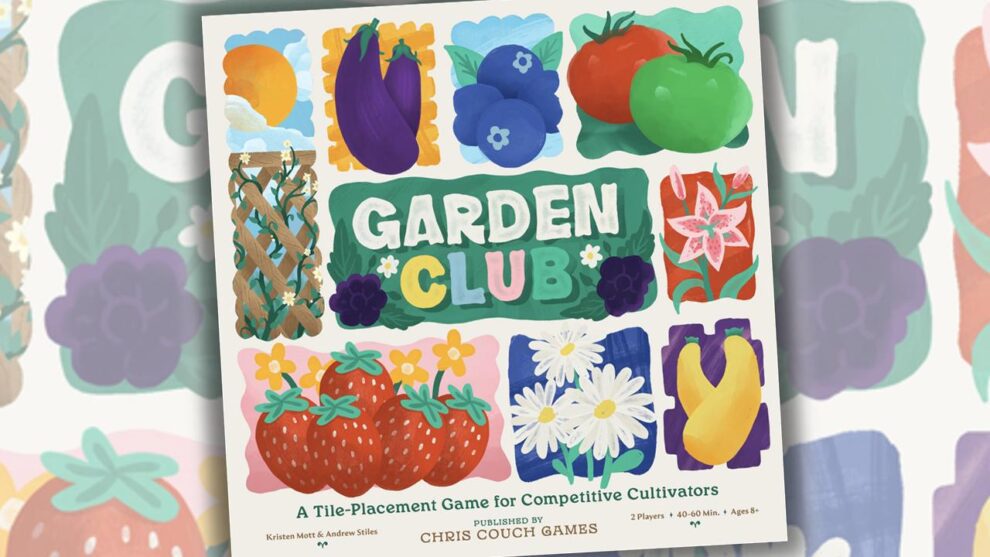
Garden Club (2026, designed by Kristen Mott and Andrew Stiles) is much better as a production than a game. Solid player boards that serve as a handsome storage area and turn tracker for each round. A rulebook that feels luxurious in the hands, from the linen finish to the easy read and the helpful game summary on the back cover. Carve-outs in the box for certain tokens and cards, and a decent amount of mini expansion content for players who want to dive deep.
As a game, Garden Club came back to Earth for my solo plays and my two-player game with my nine-year-old. Players plant and harvest on their turns, placing flower tiles on one of the 16 spaces of a shared centralized board, while making patterns that can be scored on project cards or manipulated using tool cards.

All of it feels very “Sunday afternoon.” By that, I mean that you should play Garden Club with a glass of wine, gentle music playing in the background, and sit with a partner who likes games to be just competitive enough.
This isn’t a criticism. Some players like games where you’ll spend most of your time racing up a points track, and getting things done in Garden Club is exceptionally easy using the standard project cards and base game rules. Each turn, a player can choose one of the double-sided tiles from a market to determine if the tile is one they would rather place as a harvest good, on their personal player mat, or as a flower on the garden board.
Six unique produce symbols appear randomly across the four corners of each flower tile. Matching sides with another tile will trigger a point for the player who ends each of the game’s three rounds with the majority in that produce type, and thanks to extra bonuses for the player who won that fruit or vegetable’s majority in a previous round, a 2X or 3X multiplier might drive that score up. The center of each flower tile has one of the game’s five flower colors, and matching patterns to a project card is another way to score. Every few spaces on the score track, players earn even more bonuses, so finding ways to consistently score 5-7 points every round keeps players busy with more and more ways to boost the bottom line.

After the game’s first 2-3 turns, I found a way to score a project card on almost every turn across my plays. Tool cards help players break the game’s main rules, so using one of your turn’s bonus actions to manipulate a tile before using a second bonus action to score a project card makes for easy pickings…but it is easy pickings for your opponent to do the same thing on their turn.
This all would be fine—the easy gameplay, the simple turns, the points bonanza—if the game was a full round shorter. I think there’s enough here to be enjoyable as a 30-minute game that plays out across 10-15 turns. But Garden Club runs for 18 turns and about an hour with two players, and about 40-45 minutes solo.
“I’m bored, Daddy,” my nine-year-old said during the first of three mid-game scoring rounds.

I wasn’t bored at that point, but I had to agree after we finished the summer season (13 turns each into the game) that Garden Club didn’t really have a lot more to do or say at that point. In fact, at one point, we had accumulated so many Tool cards that the draw deck of Tool cards had run out.
We still had a full season to go.
As an activity to try with my wife, I think Garden Club has a chance, especially on a date night at home where one or both of us have had a long day and we are looking for something that equates to brain candy. And, the game does offer chances to scale its difficulty north thanks to advanced project cards and a “Tomato Farmer” variant, which I did not try for this review.
Players looking for a gardening themed board game have limited options, so if tile placement and pattern building gardening games are your thing, Garden Club should get a look. Otherwise, I’m very excited to explore other games in the Chris Couch Games portfolio!