
Disclosure: Meeple Mountain received a free copy of this product in exchange for an honest, unbiased review. This review is not intended to be an endorsement.

I’m a big fan of Friedemann Friese.
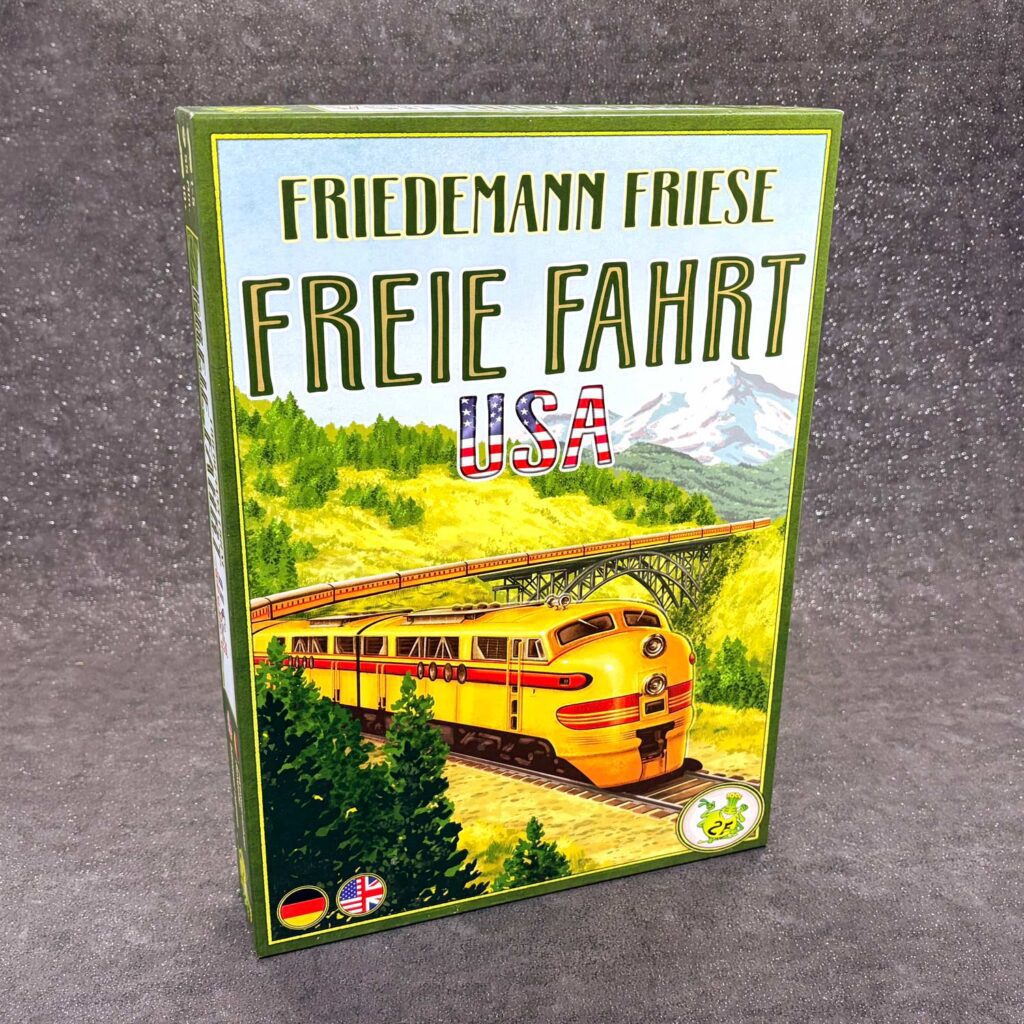
From my very first play of Power Grid back in 2016, I knew there was just something about his games that were different from other designers. And so by the time Free Ride came out in the US, in 2022, I had already acquired many of his titles (Faiyum, Feierabend, Power Grid, Copycat, etc.). My team member Tom Franklin reviewed Free Ride last year, and now I’d like to follow up with my review of Free Ride USA.
🎶 “Come on and take a free ride”. ♬
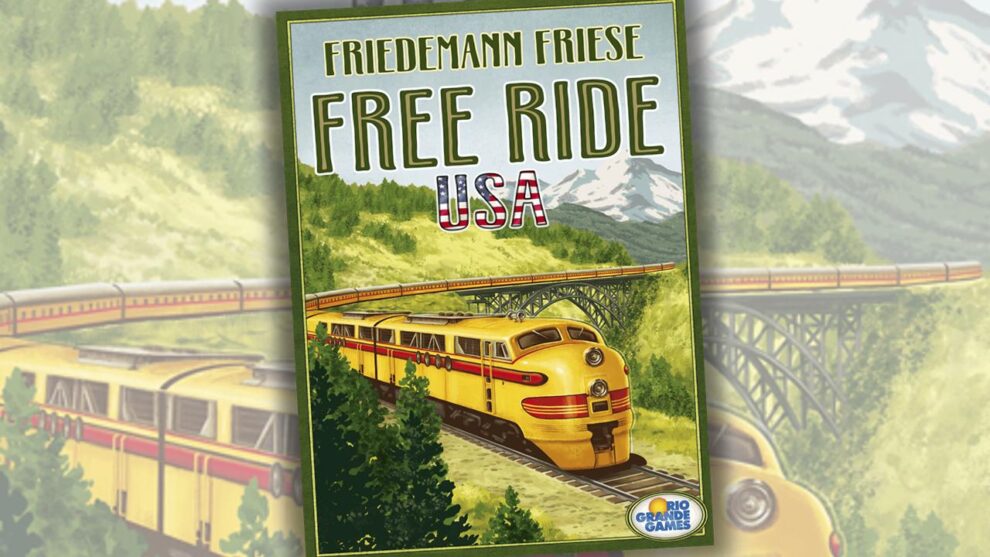
“We gotta do better, it’s time to begin” – Free Ride USA overview
Free Ride USA, like its sibling, is a “train game”, although 18XX players might take exception to that label. Players take turns performing two main actions: laying track and moving their engine across the country. As they progress from city to city, they may optionally pick up a route pair from the public display. This isn’t an “action” per se, but something they can do as part of moving their train around.
“Get yourself a free ride”
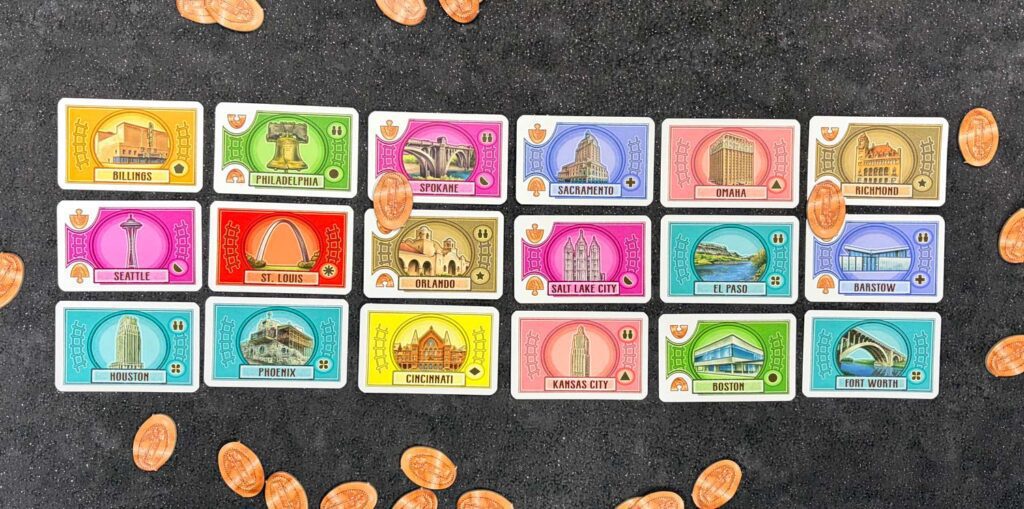
Let’s talk about the route display and selection process, because this is one of the more unique aspects of the game. At the core of Free Ride USA are decks of city cards, split into 3 distinct eras. Each of the 45 cities on the map is included once in each of the era decks. At the beginning of the game, players lay out 6 columns of 3 city cards as seen below, resulting in 12 total routes.
A route is either the top two cards of a column or the bottom two cards, but will always begin in the topmost card of whichever route they claim.
 On a turn when a player has taken the “ride the train” action (moving their train), they can pick up one of these routes, assuming the following is true:
- They have an open space on their train for a route
- At the start of the game, players may only have a single route.
- Beginning in era 2, players may have two routes.
- They have ended their turn in, or moved through, either of the starting cards of one of the routes.
After claiming their route, the remaining card in the column is discarded and 3 new route cards are laid out. This is one way in which a player can impact their opponents—since a route can only be claimed by physically occupying the starting card, you can estimate when an opponent will be able to “steal” a route you’re eyeing. You can also preemptively claim a route that might benefit an opponent, but only if you’re near that city and can swoop in to grab it.
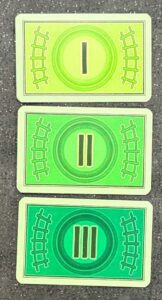
Once all the cards in the first era have been laid out, claimed, or discarded, you move on to the 2nd era, and then finally to the 3rd.
“People would say it’s that time to change”
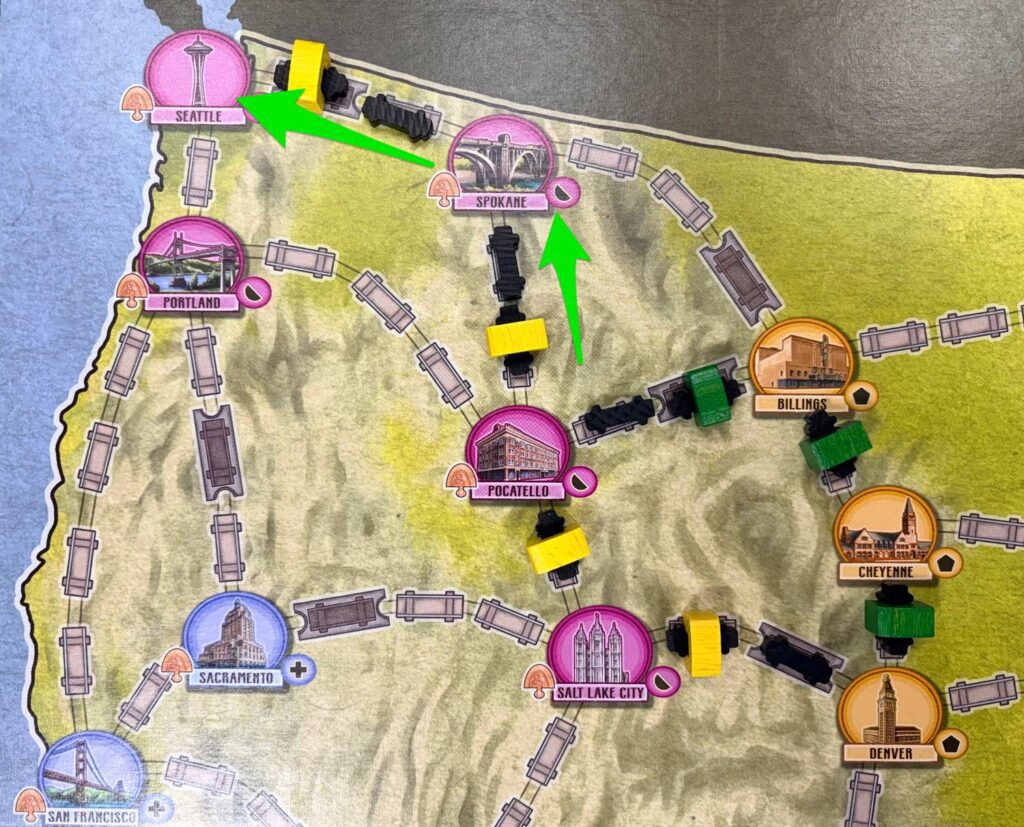
The reason for the game’s name is the way tracks are laid onto the board, and how they’re used. When taking the “rebuild rails” action players can spend two “construction points”. Either drop a track piece onto two different normal track spots, or 1 track piece on a tunnel space. If you start but don’t complete it in one turn, you mark it with your hammer token to indicate its “under construction” and you’ll finish it on a future turn. If you complete the connection between two cities, you mark it with one of your ownership tokens.
But players can only place track onto places on the board that their train can reach. This means that at the beginning of the game, they may only build outwards from the city their train marker occupies. However, once your track connects to that of other players, you can then skip over them and continue building from cities they’ve already reached.
Track built by you can always be used when taking the “ride the train” action, but if you use a track owned by another player, you must pay them a coin. When doing so, you remove their ownership token, making the track “state owned” (which makes it a “free ride” for every player for the remainder of the game). Can you tell that Friese is European?
“But having a good time so free ride still remains, yeah”
After all the cards from the 3rd era have been placed, players can “withdraw from service”, meaning they’re no longer claiming routes or moving their train. The other players can continue to complete routes, but each time play returns to a player who has already withdrawn, they claim a coin, each of which is worth 3 points at the end of the game. So if players have already withdrawn, you better make sure that your continued play is worth the difference in points they’re earning.
At the end of the game, players tally up their points as follows:
- Each unique city card is worth 5 points.
- Each duplicate city card is worth 2 points
- Each coin is worth 3 points.
Final Thoughts on Free Ride
Many people, including my teammate Tom, have billed Free Ride (or Free Ride USA) as a potential replacement for Ticket to Ride. And while there are definitely similarities, the games are different enough to coexist.
In Ticket to Ride, players can lay track anywhere they like, intentionally blocking other players from moving across that city to city connection. Routes consist of a single card; you can’t see what routes might be available until you draw cards from the deck.
In Free Ride USA (and Free Ride) players must have a physical presence in the starting city of a route in order to claim it, they can choose from 12 different public routes, meaning that they can react to changes in board start more easily, and most, importantly, track placed on the board does not block other players from accessing that city (unless they player is out of money). Free Ride USA is superior in this regard to Ticket to Ride.
But one way in which Free Ride USA differs in comparison to Ticket to Ride is in the relative value of a route. In Ticket to Ride longer routes are inherently more valuable, with some of the longest routes being worth 20 points or more, compared to a shorter route being worth only 2 or 3 points. Contrast that to Free Ride USA; completing a route between two new cities is worth 10 points (5 points for each city card). But that’s the same value whether the cities are right next to each other (Birmingham to Knoxville for example) or at opposite ends of the board (Bangor to Los Angeles).
This makes Free Ride more of an optimization puzzle because players are incentivized to claim and complete routes that are clustered together. If you’re going from Omaha to Detroit, then consider picking up that available Chicago to Memphis route when you’re done. But keep in mind that while you can claim and complete routes with duplicate cities, the value of that route diminishes if you do.
Having played both Free Ride, and Free Ride USA, I can also comment on one of the most glaring flaws in the original game. Every city on the original game’s board was colored the same tan as all the others. Combine that with the fact that most Americans are terrible at European geography, and you’ve got a map that’s really tough to visually parse. It’s so bad that many people took to placing a matched set of dice on the route cards and their corresponding starting city on the board.
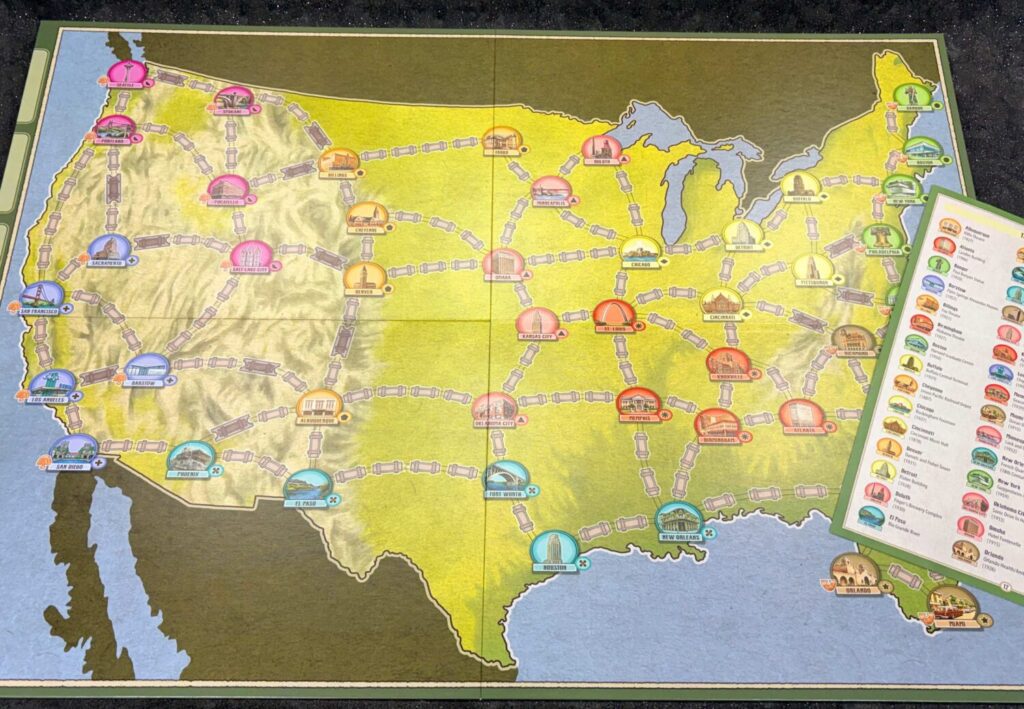
Thankfully, 2F Spiele solved that problem by highlighting regions: the West Coast is a light blue, the East Coast is green, Midwest is orange, etc. They also added icons to assist players with visual impairments. Here’s hoping 2F Spiele updates future print runs of the original game with this fix.
I really enjoy Free Ride USA. It’s a nice mental puzzle that encourages players to both review the current board state for ways to maximize their turns and to plan ahead when new cities come out. I also love that turns are lightning fast. If you’re moving your train, then your turn is done in seconds. And turns where you lay track aren’t that much longer. The only things you really need to consider are the locations of the other players in relation to routes you might be interested in claiming. Or making sure that you can lay track ahead of where you’re going so that you don’t end up having to pay another player for the privilege of converting a connection to state owned.
If you’re looking for a fun puzzle that plays in less than two hours and helps you improve your United States geography, then you can’t go wrong with Free Ride USA.
Free Ride USA details
- Designer: Friedemann Friese
- Artists: Harald Lieske
- Publishers: 2F-Spiele, Rio Grande Games, SUNNY BIRD
- Release Date: 2024
- Player count : 1 - 5
- Age range : 10+
- Time range : 50 - 90 minutes
- Mechanism(s): Connections, Contracts, Movement Points, Network and Route Building, Pick-up and Deliver, Solo / Solitaire Game, Victory Points as a Resource
- BGG Geek Rating: 7.5963 - converted to Meeple Mountain scale: 4.0.
- More articles about Free Ride USA.