
Disclosure: Meeple Mountain received a free copy of this product in exchange for an honest, unbiased review. This review is not intended to be an endorsement.
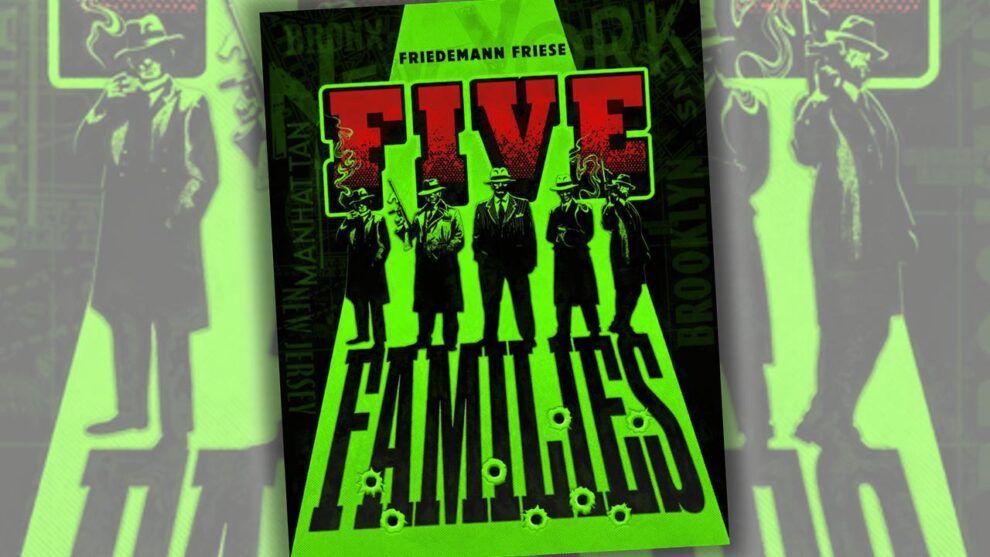
Five Families doesn’t quite work. Let’s get that out of the way at the start. Friedemann Friese’s latest big box game had a lot of promise. It mixes together a strange and confrontational auction system with area control scoring, it has wonderfully straightforward rules, and it has cute li’l mobster meeples, but none of these admirable traits can save it. Its joys are undercut by its runaway leader problem, the impact of the capriciousness of the card draw, and, worst of all, monotony.
Still, at least Five Families respects its audience enough to be one of the more interesting letdowns I’ve experienced in a while. I don’t think it’s a good game in the commercial sense, but I wish every game that didn’t work could manage to fail like this. It is something equally or possibly even more valuable than “good”: Five Families is worthwhile.
Married to the Mob
The Five Families are the five principal branches of the Mafia as it operates in the United States. If you’ve seen The Godfather, you know who these guys are. While the idea of the Five Families feels irrevocably tied to mid–20th century America—probably, come to think of it, because of The Godfather—the Five Families very much still exist, and I’m delighted to discover that they’re still run by people with names like Michael “The Nose” Mancuso and Andrew “Andy Mush” Russo. A little stability in this uncertain world is a nice thing.
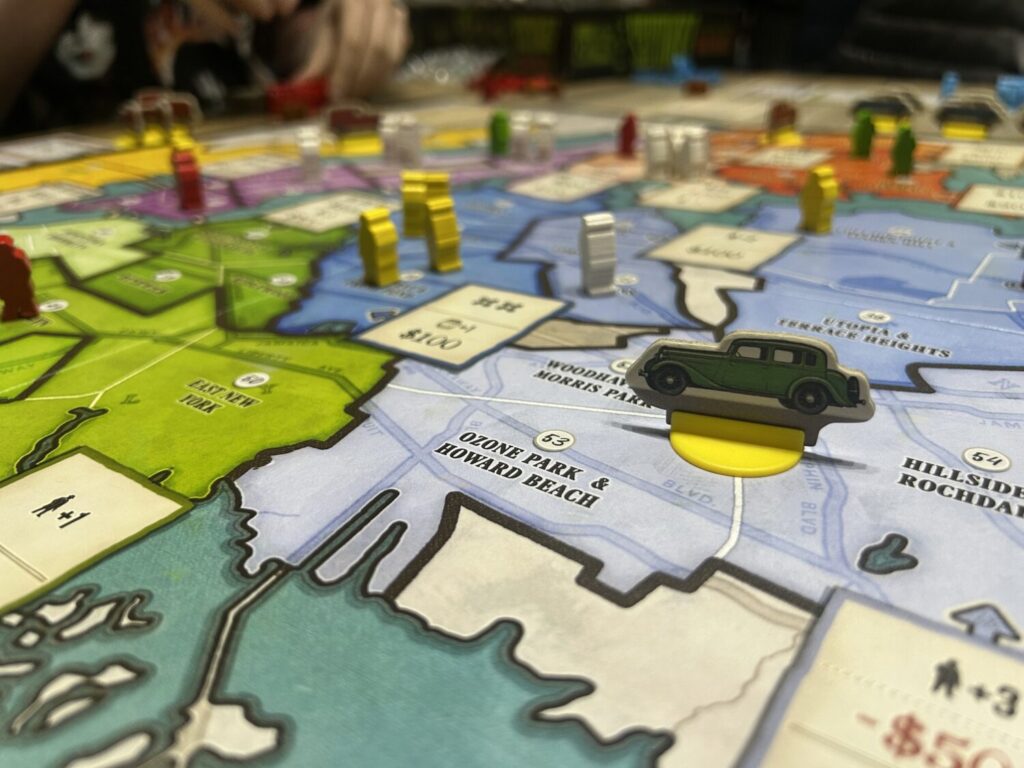
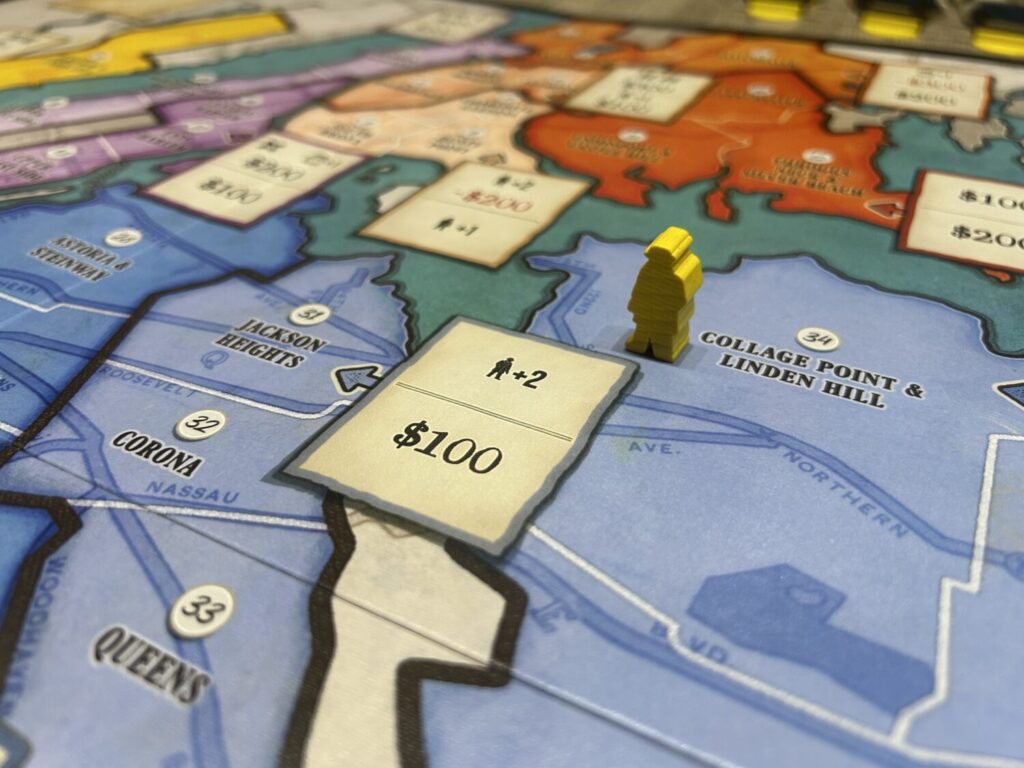
In Five Families, players squabble over control of different neighborhoods in and around New York City. From Riverdale to Gravesend, and even out west to Jersey City and Weehawken, the whole of the greater NYC Metropolitan Area is up for grabs. Well, except for the parks. Central Park and Prospect Park, like the gymnasium in West Side Story, are neutral territory.
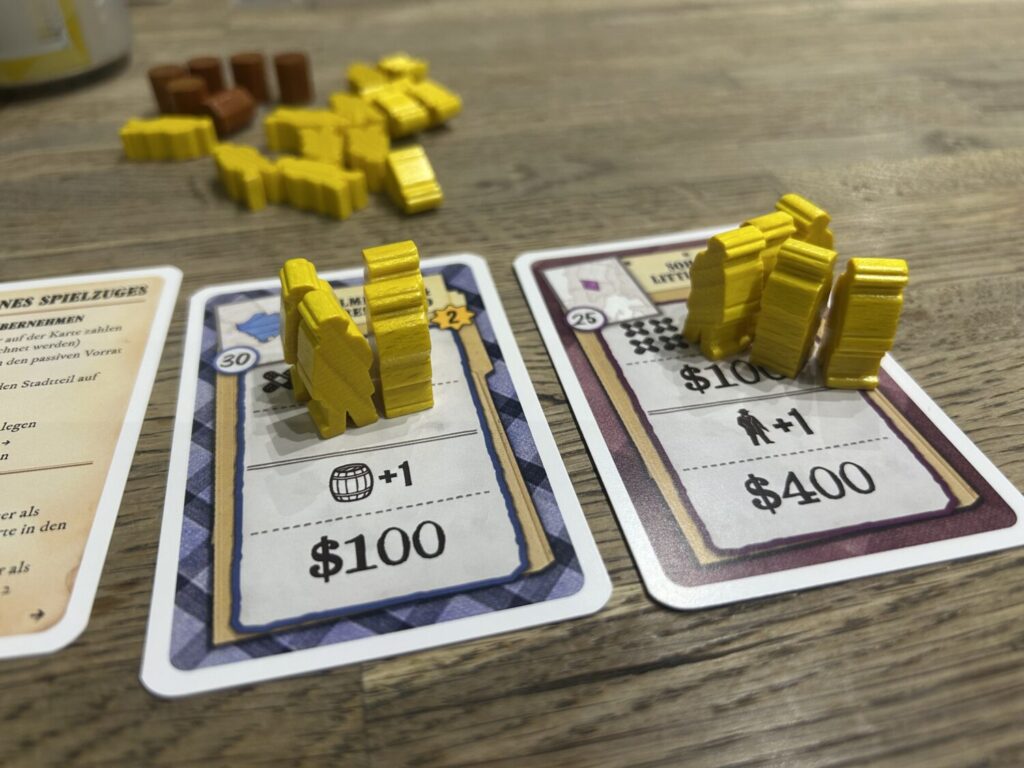
To claim a neighborhood, its card has to be in the market. Take the card and put Mobsters on it. These Mobsters are your bid, as will become apparent as the game progresses. At the beginning of your next turn, provided that neighborhood is still in front of you, you can take control of it by putting your Mobsters out on the board in the matching location. At that point, the neighborhood is yours and cannot be taken from you for the rest of the game.
The card may not still be there, though. In lieu of taking a card from the market, you can snag an uncontrolled card from one of your opponents. So long as you can send more muscle than they did, there’s nothing stopping you. My opponent might think three Mobsters is enough to take East Harlem, but I have my eyes on it, and I’m willing to send five. Contrary to what you might expect, the outbid player gets their Mobsters back. These appear to be fairly peaceful interactions as far as power struggles go.
Control of neighborhoods has two purposes. First, every controlled neighborhood gives you a once-a-turn supply of money, Mobsters, and/or Barrels, which can be turned into either a Mobster or $100 as need dictates. Managing your income as best you can is a crucial part of the game. If you have too much money and not enough Mobsters, you can’t do anything. The same is true in the other direction. By the end of my first game, one player had amassed so enormous a fortune that we’d run out of money, but she had no Mobsters with which to take control of anything.
Second, control of individual neighborhoods plays into scoring Areas, the groupings of neighborhoods around the board. Once Downtown Brooklyn, Cobble Hill, and Sunset Park have all been controlled, whichever player has the most Mobsters in that Area gets to score it. All Mobsters are returned to their players, and the winning player gets to place a single dapper car standee in the middle of it all. The capo dei capi, the boss of all bosses, is whoever has the most cars out come the game’s end.
Don’t You Fuhgedaboutit
All of the ingredients are there for Five Families to be a delirious and cutthroat experience. The ability to snag territories from your opponents should help to balance out the luck of the draw in the card market, and create opportunities to dare someone to overspend. “How badly do you really want it?” is one of my favorite tabletop questions. The shifting prioritization from the early game focus on “What income does this neighborhood provide me?” to the late-game monomaniacal focus on scoring Areas should create a snowballing sense of urgency. Bids directly translating into amount of control within a portion of a larger area, making each bid a sub-bid to a larger, biddier bid, is something I don’t think I’ve seen before, and I love the idea.
For all that, it doesn’t come together. Luck of the draw can have an enormous impact, which to be honest is the least of my concerns. There are two larger issues. The first is that, at a higher player count, someone is going to get frozen out early, and 90 minutes is a long time to spend sitting on your hands. The biggest problem: players quickly habituate to making larger initial bids for territory, which makes the game deathly boring. It isn’t much of a knife fight if everyone stands in their own corner with a gun.
On the one hand, Five Families doesn’t work. On the other, it’s some of the most fun I’ve had thinking about what almost works in a game. I want someone to steal from this game. Pilfer at will. Shamelessly rip Friedemann off. Friedemann, your output suggests you are loath to repeat yourself, but hell, you could steal from you. There is almost a magnificent game here, and I very much want to play that.