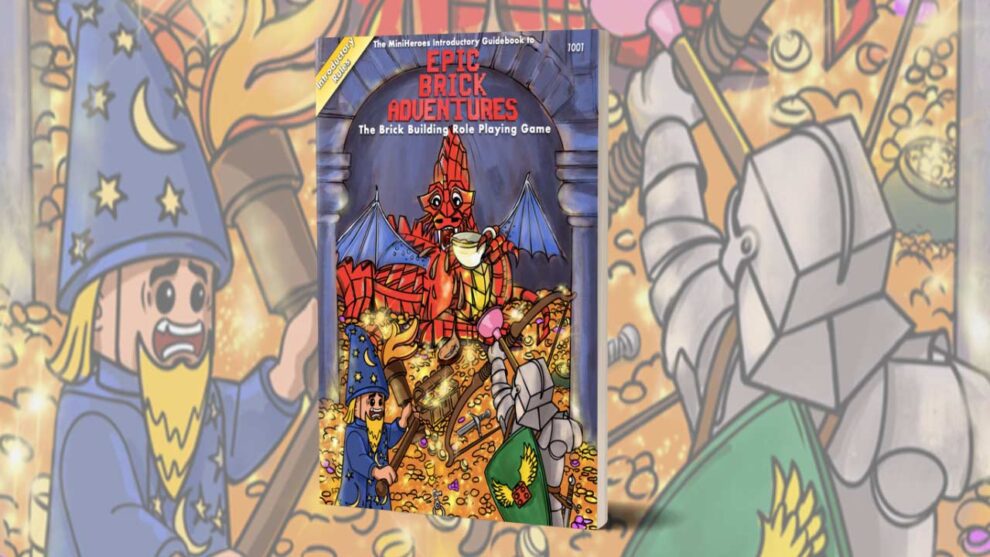

Plastic bricks were a key part of my childhood. I have fond memories of tearing up my hands rummaging through a big tub of bricks that may or may not have actually held the one piece that I was searching for. Over time, my siblings and I developed amazing characters and lore of the hijinks that happened in our brick-world, leading me to naturally want to share that with my kids as they grow up. Epic Brick Adventures is designed to couple the world of bricks with the world of roleplaying games to facilitate creativity and storytelling without any age limitations. Ahead of the Kickstarter, I was able to get a look at the Introductory Guide and the Circus Catastrophe Intro Adventure to see if this game is more than just D&D with bricks.
Epic Brick Adventures: Building You Up
Epic Brick Adventures provides a rules framework for players to use their existing collections of bricks and plastic figures in a roleplaying game setting. Minifigures become MiniHeroes as a Brickmaster leads the players through an adventure of their own devising, serving as the Gamemaster (in conventional parlance).
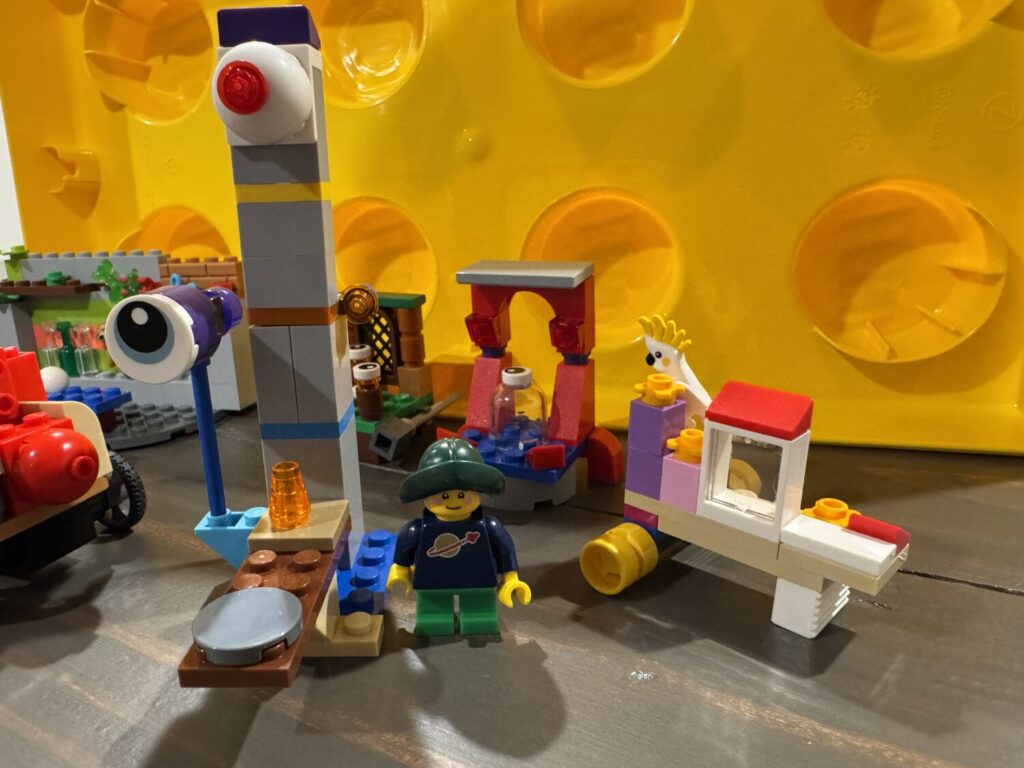
MiniHeroes have Abilities broken out into Creative, Smarts, Willpower, Sense, Muscle, and Zip with concepts of Gusto and Clutch replacing energy and hit points respectively. Tack on an Occupation and some basic equipment and you’re all set to be thrown into the Brick Realm. This can all be tracked on a paper character sheet, but there is also the option to build a little tracker out of bricks to showcase your current Gusto, Clutch, equipment, and anything else pertinent to your character.
The game differentiates itself from the heavy-hitters of the tabletop roleplaying game world through two concepts: the Bag of Bricks and the Building mechanics.
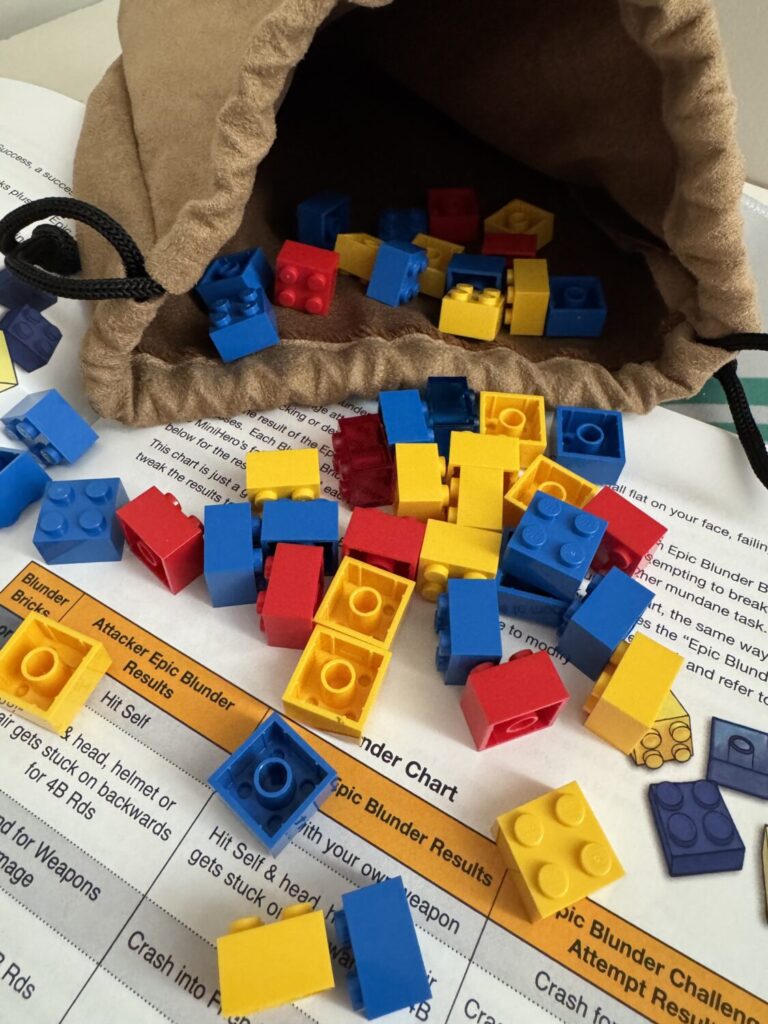
There are no dice in Epic Brick Adventures, eschewing the plastic polyhedra for a Bag of Bricks to determine outcomes of Challenges. If you don’t have a bag to fill with bricks, a deck of playing cards is recommended as an alternative, although dice or another random number generator would work as well.
The standard Action Brick distribution of a Bag of Bricks is to have 20 Success Bricks in one color, 20 Blunder Bricks in another color, along with 1 Epic Success Brick and 1 Epic Blunder Brick also in unique colors. Players then draw bricks out of the back according to their Ability and the level of Challenge, counting up the number of Successes to see if it meets or exceeds the Difficulty Level. Epic Bricks give spectacular or detrimental results on top of a success or failure, leading to big, impactful story moments.
Building is the crux of the game, otherwise what do we have all these bricks piled around for? The Brickmaster prepares the adventure by pre-building some set pieces, vehicles, etc for the players. Additionally, there should always be bricks on hand for the players to use. Depending on the complexity of what the players are building, consult the Brick Building chart to review Difficulty, number of bricks, and the time it takes to build. This could be anything from a table to a large castle, with the latter taking a number of days to complete. It should be noted that the duration included in the table indicates in-game time as opposed to how much time you might allow for the players to complete the task. At least, that’s how I interpreted the rules, considering I’m not going to take a six day break in the middle of an adventure for the players to make a spaceship.
Players contribute towards building—and sometimes unbuilding the world around them—and make their creation. And then, like all Challenges, Action Bricks determine the outcome. The BrickMaster can then award Boosts or Blocks to the Challenge draw depending on the perceived quality of the build. This is the part of the game that only sort of makes sense to me. If the players build something that is determined to be a failure but looks good, it feels bad to destroy it right away or have it not work. Things are complicated further when thinking about players building something like a house structure that fails, causing it to fall apart.
When I played with my kids, I actually took my own liberties to never have the Failures on a build render the creation completely useless, and I certainly wouldn’t destroy what they made. Especially if the players were to spend literal days building something that comes down to a few second draw from the Bag of Bricks, that would feel bad.
Failures are a good opportunity for the BrickMaster to introduce another Challenge, problem, or obstacle instead of invalidating some intense, creative work. Take the castle example again. Perhaps the castle is attacked by a siege immediately, or a single tower was accidentally made of fragile sandstone bricks and won’t hold up. There could be a melancholic dragon who just wants a friend; the moat’s alligators could be herbivores, or the funds for the land didn’t clear escrow and now there’s a legal dispute over the castle’s owner.
Epic Brick Adventures: Piece by Piece
There’s a lot to like in Epic Brick Adventures. A lot of people are already going to have everything they need without having to go and buy specialty dice just by nature of the popularity of building bricks. Of course, there is one prominent brand that leads the industry in this regard, but you can use anything in the same scale.
The introductory adventure, Circus Catastrophe is well-designed in the sense that it showcases core game concepts through the defined set pieces of sideshows at a carnival. For example, players learn about Muscle’s impact on Challenges through a bell-ringing minigame, or about Building through the Puzzler’s puzzle. As with the rest of the content, however, there is definitely opportunity for improvement in presentation and layout.
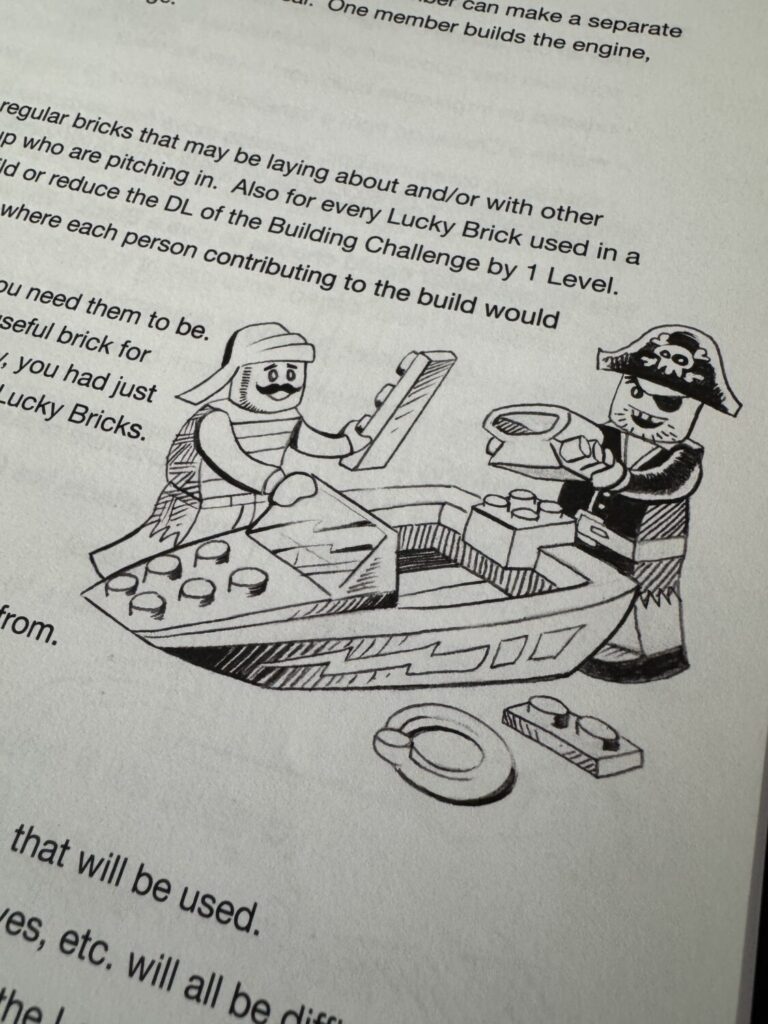
For the most part, the Introductory Guide reads as a wall of black text on a white background, with the occasional black-and-white image or yellow-headlined table to break up the space. In a game of creativity of imagination, there should be more color and pop!
I’ve also found a number of grammatical or logical errors in the text that will hopefully get cleaned up ahead of the Kickstarter. Seeing the White Wizard spelled as Soromon caused me to weep heavily, but there were other things too. During the Team Building explanation, there’s a mention of a group combining their dice. But there are no dice. A similar mention on the Brick Building chart shows how a TV is a Piece of Cake to build, but a Simple Tool is more complex and requires 10-20 pieces. And I don’t think I need a table showing me a spread of Abilities with a value of 3 when I was just told that the Average Brick Person would have a 3 in each of those areas.
Epic Brick Adventures mentions early on that we shouldn’t get “too caught up in the rules”, but then proceeds to generate a lot of rules which I find to be at odds with the core of the game. The game’s core differentiator from others in the space is the building. It’s imagination. It’s problem-solving and working with what you have. Whenever I watch the LEGO Movie, Emmet and Co. build incredibly quickly and their creations rarely just fail. That’s what I want my MiniHeroes in Epic Brick Adventures to be doing.
My advice is to streamline. I didn’t worry at all about movement rules with my kids. Using loose definitions of Near, Far, and Very-Far away worked just fine, as the game doesn’t need that kind of minutiae. Reduce terminology and be consistent (is it a Bag of Bricks or a Brick Bag?). The concept of Actions—while necessary in games like Pathfinder—were too much for young kids. I just asked what they wanted to do, and they did it. They had a blast pulling Bricks out of the Bag to generate their successes, which was great because these are kids that absolutely love rolling dice.
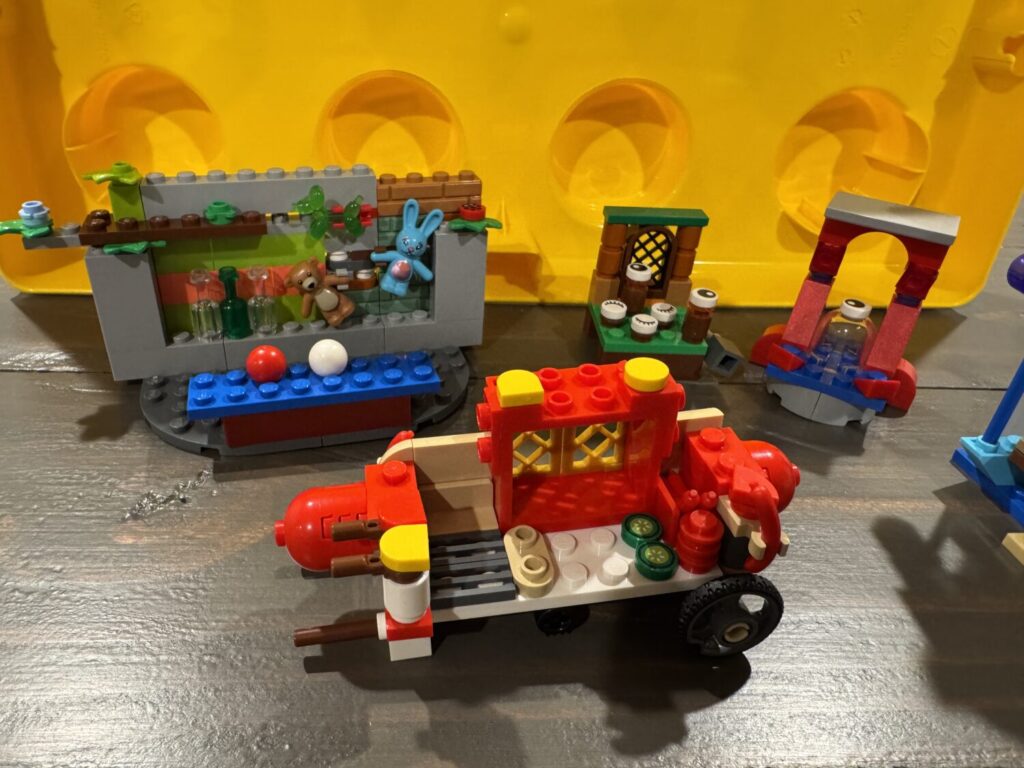
There is some high overhead for the BrickMaster as well in terms of preparation time. Even with the provided building instructions for the Circus adventure, it still took me a while to dig through our bricks and put together builds that looked close enough to the intended builds. Once you are making adventures on your own, you have to prepare all of those models and available bricks for the players ahead of time. This is not a game that handles a Theater of the Mind style of play because the focus is on the tangible aspect of building.
Epic Brick Adventures: Build in Progress
The notion of Epic Brick Adventures is interesting because it adds mechanics to play fueled by imagination. It’s taking an activity that I already enjoy with my kids and offers an extra layer of logic on top of it. With the D&D line of minifigures that were recently released, it’s not the first time that I’ve seen bricks and minifigures coupled with a tabletop roleplaying game either. People have been using bricks for terrain, characters, and set pieces for a long time.
The game takes a swing at turning those bricks into something more, but it seems to stumble in its own way with how many extra layers of rules that it adds, just in the Introductory Guide; the Core Rules are expanded even beyond that. The Bag of Bricks gives a dimension of suspense for Challenges, especially with the Epic Bricks, and it is a highlight of the system. Building, on the other hand, has too much framework for something that is largely driven by imagination.
I’ve read a fair number of roleplaying game rulesets and Epic Brick Adventures feels too much like a reskinned version of D&D that tacks on some building rules. I’d actually like to see more flexibility and rewarding creativity through a reduced ruleset, where players can shine with their ideas beyond just being rewarded with a Hero Point-adjacent Lucky Brick. Using a structure more like Forged in the Dark seems like it would fit better than repurposing a d20-based system.
Epic Brick Adventures hopes to build something grandiose, but the pieces aren’t quite pushed in all the way.