
Disclosure: Meeple Mountain received a free copy of this product in exchange for an honest, unbiased review. This review is not intended to be an endorsement.

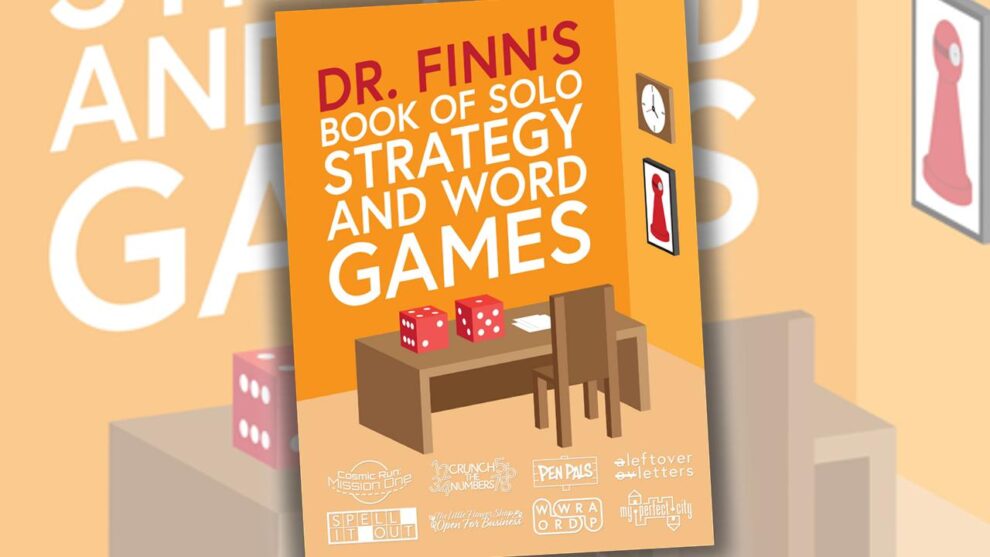
Thanks to my side gig writing a weekly column for BoardGameGeek, I recently got a note from Steve Finn, the designer of Biblios as well as the co-designer of Cities and Cities USA. Steve saw that I do a ton of business travel, so he was kind enough to send a review copy of his recent release Dr. Finn’s Book of Solo Strategy and Word Games.
The book really is a book—it’s basically a workbook that includes eight titles, each of which features a short rules write-up along with worksheets to play each game eight times. In that way, this book has 64 total plays available, and for this review, I tried four of the games twice each.
The setup is very simple: you have to be able to read basic English, possess a pen or a pencil, and have access to as many as four normal six-sided dice. If you don’t like to read, Steve’s got you covered—each game’s rules include a QR code that links to a teach video for each of the eight games. And if you don’t have dice, Steve STILL has you covered, with an online dice simulator that takes care of the die rolls for you.
Some thoughts on those individual games are below, as well as a few closing thoughts.

Cosmic Run: Mission One
Cosmic Run: Mission One is the most complex game, rules-wise, of the four games I tried; five full pages of rules lay out the situation.
Cosmic Run is a race to reach four different planets before “the alien” does. That alien is simply the bot you are playing against in this solo affair. Cosmic Run is a dice placement game, where players must allot die results to either special “Ally Powers” or specific planets to move player-controlled ships closer to those planets by crossing out movement spaces along the way.
Despite the heavier ruleset, Cosmic Run: Mission One is very light in execution, and choices narrow as the game goes along. As it turned out, Cosmic Run: Mission One was both my first foray in the book and my favorite game across the four I tried. It was very much a game I could play at an airport, or at my hotel room, with other distractions and no loss of intrigue during my turns.
The Ally Powers include six different ways to bail out bad turns, but thanks to a bonus scoring mechanic for available but unused ally powers, it became fun to gain access to certain powers but never use them. And, like other games in this book, Cosmic Run is a breezy 15-minute experience; as a light strategy title, Cosmic Run is a very approachable game.

Pen Pals
While none of the games in this book were bad, Pen Pals was my least favorite game of the four games I tried for this review.
Across 12 turns, players roll two dice to determine which fence segments must be drawn on a grid from a market of choices. The game’s board is a grid of farm animals which must be fenced in along with buckets that were drawn during setup. On a turn, a player uses the two die results to determine which row and column are activated to select a fence segment that must be drawn adjacent to any previously-drawn fence segment.
At the end of the game, scoring is tied to pre-populated farm animals and, ideally, a single bucket in each section. For fenced-in areas that feature only a single bucket, scores can really spike if your plans ended with a high number of the same, or even different, animals in each area.
I’m sure there’s more strategy to Pen Pals than I am giving it credit for. And with a small sample of plays, I can only tell you what I saw. However, Pen Pals didn’t give me much hope that it would be a game I would regularly return to. Die rolls are linked to specific fence types, and sometimes, the thing you want to draw has already been crossed off, thanks to a rule that forces the player to cross out used choices on each turn.
Again, Pen Pals isn’t bad, but as an activity, there are better options in this book.

Word Wrap
Full disclosure: I’m not a word game player normally. Games like Bananagrams, Illiterati, and Scrabble still live on my game shelves, but I never choose them over a board game where I don’t have to choose my letters carefully!
With that as our frame, I approached Word Wrap with trepidation. Honestly, I approached it mainly because it was the third game in the book.
Word Wrap is the simplest game, rules-wise, of the four I played. Using a grid of scrambled letters (imagine something that looks like a word search), players get eight turns to capture letters using polyomino shapes that can be turned into words. Each turn begins with a die roll, then players use one of five shapes (rolls of a six grant the player a choice of a wild) to surround four letters in the grid. The captured letters are then entered—together, or split—into one of the seven lines that must form completed words for scoring.
For a wordsmith, I would guess that Word Wrap would be a fun challenge. For me, an average word game player, Word Wrap was a blast, even if my scores fell into the Mid ranking, which is the lowest tier for this game on the Total Score Sheet. Building simple three- or four-letter words on my turns was easy, but the real challenge came from building words that could take advantage of letter scoring bonuses within each word block.

My Perfect City
Fans of games such as Cartographers, Tiny Towns, Between Two Cities, or other tile/building placement games where each shape has a different scoring rule, will feel right at home with My Perfect City. It’s a very straightforward tile placement game tied to a die roll and a choice of tiles based on the die result. There are five different building types that have to be placed in a 6×6 grid, with each building featuring its own scoring rules listed at the top of each worksheet.
My Perfect City ended up being my second favorite title of the four I tried. The teach takes seconds, and choosing which tile to place each turn quickly became a fun puzzle. Three different once-per-game powers are also available to help bail out a bad turn, but I found a strong desire to high score this puppy right after each of my plays. Scores here stay low—a top-notch rank in My Perfect City pushes over the 35-point line, and I ended up near the middle in both plays—which gave me the sense that I was always one move away from reaching the sky.
I love Tiny Towns, and Cartographers is excellent, so My Perfect City was easy to grasp. It was not easy to win, and including a title like My Perfect City helped cement my feelings on the book as a whole.
Final Thoughts
Dr. Finn’s Book of Solo Strategy and Word Games became a nice diversion when I was on the road. I could see the book becoming a nice way to spend an evening at home with some simple solo challenges to play when I didn’t want to set up a full game. (For me, toting the game around with my work laptop was ultimately the best bet.)
In a fashion similar to other solid “high score” challenges, the workbook has a Total Score Chart where players can track their scores, with each game having a score breakdown in tiers. On my very first play of Cosmic Run: Mission One, I scored exactly 50 points, enough to push me into the General rank, the game’s top ranking. Meanwhile, I got destroyed playing Word Wrap, with a score that only reached the halfway point of the “Mid” ranking. (I thought I was a better word game player…maybe not!)
My only major negative: each game uses the exact same format for each worksheet. For example, Word Wrap has eight worksheets available for play…but the grid’s letters are laid out the same way each time.
I get it—I’m sure this forces players into a loop to try and get the highest score with a static environment, and from a production perspective, I assume these elements kept logistics and costs down. But shouldn’t it be possible for each of the eight Word Wrap sheets to have a completely different series of letter ordering on each sheet? One section of the sheet includes the letters C, E, U, and R; my lazy brain just used CURE for that each time in the first four-letter word block to score.
For just $15, I highly recommend Dr. Finn’s Book of Solo Strategy and Word Games for people who travel often. I’m sure at least a couple of these eight games will work for almost anyone, and even if you only play word games, there are three word games across the eight in the book. And even though the game sells itself as a book for solo gamers, my experience mixed with a note from the book’s author indicates that doing some of these games as two-player affairs will work just fine.
Gaming road warriors: give this a look!
Dr. Finn’s Book of Solo Strategy and Word Games details
- Designer: Steve Finn
- Artists: N/A
- Publishers: Dr. Finn's Games
- Release Date: 2025
- Player count : 1
- Age range : 10+
- Mechanism(s): Paper-and-Pencil, Solo / Solitaire Game
- BGG Geek Rating: 7.54828 - converted to Meeple Mountain scale: 4.0.
- More articles about Dr. Finn’s Book of Solo Strategy and Word Games.