Disclosure: Meeple Mountain received a free copy of this product in exchange for an honest, unbiased review. This review is not intended to be an endorsement.

About a month ago, I received a text out of the blue from a friend I hadn’t heard from in nearly two years:
“Have you played Dark Pact by Tom Lehmann? I’ve played it twice and I think it might be the greatest deck-builder.”
A grain of salt must accompany these words as they travel down your gullet. The sender of that text is an avid Lehmann-head. He loves Winter Court, a novel sentence in the English language. He is constantly trying to bust out New Frontiers at parties. He carries a complete set of Dice Realms at all times, just in case the mood strikes.
I get it. I will never play another game as much as I have already played Race for the Galaxy. It would be untrue to deny that Lehmann’s spell has won me over from time to time. I would not go so far as to call myself a disciple, though. I find most of Lehmann’s games too dry. They are mathematically precise in a way that suggests an awe-inspiring understanding of the numbers behind the fun, but they are often that at the expense of, well, the fun. It has never before occurred to me that Lehmann and Reiner Knizia can be thought of as opposite sides of the same coin, but I now find myself considering exactly that.
My respect for Lehmann is certainly enough that I will always check out a game with his name on the box. That’s why I’ve played Winter Court, New Frontiers, and Dice Realms. All three, for what it’s worth, are games I think would absolutely reward deep dedication, though that wouldn’t stop me from thinking their adherents could do with some outside time. “Tom Lehmann designed a deck-builder” is enough to get me to open the box. What is less clear from the jump is whether or not doing so is a good idea.
Doe Mignon
Another anecdote. About fifteen minutes into our first game of Dark Pact, my coworker Travis was looking over the card market when he announced, “This game is unplayable for normal people.”
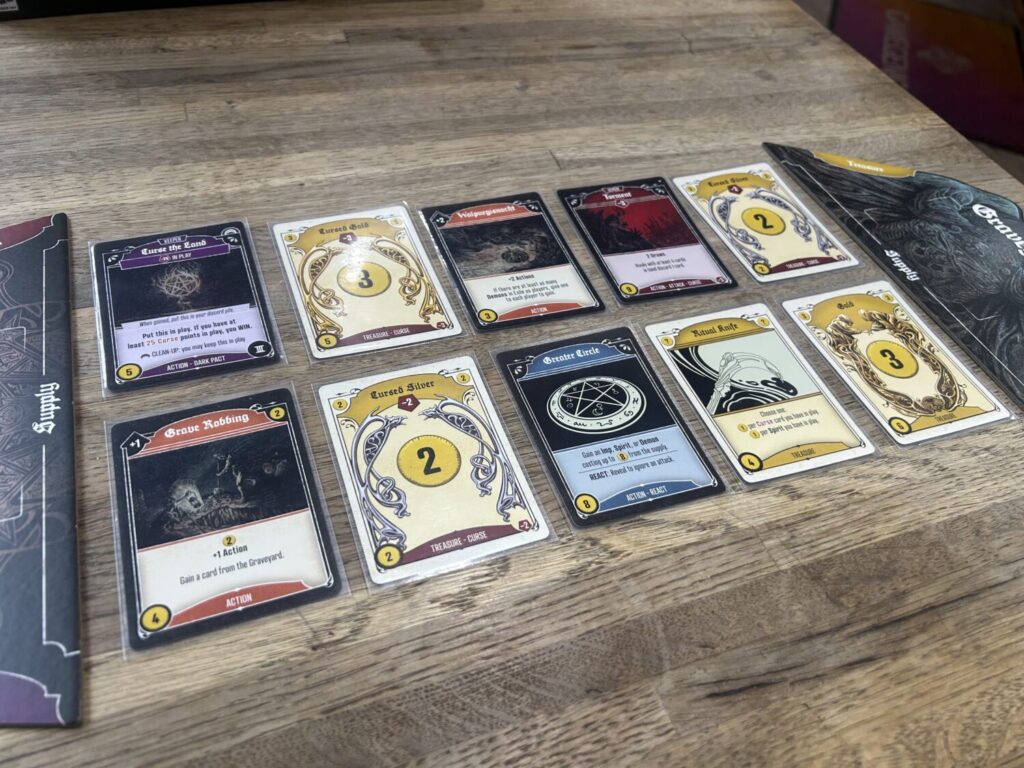
It doesn’t present that way. Anybody familiar with Dominion would be able to sit down and get started, with relatively little adjustment. There’s a card market with 10 cards in it; you start each turn with a single action before moving onto your buy phase; cards give you some combination of card draw, extra actions, and money along with their individual effects; and you draw up to five cards into your hand at the end of each turn. So far, so Dominion.
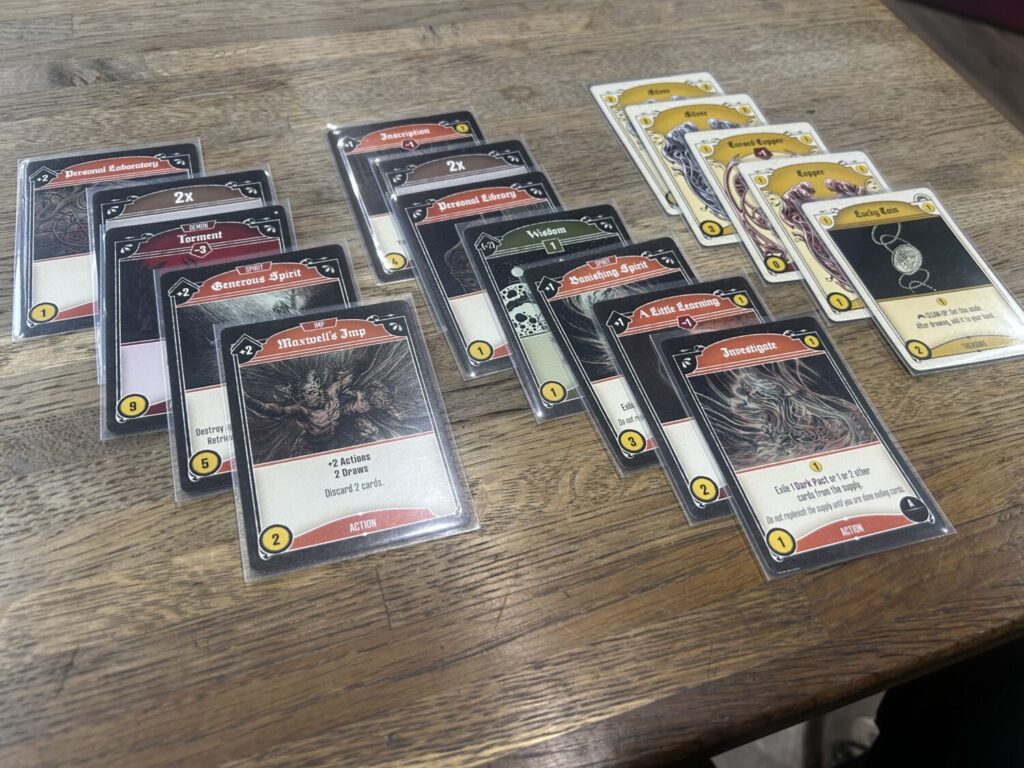
If it is Dominion, it’s Dominion with power creep. The biggest innovation on the formula here is naught but math itself: multiplier cards. These are grey cards that carry no symbols other than a “x2” or a “x3.” For how bland they are, they are powerful things. Multiplier cards are paired with other cards, and augment their effects. If I play a x2 with a card that gives me +1 Action, +1 Draw, and +1 Gold, I instead gain two actions, I draw two cards, and I gain two money. If I play two x2 cards, inshallah, I get four of everything.
And so it goes. By the end of the game, you can generate dozens of actions and north of 40 money. Dark Pact is begging for a reputation along the lines of, “Dominion but the numbers get much larger.” That’s both correct on the merits and reductive.
Dark GOAT
My biggest issue with Dominion is that most of my decisions are made before the game starts. Unless you are using some of the more baroque expansions, you’re more or less locked in from the first turn. There is little opportunity for creativity or meaningful player interaction. Dark Pact doesn’t have that problem, for a number of equally inspired reasons.
There’s no set card market at the beginning of the game, so the cards on offer are constantly changing. You can buy as many cards as you can afford on a turn—you’ll rarely have the money for more than one or two but it does happen—and rather than going into your discard, they go into your hand, where you can keep them for next turn if desired. For a deck-builder, there is a surprising amount of genuine planning.
Player interaction is largely indirect, but as the game progresses you get a feel for what your opponents are up to, and you can use that awareness to get rid of cards from the market that they might want. That includes the most important cards of all, the eponymous Dark Pacts. The multipliers seem to be what’s getting all the attention, but the Pacts are Lehmann’s real breakthrough. Thirteen of them are shuffled into the market deck at the start of the game, each with a unique victory condition. “If you have 40 unspent Gold, you win.” “If the cards in your hand are worth 18 points, you win.” “If you have 21 cards in play, you win,” etc., etc. Players jockey for Pacts as they come up in the market, and there are few things as satisfying as punting to the exile a Pact that your opponent was in a perfect position to benefit from.
Pacts rather brilliantly open up the possibilities of the game. Dominion is ultimately a game about nabbing green cards for points. Everything else you do, the draws and the extra actions and the extra money and the combos when they actually work, is in service of said nabbing. You can fully explore the mechanisms made available to you and lose to the person across the table who drew money in the right clumps. In Dark Pact, the mechanics themselves become the point. How you play is how you win. Provided you can get the corresponding Pact, just about any strategy you can think of is a viable one. It’s thrilling.
I don’t know how long the love affair will last. Individual sessions don’t feel meaningfully distinct from one another, which is usually a bad sign for long-term interest, but ten or so games in, I love it. Dark Pact is a blast. It’s definitely not a game for more than two players, dragging as it does with the extra participants, but it is a thrilling duel. The single most dramatic win of my gaming life happened during a game of Dark Pacts, when I managed to fight my way back from an anomalously and punishingly slow start. A recent game ended after a turn in which I managed to generate 47 gold, bought out the entire card market, and began my next turn with 18 cards in hand. It’s that kind of game.
Travis went a bit too far when he said it isn’t playable by normal people, but I know what he means. It is an overwhelming thing at first if you aren’t One of Us. Dark Pact isn’t for everyone, but it is magnificent if it’s for you. If your favorite part of Dominion is figuring out how many actions you have left this turn, have I got a game for you.
Dark Pact details
- Designer: Thomas Lehmann
- Artists: Dug Nation
- Publishers: Trick or Treat Studios
- Release Date: 2026
- Player count : 1 - 4
- Age range : 14+
- Time range : 50 minutes
- Mechanism(s): Deck, Bag, and Pool Building
- BGG Geek Rating: 7.11245 - converted to Meeple Mountain scale: 3.5.
- More articles about Dark Pact.