

Disclosure: Meeple Mountain received a free copy of this product in exchange for an honest, unbiased review. This review is not intended to be an endorsement.

Hello and welcome to ‘Focused on Feld’. In this series of reviews, I am working my way backwards through Stefan Feld’s entire catalogue. Over the years, I have hunted down and collected every title he has ever put out. Needless to say, I’m a fan of his work. I’m such a fan, in fact, that when I noticed that there were no active Stefan Feld fan groups active on Facebook, I created one of my own.
Today we’re going to talk about Civolution: Acceptance Letter, the much anticipated expansion for 2024’s Civolution, his 41st game.
This expansion includes three modules that can be added together or used separately. I’m not going to explain how the base game is played. This review assumes you already know. If not, you can check out my review of the Civolution base game.
Instead, we’re going to explore the new modules and discuss how they work and what I think about them. It is also my fervent hope that I’ll be able to answer the question you’ve asked yourself that, no doubt, led you here: is this an expansion that I need in my collection?
Module 1: Starting Attribute Chips
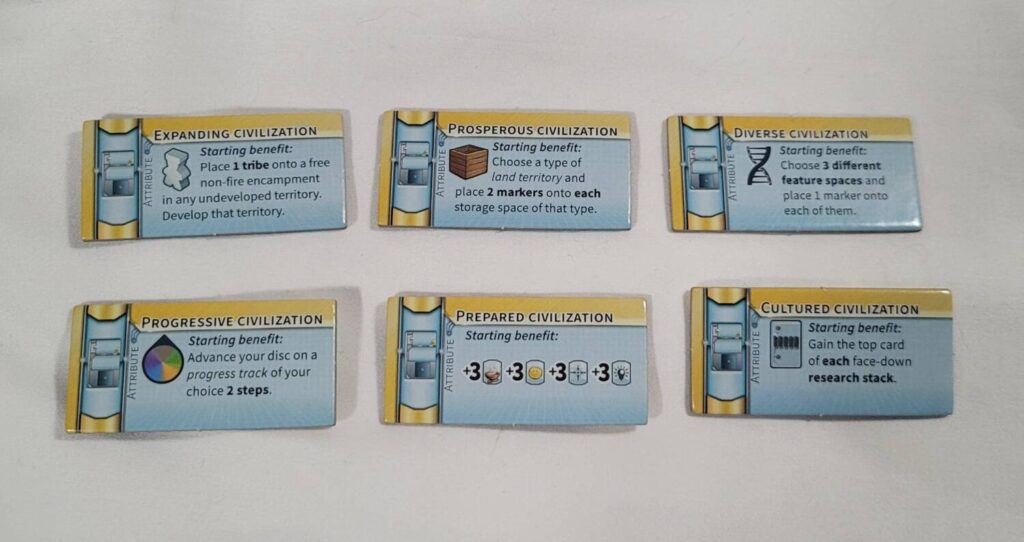
Civolution: Acceptance Letter includes six Starting Attribute chips. During setup, whether by random assignment or by drafting them, each player will receive one of these. Upon receipt, players will install the chips into one of the columns above their player board where they will immediately receive the chip’s benefits.
Much like the Prelude expansion for Terraforming Mars, these chips are meant to jumpstart a player’s civilization by providing them with resources or board positions that would normally take them several turns to acquire. Less obvious is that depending on where the player chooses to install them, these Starting Attribute chips also provide the players with a number of victory points before the game has even gotten started.
Thoughts About Starting Attribute Chips
When I first learned that this expansion was going to include these Attribute chips, I was excited. Attribute chips in the base game are immensely powerful and incredibly hard to obtain. Each chip requires your civilization to have multiples of the same feature markers, and you have to give up one of those markers upon acquiring the chip. As such, in most games of Civolution I’ve played, these chips are rarely ever acquired.
Upon opening the envelope this expansion came packaged in and reading over what these Starting Attribute chips actually do, I felt equal measures of disappointment and approval. I was disappointed that none of these chips provided ongoing benefits like the regular Attribute chips do. A regular Attribute chip acquired early helps give the player direction, which is something you desperately need in this large, sprawling game. These Starting Attribute chips do not provide that. What they do provide, however, is a powerful starting position.
Well, mostly.
Two of the new Starting Attribute chips feel vastly underpowered when compared to the others. Specifically, I am speaking of Cultured Civilization (you start the game with extra cards in hand) and Expanding Civilization (you start the game with an extra tribe on the board in a territory of your choosing, allowing you to develop the territory). I mean, they’re not terrible, but they’re far less beneficial than a chip that lets you set yourself up for acquiring another early game Attribute chip (Diverse Civilization, which gives you three additional feature markers) or a chip that loads your board up with six additional resources (Prosperous Civilization), which are needed to play cards from your hand or to construct settlements and statues.
The problem with Cultured Civilization is that you’re provided with a lot of extra cards, but none of the resources needed to play them. Sure, you’ve got a wealth of extra options, but those options do you little good if you’re unable to capitalize on them. As for Expanding Civilization, the potential benefit you’ve unlocked (an extra raw material that you can collect later) is lessened by the knowledge that a.) you’ve started the game with another mouth to feed and b.) you’ve identified a mystery resource for your opponents that they would have had to exert effort of their own in order to discover it. The chip would be far more useful if you were able to not only produce the raw material but you were able to transport it right away. I guess the other benefit is that you’ve given yourself a new location from which to expand your civilization, but that takes the same amount of effort it would have taken to just migrate to the same space by normal means.
In a game with asymmetric powers, which this module essentially provides, you know you’ve got it right when every player at the table is looking at everyone else’s powers and wishing they had those powers instead. These two Starting Attribute chips don’t achieve that. If you wind up stuck with one of these, nobody’s going to be envying your poor luck.
I will always play with this module, but it isn’t my favorite. In my opinion, this is the second best of the three modules.
Module 2: Creature Chips
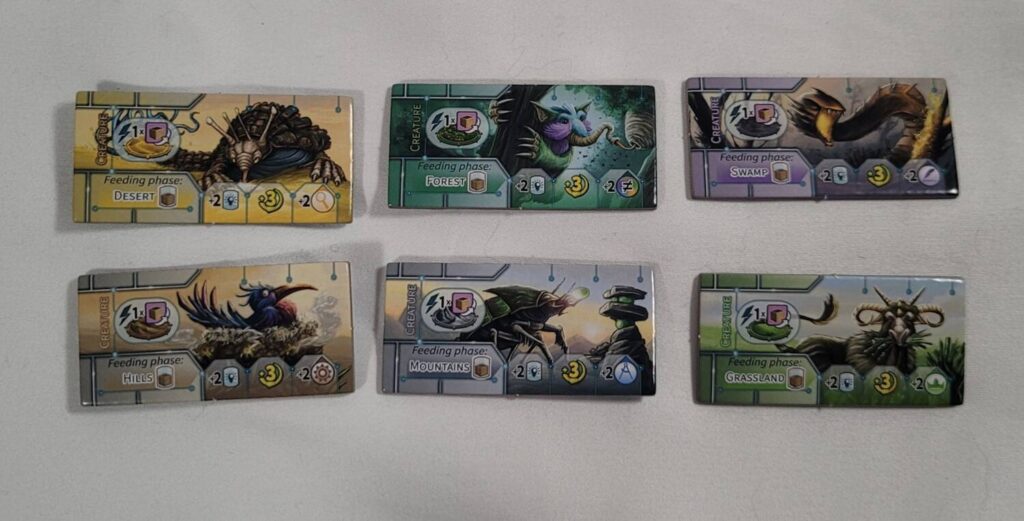
During setup, the six Creature chips are shuffled and placed face down above the Hunting table of the central game board. Then one of them will be turned face up. When a player goes hunting, they will perform the hunt as usual, using the value of the pink die to determine how much food they receive. Then, if the Creature chip’s territory matches the territory in which the player has chosen to hunt, they will look at the Favor of Agera track as if they were performing a favor check. If the value on the pink die is less than or equal to the player’s position on the Favor of Agera track, then they have ‘tamed’ the face up Creature chip and can collect it and install it into one of the columns above their player board.
As mentioned earlier, each Creature chip is associated with a specific territory (forest, mountains, deserts, etc.). Upon installing the chip, the player will perform a lucky find in the associated territory. Then, from that point on, each Creature chip the player has collected will provide the player with special benefits during the Feeding phase. These creatures like to eat resources that their favored territories are able to produce. Each Creature chip has three feeding spots printed along the bottom of the chip, and these feeding spots are filled in from left to right, imparting the benefits as they’re covered up. The first two benefits are always the same: two Inspiration and then three victory points. The third benefit is two movements up a specific track.
To have that all make a bit more sense, consider what happens if you manage to tame the forest creature. Upon installing the creature above your player board, you will perform a lucky find, rolling a die to determine whether you’ll receive a free wood, wax, or oil. During the feeding phase, you may add a wood, wax, or oil to the first feeding spot on the Creature chip, earning two Inspiration. Then, you can add a wood, wax, or oil to the second spot, earning its benefit, and so on.
Thoughts About Creature Chips
I like the idea of this module a lot. However, in order to obtain one of these Creature chips, it requires a great deal of preparation (doing everything you can to increase your position on the Favor of Agera track) or a great deal of sacrifice (using Inspiration to adjust your pink die value to bring it within your Favor of Agera range, potentially costing you food in the process). The need to be hunting in the same territory as the one the available Creature chip prefers puts extra restrictions on the whole deal, as some territories provide far less food than others, making them almost useless locations in which to hunt. Because of these restrictions, it’s been exceedingly rare in the games I’ve played that players actually manage to acquire any of these chips.
This, in my opinion, is the most useless of the three modules. The only reason to ever include it is because it’s easy to include. But, it may as well not be there for how little it is actually used. If the need to hunt in the creature’s preferred territory in order to have some hope of taming the creature were removed, it would be a module that would be used much more often.
Module 3: Level 4 Module Tiles
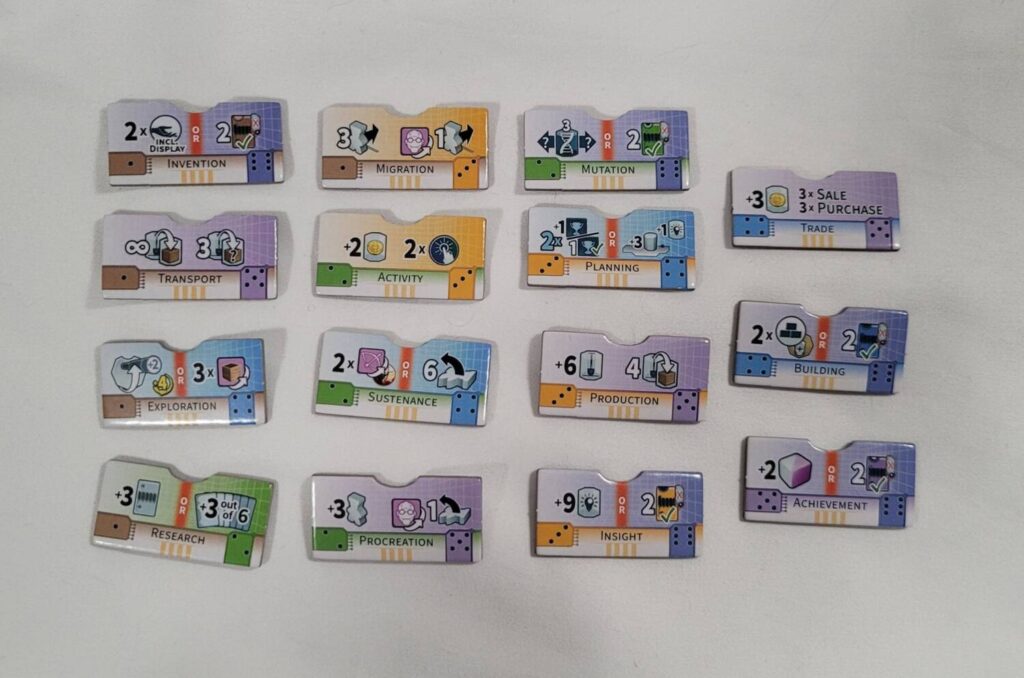
There are fifteen different modules in the base game that can be upgraded to a maximum of Level 3. This expansion includes a Level 4 upgrade for each module (a single copy of each). During setup, these Level 4 tiles are drafted in a snake draft such that each player will begin the game with three of them in their supply. Out of the three they selected, each player may select one module to upgrade a single time. This means that it is possible for a player to begin the game with one of their modules already upgraded to Level 3 (one from the Level 4 tile draft and one from their base game setup card).
Thoughts About Level 4 Module Tiles
These Level 4 modules are extremely powerful. There isn’t a single one of them that I wouldn’t be happy to have at my disposal. Of particular note are the Level 4 Sustenance and Transportation modules. The Level 4 Sustenance module allows the player to perform two hunts, but it allows them to perform hunts in territories in which hunts have already been performed (a thing which is not normally allowed). The Level 4 Transportation module allows the player to collect all of their raw material tokens from the board, but of those collected, three of them can be collected as any resource of that player’s choosing. Normally, if you collected a raw material token from, say, a territory which produced oil, then the token would be added to the oil space on your player board. This Level 4 module would allow you to add that collected token somewhere else, turning oil into jade, for instance. That is incredibly powerful.
This module, in my opinion, makes the entire expansion worth it. I will never play Civolution without it again.
Civolution: Acceptance Letter details
- Designer: Stefan Feld
- Artists: Dennis Lohausen
- Publishers: Deep Print Games, DiceTree Games, Gémklub, Ghenos Games, Hobby Japan, Maldito Games, Pegasus Spiele
- Release Date: 2025
- Player count : 1 - 4
- Age range : 14+
- Time range : 90 - 180 minutes
- Mechanism(s): Area Movement, Dice Rolling, Events, Income, Modular Board, Open Drafting, Pattern Building, Tech Trees / Tech Tracks, Track Movement, Variable Set-up
- BGG Geek Rating: 8.43282 - converted to Meeple Mountain scale: 4.0.
- More articles about Civolution: Acceptance Letter.